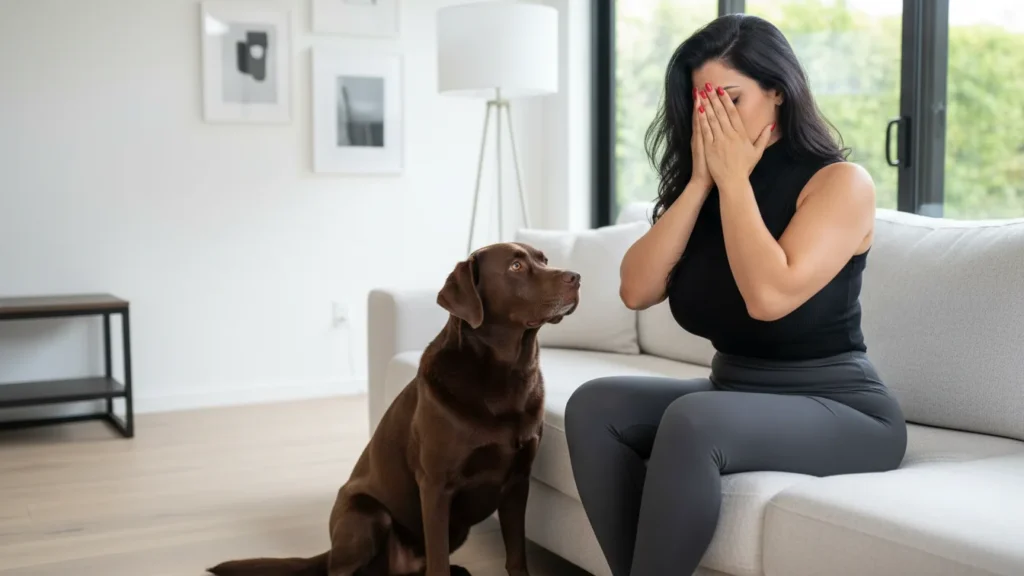
“The Moment You Feel It — Your Dog Does Too”
Your chest tightens.
Your thoughts race.
Your breathing shifts.
Before you’ve said a word, your dog changes.
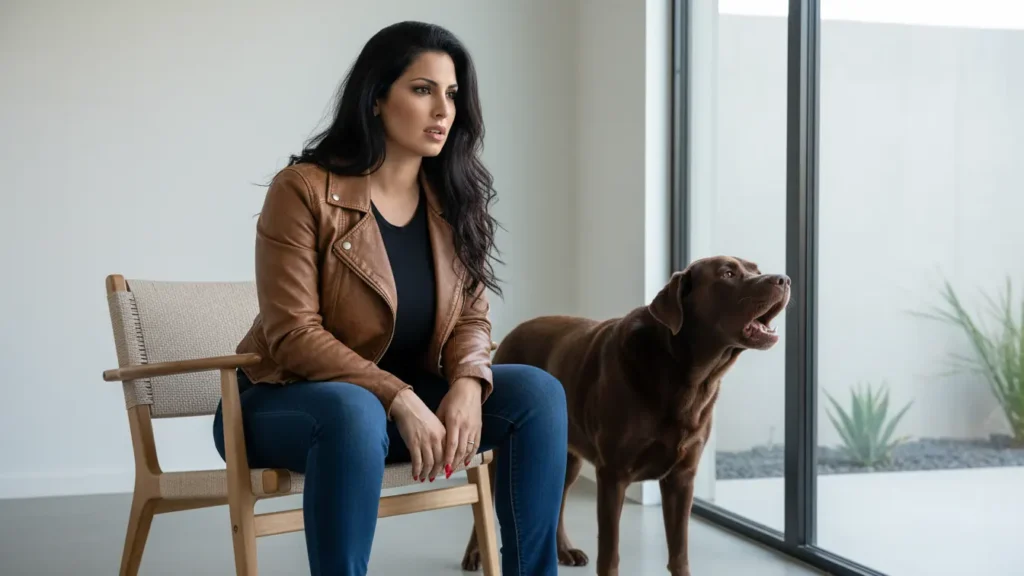
They pace.
They whine.
They follow you closely—or retreat.
You wonder, “Why is my dog suddenly anxious?”
Often, the answer is closer than you think.
Dogs don’t just live with us.
They live in sync with us.
And when anxiety enters your body, your dog frequently absorbs it—quietly and instinctively.
Dogs Don’t “Catch” Anxiety — They Detect It
Dogs don’t understand deadlines, finances, or social pressure.
What they understand is biology.
When you feel anxious, your body releases:
- Cortisol (stress hormone)
- Adrenaline
- Changes in breathing rhythm
- Muscle tension
- Subtle scent changes through sweat and breath
Dogs detect all of this.
To them, anxiety isn’t invisible.
It’s a full sensory signal.
The Science of Emotional Contagion
This phenomenon is called emotional contagion.
It’s the ability of one individual’s emotional state to influence another’s—without words.
Research in animal behavior shows dogs:
- Synchronize heart rates with owners
- Mirror emotional expressions
- Adjust behavior based on human mood
According to studies frequently cited in canine behavior literature and acknowledged by organizations like the American Kennel Club, dogs are uniquely tuned to human emotional states due to thousands of years of co-evolution.
In short:
Dogs evolved to feel what we feel.
Why Dogs Are Especially Vulnerable to Human Anxiety
Dogs rely on humans as:
- Leaders
- Safety signals
- Emotional anchors
When that anchor feels unstable, the dog’s nervous system reacts.
From an evolutionary perspective:
If the leader is anxious, something must be wrong.
Your dog’s anxiety isn’t weakness.
It’s survival logic.
How Anxiety Transfers Without You Realizing
Most owners don’t notice the moment transfer happens.
It’s subtle.
Common unconscious signals include:
- Faster movements
- Tense posture
- Shallow breathing
- Irritable tone
- Inconsistent commands
Dogs read these instantly.
Even if you’re smiling, your body may be telling a different story.
Dogs trust the body—not the words.
Why Calm Words Don’t Always Work
Many owners say:
“I tell my dog everything is fine.”
But dogs don’t process reassurance the way humans do.
They respond to:
- Tone
- Rhythm
- Energy
- Body language
If your nervous system is activated, your dog feels it—regardless of what you say.
This is why anxious owners often have anxious dogs despite good intentions.
Real-Life Example: Anxiety That Appears “Out of Nowhere”
A common scenario:
An owner starts feeling overwhelmed at work.
Sleep becomes lighter.
Patience shortens.
Weeks later, the dog develops:
- Separation anxiety
- Reactivity on walks
- Restlessness at home
Nothing changed in the dog’s routine.
But something changed in the owner’s nervous system.
The dog didn’t misbehave.
They adapted.
Dogs Mirror Anxiety More Than Other Emotions
Why anxiety specifically?
Because anxiety signals danger.
Joy is safe.
Sadness is quiet.
Anxiety means action is needed.
Dogs evolved to respond rapidly to threat signals—especially from those they trust most.
That’s why anxiety transfers faster and more strongly than happiness.
How Dogs Express Borrowed Anxiety
When dogs mirror human anxiety, it often looks like:
- Pacing or restlessness
- Excessive following
- Whining or vocalization
- Destructive behavior
- Hyper-vigilance
- Changes in appetite
These behaviors are often misdiagnosed as “training issues.”
But they’re emotional responses, not disobedience.
Why This Matters More Than Ever
Modern life is loud, fast, and mentally demanding.
Humans normalize stress.
Dogs don’t.
They live fully in the nervous system state of the home.
Understanding emotional transfer helps prevent:
- Chronic anxiety in dogs
- Behavioral problems
- Overuse of punishment-based training
Calmer humans create calmer environments—whether intentionally or not.
Mistakes Owners Make When Addressing Dog Anxiety
Even loving owners often do the opposite of what helps.
Common mistakes include:
- Reassuring excessively (which reinforces anxiety)
- Punishing stress behaviors
- Ignoring their own stress
- Assuming the dog is “dramatic”
The dog isn’t creating anxiety.
They’re reflecting it.
Actionable Steps to Break the Anxiety Loop
You don’t need to be perfect. You need to be aware.
Practical steps:
- Slow your own breathing first
- Move calmly and deliberately
- Maintain predictable routines
- Avoid frantic energy during stressful moments
- Model the emotional state you want your dog to feel
Dogs learn calm by feeling it—not being told about it.
Hidden Tip: Regulate Yourself, Not the Dog
The fastest way to calm an anxious dog is often to:
- Sit quietly
- Relax your shoulders
- Breathe deeply
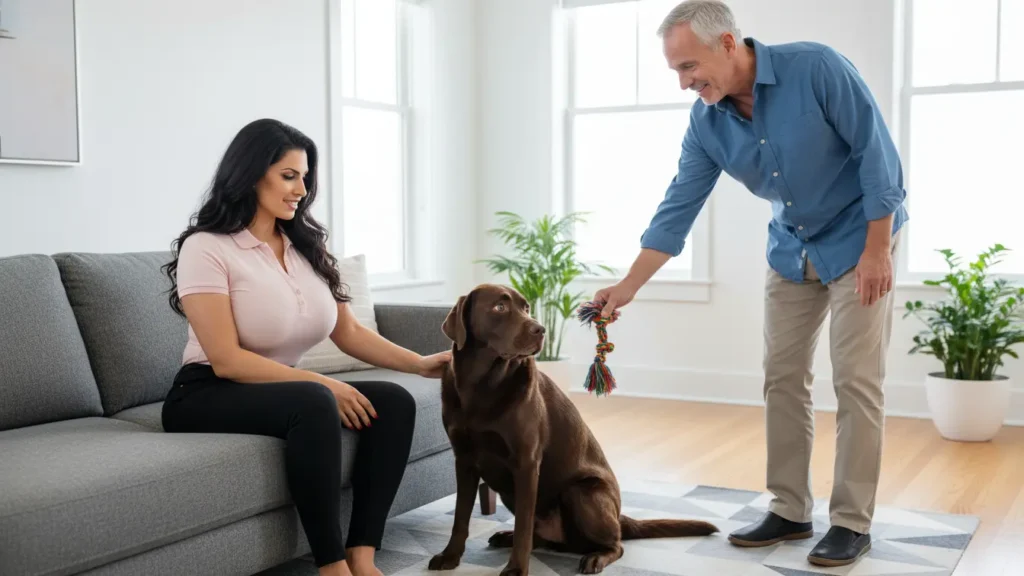
Dogs subconsciously synchronize with stable nervous systems.
Your calm becomes their calm.
Comparison Table: Human Anxiety vs Dog Response
| Human Signal | Dog Interpretation | Dog Response |
|---|---|---|
| Fast movement | Potential danger | Hyper-alert |
| Tense posture | Uncertainty | Clingy or avoidant |
| Raised voice | Threat signal | Stress behaviors |
| Calm breathing | Safety | Relaxation |
| Predictable tone | Stability | Trust |
Can Dogs Help Reduce Human Anxiety Too?
Yes—and this is where the relationship becomes healing.
Studies show interaction with dogs can:
- Lower cortisol
- Reduce heart rate
- Increase oxytocin
This means emotional transfer works both ways.
But it starts with awareness.
Key Takeaways
- Dogs mirror their owner’s anxiety through emotional contagion
- Stress hormones, body language, and tone drive transfer
- Dogs react instinctively, not intentionally
- Correcting your own nervous system helps your dog
- Calm leadership creates emotional safety
Frequently Asked Questions
Can dogs sense anxiety even if I hide it?
Yes. Dogs read physiological signals, not just behavior.
Does this mean anxious people shouldn’t have dogs?
No. Awareness and regulation matter more than perfection.
Can training fix anxiety caused by emotional transfer?
Training helps, but emotional regulation is foundational.
Do some dogs mirror anxiety more than others?
Yes. Sensitive, bonded, and working breeds often mirror more strongly.
Is mirrored anxiety permanent?
No. With consistent calm environments, dogs rebalance naturally.
A Calm, Honest Conclusion
Your dog isn’t anxious because of you.
They’re anxious with you.
This isn’t a flaw—it’s a bond.
When you understand that dogs don’t just listen to your words but live inside your emotional world, everything changes.
Calm becomes contagious.
Safety becomes shared.
And healing begins—on both ends of the leash.
Disclaimer: This article is for general educational purposes only and does not replace professional veterinary or behavioral guidance.

Dr. Sofia Romano, DVM, is an experienced veterinarian specializing in small-animal medicine and preventive care. She has treated thousands of cases using evidence-based diagnostics and modern clinical practices. Dr. Romano is dedicated to providing science-backed pet-health guidance that helps owners make informed decisions and improve their pets’ quality of life.




Pingback: What Your Dog’s Eyes Reveal About Their Emotional State — The Silent Language Most Owners Miss
Pingback: Why Dogs Choose One Person As “Their Human” — The Deep Bond Science Can Finally Explain
Pingback: Why Dogs Sense Tension Before Arguments Start — The Invisible Signals They Read Before We Speak
Pingback: Why Dogs Watch You More Than You Realize — The Quiet Behavior That Explains Everything
Pingback: Why Dogs Can Smell Your Stress — The Hidden Emotional Sense That Explains Their Uncanny Bond With Humans
Pingback: Why Dogs Suddenly Avoid Eye Contact — The Quiet Signal They’re Trying To Send You
Pingback: Why Dogs Stay Close When You’re Sick — The Deep Instinct That Makes Them Your Quiet Guardian