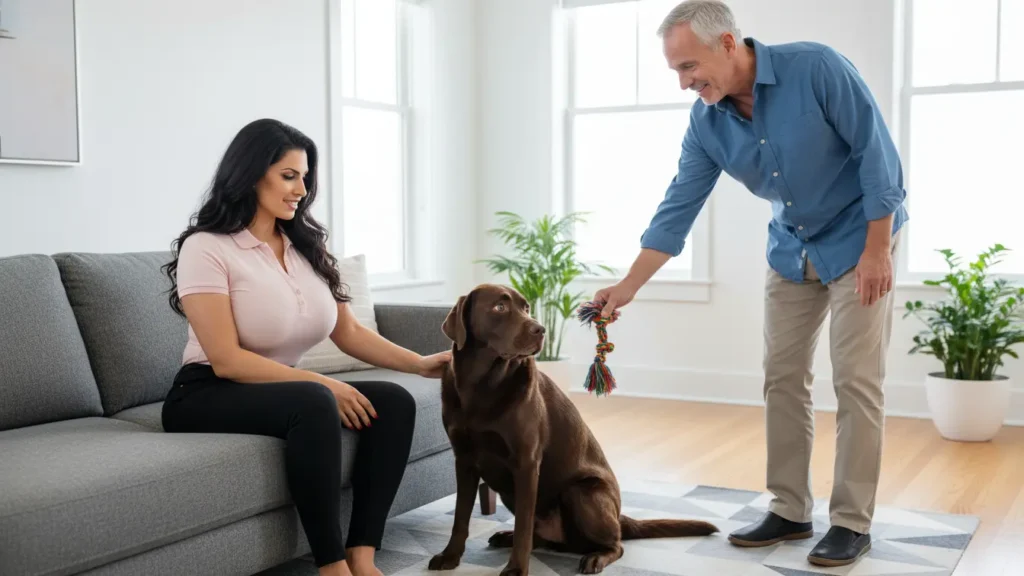
Ask anyone who’s worked at a shelter or a vet clinic, and they’ll tell you the same thing without hesitation: skittish dogs are, on the whole, more wary of unfamiliar men than unfamiliar women. It’s common enough that some clinics and kennels have specifically noted better results using female staff with fearful dogs. What’s genuinely interesting is that despite how consistent this pattern is in practice, the people who study dog behavior professionally are refreshingly honest that they don’t have a fully confirmed answer for why.
An Honest Starting Point
Patricia McConnell, a certified applied animal behaviorist who has written about this exact question for years, puts it plainly: it’s well known in the training and behavior field that shy dogs are, on the whole, more afraid of men than women — even dogs who’ve only ever experienced kindness from men throughout their lives. That last detail matters. It rules out the simplest explanation people usually reach for first.
The Explanation That Doesn’t Hold Up as Well as You’d Think
The instinctive assumption is trauma — that a fearful dog “must have been hurt by a man.” Some dog behavior consultants who work directly with fearful and aggressive dogs push back on this as the primary explanation, noting that both men and women can and do mistreat animals, which doesn’t explain why the fear so disproportionately lands on men specifically. If prior abuse were the main driver, the fear pattern wouldn’t skew this consistently by gender — it would more evenly reflect whoever actually caused harm in a given dog’s individual history. Past trauma is real and does happen, but researchers and behaviorists increasingly see it as one contributing factor among several, not the core explanation.
The Physical Differences That Are Genuinely Well-Documented
Some of the leading theories rest on measurable, statistically real differences between average male and female voices and body size — differences dogs are well-equipped to perceive. Peer-reviewed research has confirmed that dogs are sensitive to the specific combination of pitch and vocal tract length that distinguishes male and female human voices, meaning dogs aren’t just hearing “a voice” — they’re picking up on cues correlated with a speaker’s size and sex with real precision. Since men’s voices are, on average, lower-pitched and louder, and men are, on average, taller and larger-bodied, several behaviorists and veterinarians point to this combination — size plus vocal depth — as a plausible, straightforward reason a wary dog might find an approaching man more physically intimidating on a purely perceptual level.
The More Speculative (But Genuinely Fascinating) Theory
The most-cited piece of research on this topic isn’t actually about dogs at all. A 2008 study published in Current Biology used point-light figures — human motion represented only by small lights placed at major joints — and asked people to judge whether each figure was walking toward them or away from them. Figures identified as male were consistently perceived as approaching, while figures identified as female were consistently perceived as moving away, regardless of their actual direction of travel.
McConnell’s theory, which she’s careful to describe as her own untested hypothesis rather than settled science, is that dogs may perceive human movement patterns the same way: fearful dogs are consistently more afraid of something moving toward them than something moving away, and if male movement genuinely reads as more “approaching” even when it isn’t, that alone could account for a meaningful part of the fear gap. It’s a compelling idea precisely because it doesn’t require assuming anything about men’s actual behavior or intent — just a difference in how movement is visually perceived, filtered through a fear-sensitive nervous system tuned to detect approach as the more dangerous scenario.
A Cause That’s Easy to Overlook: Simple Exposure
One of the more practical, evidence-grounded explanations has nothing to do with perception at all: socialization. Puppies who are consistently and positively exposed to a wide range of people — different sizes, voices, movement styles, genders — during their early developmental window tend to grow into adults more comfortable across that same range. In practice, some dogs, particularly those raised in households or shelter environments with more consistent female caretaking, simply get less early, positive exposure to unfamiliar men specifically, leaving a gap in their social comfort that shows up later as wariness. This is a genuinely fixable factor, unlike some of the more speculative physical and perceptual theories above.
What This Doesn’t Mean
It’s worth being precise about the actual shape of this pattern, because it’s easy to overstate. This fear response shows up specifically in shy, anxious, or under-socialized dogs reacting to unfamiliar men — not a blanket rule about dogs and men generally. Research and clinical experience both indicate dogs are typically just as comfortable with familiar men as they are with familiar women; the fear gap is almost entirely about strangers, not about men as a category their own household men belong to. A confident, well-socialized dog often shows little to none of this pattern at all.
What Actually Helps
Behaviorists consistently recommend the same core approach regardless of which specific theory turns out to be most accurate: slow, structured, positive exposure. Simple techniques — having an unfamiliar man toss treats from a distance rather than approaching directly, avoiding direct eye contact and looming body language during initial interactions, letting the dog choose to approach rather than being approached, and gradually building comfort over repeated, low-pressure encounters — tend to work well regardless of the underlying cause, because they address the fear response itself rather than needing to pin down the exact reason behind it first.
The honest state of the science here is that no one has definitively proven which of these explanations matters most, and it’s likely some combination of all of them rather than one single cause. What’s genuinely well established is the pattern itself, observed consistently enough across shelters, clinics, and training practices that it’s treated as a real, practical consideration — even while the deeper “why” remains a genuinely open question.
Sources & Further Reading
- Why Dogs are More Afraid of Men, Revisited — Patricia McConnell
- Why Don’t Dogs Like Men as Much as Women? — Fatherly
- Domestic dogs are sensitive to the correlation between pitch and timbre in human speech — PMC/NIH
- Why Is My Dog Afraid of Men? — Rover
- Why Do So Many Dogs Seem to Hate Men? — Adopt a Pet

Dr. Sofia Romano, DVM, is an experienced veterinarian specializing in small-animal medicine and preventive care. She has treated thousands of cases using evidence-based diagnostics and modern clinical practices. Dr. Romano is dedicated to providing science-backed pet-health guidance that helps owners make informed decisions and improve their pets’ quality of life.




Pingback: Why Dogs Start Fighting With Other Pets — The Hidden Triggers Most Owners Miss
Pingback: Why Dogs Stare At You While Pooping — The Vulnerable Instinct Most Owners Misunderstand
Pingback: Why Dogs Bark At Their Own Reflection — The Confusing Instinct Most Owners Don’t Expect