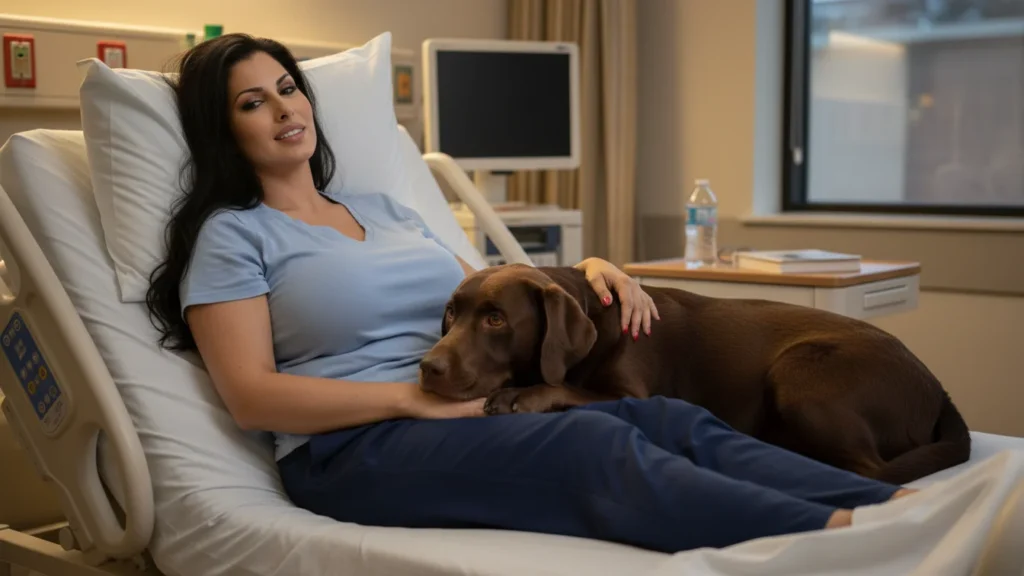
There’s a particular kind of dog behavior almost every owner has a story about: you come down with something, and suddenly your dog won’t leave your side. They curl up against your legs on the couch, follow you from room to room, or just lie there watching you with an unusual stillness. It feels protective, almost like they know something’s wrong before you’ve even said a word about it.
The science behind this is more concrete than most people expect. It isn’t just comfort-seeking or coincidence — it’s built on the same extraordinary biological hardware that has, in real clinical settings, allowed dogs to detect actual disease.
The Same Nose That Detects Cancer
The starting point for understanding this behavior is a body of legitimate medical research into canine scent detection. Illness changes the chemistry of the human body in ways that are often invisible to us but very much perceptible to a dog’s nose. Diseases alter the volatile organic compounds — VOCs — that our bodies release through breath, skin, sweat, and other secretions, and dogs are extraordinarily good at picking up on those changes.
In one widely cited 2006 study published in the Journal of Alternative and Complementary Medicine, trained dogs identified lung cancer in breath samples with 99% sensitivity and specificity, and breast cancer with 88% sensitivity and 98% specificity — remarkable numbers for scent detection alone. Since then, researchers have explored dogs’ ability to detect bladder, prostate, skin, and ovarian cancers using similar methods, along with infections like C. diff and even COVID-19 in screening settings.
Diabetes alert dogs represent one of the most practical, real-world applications of this ability. These dogs are trained to detect isoprene, a naturally occurring compound in human breath that rises measurably when blood sugar drops too low, alerting their owner sometimes up to 20 minutes before a dangerous hypoglycemic episode would otherwise become apparent.
And in a 2019 study published in Scientific Reports, researchers demonstrated that dogs could reliably discriminate a specific “seizure odor” from samples taken during epileptic seizures compared to samples taken during calm or exercise activity — with three of the five trained dogs identifying the correct sample 100% of the time. This gave real scientific backing to something many owners of people with epilepsy had described anecdotally for years: their dog seeming to sense a seizure coming before it happened.
What This Means for the Dog on Your Couch
It’s important to draw an honest distinction here: the studies above involve dogs that underwent specific, rigorous training to detect a particular disease signature — they are not simply demonstrating an innate skill that every untrained pet dog walks around with. A family dog hasn’t been taught to identify the chemical signature of the flu the way a diabetes alert dog has been taught to detect isoprene.
That said, the underlying sensory capability isn’t something dogs need training to possess — the training simply teaches them what to do with a scent difference they can already detect. A dog’s nose carries up to 300 million olfactory receptors compared to a human’s roughly 5–6 million, and illness of almost any kind — a cold, the flu, a stomach bug, a fever — produces at least some detectable shift in a person’s scent, sweat chemistry, and body temperature. It’s entirely plausible, and consistent with what we know about canine olfaction, that an untrained pet dog notices something has changed about their sick owner’s scent, even without being able to identify what that change specifically means the way a trained detection dog would.
Scent isn’t the whole story, either. A sick person typically moves differently — more slowly, with less energy, spending more time lying down. Voice and breathing often change too. Dogs are demonstrably skilled at reading changes in human posture, movement, and vocal tone, all of which shift noticeably when someone doesn’t feel well. A dog staying unusually close to a sick owner is likely responding to a combination of subtle scent changes and obvious behavioral ones — not one single “illness detector” cue, but a stack of signals pointing in the same direction.
Why They Respond by Staying Close
Detecting that something is different is one thing; choosing to stay close is another, and that part connects back to the deep attachment bond between dogs and their owners. Research on dog-human attachment has shown that dogs treat their owner as something like a “secure base” and “safe haven” — a source of comfort during uncertainty, and also, it seems, a recipient of comfort when something appears wrong. The same relationship that makes a dog anxious when separated from an owner appears to motivate a dog to stay near an owner who seems unwell, off, or in distress — echoing the same comfort-seeking and comfort-offering behavior researchers have documented in dogs responding to a crying or upset owner.
What This Means for You and Your Dog
- Your dog noticing you’re sick isn’t your imagination. Between scent changes tied to illness, shifts in movement and voice, and a dog’s documented attentiveness to their owner’s state, there’s a real, multi-channel basis for that behavior.
- A pet dog’s response isn’t a diagnosis. Persistent, unusual attention from your dog toward a specific mole, area of your body, or symptom is worth mentioning to a doctor — there are real, documented cases of dogs noticing something before a diagnosis — but it’s not a substitute for medical evaluation, and most of the time, a clingy dog just means you have a cold.
- Their extra closeness during illness is likely genuine comfort-seeking behavior, not just neediness. It mirrors the same attachment-driven responses researchers see when dogs comfort a distressed or crying owner.
- If you’re using a working medical alert dog, trust the training — but verify with proper monitoring too. Even highly trained detection dogs have documented accuracy ranges, and real-world performance can dip compared to controlled study conditions, which is why they’re used to complement medical devices and testing, not replace them.
Your dog curling up next to you on a sick day isn’t just sentimentality. It’s a nose built to notice what’s changed about you, a memory and attachment system built to care, and an instinct, still not fully understood, that some dogs have turned into genuinely lifesaving skill.
Sources & Further Reading
- Dogs demonstrate the existence of an epileptic seizure odour in humans — Scientific Reports (Nature)
- Dogs Detect the Scent of Seizures — Scientific American
- Using dogs’ noses to sniff out disease — UCLA Health
- Can Dogs Smell Cancer? How Dogs Detect Diseases — GoodRx
- The use of sniffer dogs for early detection of cancer: a One Health approach — American Journal of Veterinary Research

Dr. Sofia Romano, DVM, is an experienced veterinarian specializing in small-animal medicine and preventive care. She has treated thousands of cases using evidence-based diagnostics and modern clinical practices. Dr. Romano is dedicated to providing science-backed pet-health guidance that helps owners make informed decisions and improve their pets’ quality of life.





Pingback: Why Dogs Choose One Person As “Their Human” — The Deep Bond Science Can Finally Explain
Pingback: Why Dogs Can Sense Emotional Stress Through Smell — The Hidden Science Behind Their Uncanny Awareness
Pingback: Why Dogs Can Smell Your Stress — The Hidden Emotional Sense That Explains Their Uncanny Bond With Humans
Pingback: Why Dogs Change Sleeping Spots Often — The Quiet Signals Your Dog Is Sending Without Making A Sound
Pingback: Why Dogs Become Over Attached After Illness — The Emotional Shift Most Owners Don’t See Coming