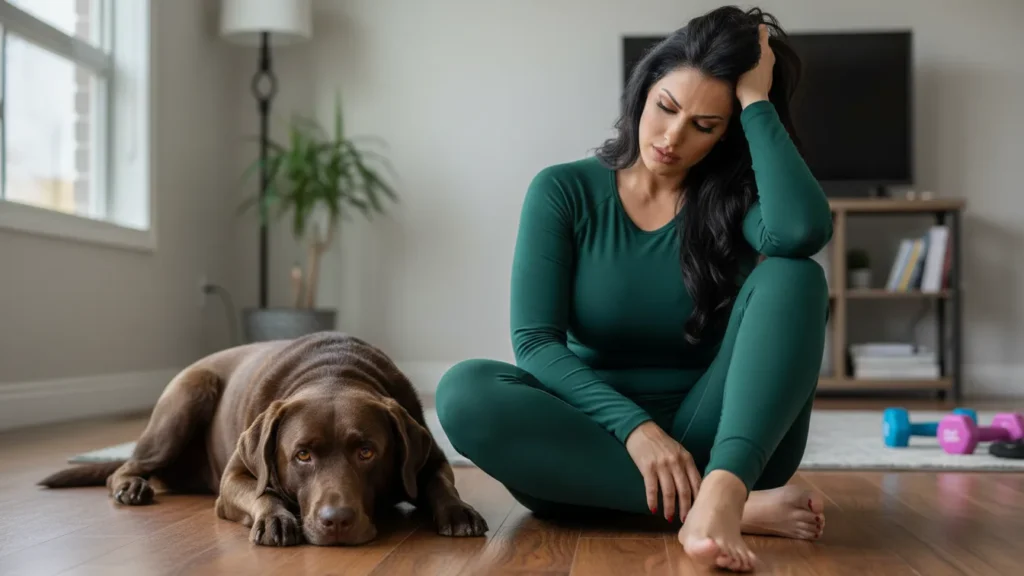
When Your Stress Becomes Your Dog’s Stress
You’re tense—but silent.
Bills, deadlines, unresolved worries sit quietly in your body.
You don’t raise your voice.
You don’t change routines.
Yet your dog starts pacing.
Becomes clingy.
Sleeps less deeply.
Reacting to things they normally ignore.
Nothing obvious happened.
But something changed.
Dogs don’t just notice human stress.
In many cases, their bodies biologically mirror it.
This isn’t metaphor.
It’s physiology.
Dogs and Humans Share More Than a Home
Thousands of years of domestication didn’t just change how dogs look.
It rewired how they synchronize with humans.
Dogs evolved to:
- Read human emotional cues
- Align with human behavior
- Regulate their own stress based on human safety signals
Modern research shows dogs don’t merely observe human emotions—they absorb them.
This process is known as emotional contagion, and hormones play a central role.
Cortisol: The Hormone at the Center of It All
Cortisol is the primary stress hormone in mammals.
In humans, cortisol rises due to:
- Emotional stress
- Mental pressure
- Anticipation
- Chronic worry
In dogs, cortisol rises in response to:
- Environmental threat
- Unpredictability
- Social stress
- Human emotional state
Multiple studies have found that dogs living with chronically stressed humans often show parallel cortisol patterns—even when their own environment is stable.
This phenomenon has been discussed in canine behavior literature referenced by the American Kennel Club and supported by peer-reviewed animal behavior research.
How Stress Hormones Transfer Without Touch
Dogs don’t need words to detect stress.
They pick it up through:
- Scent (stress changes human body odor)
- Micro-movements (tension in muscles and posture)
- Breathing patterns
- Heart rate changes
- Voice tone, even when calm-sounding
Dogs can detect chemical changes released through sweat and breath—many of which correlate with cortisol spikes.
To a dog, stress has a smell.
Emotional Contagion: When Nervous Systems Sync
Dogs are social mammals.
In social species, survival depends on alignment.
If one member detects danger, others prepare—even before the threat is visible.
This is emotional contagion.
In dogs:
- Human stress signals = potential threat
- Dog nervous system prepares defensively
- Cortisol rises to match perceived risk
The dog isn’t anxious about your problem.
They’re responding to a biological signal that says:
“Something isn’t safe yet.”
Why Calm Humans Create Calm Dogs
Dogs take emotional cues from the most stable figure in their environment.
When a human is:
- Predictable
- Emotionally regulated
- Calm under pressure
The dog’s nervous system downshifts.
This is why:
- Dogs relax faster with calm handlers
- Training succeeds more easily with regulated humans
- Dogs behave better around emotionally steady people
Leadership, to a dog, means emotional regulation, not authority.
Why Chronic Stress Affects Dogs More Than Acute Stress
Short-term stress happens.
Dogs are resilient.
But chronic stress is different.
When a human stays tense for weeks or months:
- Cortisol remains elevated
- Emotional signals never fully reset
- The dog’s baseline stress level shifts
Over time, dogs may show:
- Hypervigilance
- Sleep disruption
- Reactivity
- Separation distress
- Digestive changes
Not because the dog is “sensitive”—but because their biology is synchronized with yours.
Real-Life Example: “My Dog Changed When My Job Did”
Many owners report similar stories:
“My dog became anxious when I started my new job—even though nothing changed at home.”
“When my anxiety worsened, my dog stopped relaxing unless I was home.”
“After therapy helped me calm down, my dog’s behavior improved too.”
These aren’t coincidences.
They’re shared physiology.
Comparison: Human Stress vs Dog Stress Responses
| Aspect | Humans | Dogs |
|---|---|---|
| Primary stress trigger | Cognitive worry | Sensory & social signals |
| Cortisol activation | Internal + external | Mostly external |
| Stress expression | Suppressed | Behavioral |
| Recovery speed | Slower | Faster with safety |
| Dependence on others | Low | High (bonded humans) |
Dogs don’t hold stress internally.
They express it.
Why Dogs Don’t Mirror Everyone Equally
Dogs don’t mirror all humans.
They mirror bonded humans.
The closer the emotional bond:
- The stronger the hormonal synchronization
- The deeper the stress mirroring
This is why dogs often reflect the emotional state of:
- Primary caregivers
- Most consistent companions
- Emotionally expressive humans
Attachment intensifies biological alignment.
Common Mistakes Owners Make
When dogs show stress behaviors, owners often:
- Focus only on training
- Increase discipline
- Assume boredom or stubbornness
- Ignore their own emotional state
Training without regulation treats the symptom—not the source.
Dogs don’t need calmer rules.
They need calmer environments.
Actionable Steps to Reduce Stress Transfer
You don’t need to eliminate stress from your life.
You need to buffer it.
Helpful steps:
- Slow your breathing around your dog
- Maintain predictable routines
- Avoid emotional dumping near your dog
- Create quiet, safe spaces
- Practice calm exits and arrivals
Dogs regulate faster when humans model regulation.
Hidden Insight: Dogs Often Act as Stress Barometers
Many dogs show stress before humans consciously acknowledge it.
Why?
Because dogs respond to:
- Subconscious tension
- Suppressed emotions
- Internal stress humans haven’t processed yet
In this way, dogs act like early-warning systems.
Not judgmental.
Not reactive.
Just honest.
Why This Matters Today
Modern life is chronically stressful.
Remote work, financial pressure, constant stimulation—dogs live inside it with us.
Understanding stress mirroring:
- Prevents unnecessary labeling
- Improves human–dog relationships
- Reduces behavioral misinterpretation
- Encourages healthier households
When humans regulate better, dogs follow.
Key Takeaways
- Dogs biologically mirror human stress hormones
- Cortisol synchronization is real and measurable
- Emotional contagion is automatic, not learned
- Chronic human stress affects dogs deeply
- Calm regulation is more effective than correction
- Dogs aren’t absorbing stress—they’re responding to signals
Frequently Asked Questions
1. Can my stress really affect my dog’s hormones?
Yes. Studies show cortisol alignment between bonded dogs and humans.
2. Does this mean dogs feel my anxiety?
They don’t understand the cause—but their bodies respond to the signals.
3. Why is my dog anxious even when I hide stress?
Dogs detect subconscious cues humans can’t fully control.
4. Can reducing my stress help my dog?
Often, yes—especially in bonded pairs.
5. Are some dogs more sensitive than others?
Yes. Temperament and attachment strength matter.
Conclusion
Dogs don’t just live with us.
They sync with us.
Their nervous systems listen when ours is unsettled.
Their hormones rise when ours stay elevated.
Their behavior changes when our inner state shifts.
This isn’t a flaw.
It’s one of the deepest bonds between species ever formed.
When you understand that your calm is not just self-care—but care for your dog—everything changes.
Disclaimer: This article is for educational purposes only and does not replace professional veterinary or behavioral advice.

Dr. Sofia Romano, DVM, is an experienced veterinarian specializing in small-animal medicine and preventive care. She has treated thousands of cases using evidence-based diagnostics and modern clinical practices. Dr. Romano is dedicated to providing science-backed pet-health guidance that helps owners make informed decisions and improve their pets’ quality of life.





Pingback: Why Dogs Change Behaviour Before Major Life Events — The Signals They Sense Before You Do
Pingback: Why Dogs Suddenly Sleep Much More Than Usual — What Their Bodies May Be Telling You
Pingback: Why Dogs Stretch Repeatedly — What Their Body Language Is Really Telling You
Pingback: Why Your Dog’s Tongue Color Matters More Than You Think — Subtle Clues Most Owners Overlook
Pingback: Why Female Dogs Act Differently After Heat Cycles — The Hormonal, Emotional, And Brain Changes Most Owners Never Expect
Pingback: Why Dogs Refuse Their Favourite Food Suddenly — The Quiet Reasons Most Owners Misread
Pingback: Why Dogs Get Anxious During Quiet Evenings — The Subtle Trigger Most Owners Never Connect