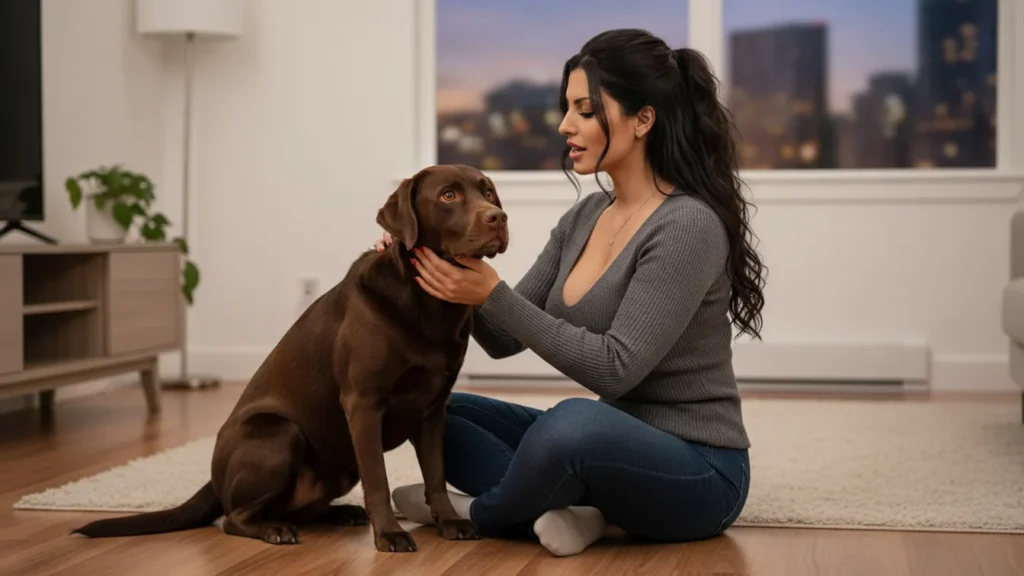
The house finally settles down. Dinner’s done, the TV’s off, phones are away, and it’s just… quiet. For most people, this is the best part of the day. For some dogs, it’s the exact opposite.
Suddenly your dog is pacing between rooms. Panting for no visible reason. Whining at nothing. Following you from the couch to the kitchen to the bathroom, unable to settle no matter how many times you tell them everything’s fine.
It seems backwards. Shouldn’t calm surroundings produce a calm dog? For a surprising number of dogs, quiet evenings are actually one of the hardest parts of the day — and understanding why reveals a lot about how differently dogs experience silence, stillness, and the absence of activity.
Silence Isn’t Neutral to a Dog — It’s Information
For humans, quiet often means “nothing is happening, relax.” For dogs, quiet is rarely that simple. Dogs experience their environment through constant sensory monitoring, and a sudden drop in activity, noise, and stimulation can register less like peace and more like unresolved ambiguity — the environment has changed, and their brain hasn’t finished interpreting why.
Veterinary behaviorists note that dogs are highly sensitive to shifts in household energy, and a quiet evening after a busy day can represent one of the largest sensory contrasts a dog experiences daily. That contrast itself can be more unsettling than the quiet in isolation.
1. Understimulation Doesn’t Disappear — It Resurfaces
Many dogs spend the day in a lower-stimulation state simply because their people are busy: working, running errands, managing a household. Evening quiet often arrives right as a dog’s built-up mental and physical energy has nowhere left to go.
This is sometimes called “trapped energy,” and it’s especially common in working and high-drive breeds — Border Collies, retrievers, herding dogs, terriers — that were bred for sustained mental and physical engagement. When the day’s activity winds down before that energy has been adequately spent, restlessness and anxious pacing are common outlets. It’s not that the dog dislikes quiet; it’s that the quiet arrives before their internal “off switch” has anything to click into.
2. Evening Is When the Brain Has Time to Notice Discomfort
During an active day, mild physical discomfort — sore joints, a slightly upset stomach, mild ear irritation — often gets masked by distraction and movement. In the stillness of evening, with nothing competing for attention, that same discomfort can become far more noticeable to the dog, sometimes producing restlessness that looks behavioral but is actually physical.
Veterinarians frequently point to evening restlessness as a useful diagnostic clue, since dogs experiencing pain, digestive discomfort, or early arthritis often show symptoms more clearly once movement and distraction decrease. If your dog’s evening anxiety is a relatively new pattern, a vet check is a reasonable first step before assuming it’s purely behavioral.
3. Quiet Evenings Can Mimic Pre-Departure Cues
For dogs with any degree of separation-related anxiety, evening stillness can closely resemble the early signals that have historically preceded being left alone: reduced activity, people settling into stationary positions, lights dimming, movement toward bedrooms.
Even if no one is actually leaving, a dog whose nervous system has learned to associate “everyone slowing down” with “departure is coming” may begin showing anticipatory anxiety symptoms — panting, pacing, whining — purely from pattern recognition, regardless of whether anyone is going anywhere.
4. Anxiety Has Fewer Places to Hide
During an active day, low-level anxiety in a dog can often be absorbed into normal behavior — a bit more alertness during a walk, slightly more clinginess during meal prep, a touch more reactivity to a passing car. These small signs blend into the noise of a busy day and go unnoticed.
In a quiet evening, with far less happening, that same underlying anxiety has nothing to blend into. It becomes the most visible thing in the room. Some behaviorists describe this as anxiety becoming “unmasked” rather than newly created — the quiet doesn’t cause the anxiety so much as it removes the distractions that were previously covering it.
5. Circadian and Light-Related Factors
Dogs, like humans, have biological rhythms influenced by light exposure. Evening light changes — dimming natural light, artificial lighting shifts, the transition toward nighttime — can influence hormone regulation, including melatonin and cortisol patterns. For some dogs, especially older dogs or those with existing anxiety tendencies, this hormonal transition period can coincide with increased restlessness, similar to how some humans experience heightened anxiety specifically in the evening hours.
Why Some Dogs Are More Prone to This Than Others
- High-energy or working breeds without adequate daytime physical and mental outlets are especially prone to evening restlessness.
- Dogs with a history of inconsistent evening routines — variable bedtimes, unpredictable departures, inconsistent evening walks — often show more anticipatory anxiety once things go quiet.
- Senior dogs, particularly those with early cognitive decline, frequently show a well-documented pattern sometimes called “sundowning,” where confusion and restlessness increase specifically in the evening.
- Naturally anxious or under-socialized dogs often have less capacity to self-soothe during low-stimulation periods, since they may not have developed strong independent settling skills.
What Actually Helps
- Frontload physical and mental activity earlier in the day where possible, so your dog’s energy has a healthy outlet before evening stillness arrives.
- Create a consistent evening wind-down routine — the same order of events each night helps a dog’s pattern-recognition system anticipate quiet as safe, rather than as an unresolved shift.
- Offer a calm-appropriate outlet during quiet hours, like a long-lasting chew or a food puzzle, giving anxious energy somewhere productive to go.
- Avoid inadvertently reinforcing anxious pacing with excessive attention; calm acknowledgment paired with redirection to a settled activity tends to work better than either ignoring it completely or over-comforting it.
- Rule out medical causes — especially in older dogs or dogs with a sudden onset of evening restlessness — since pain and cognitive decline are common, often overlooked contributors.
- Consider professional support if evening anxiety is severe, persistent, or paired with destructive behavior, since structured behavior modification plans are often needed for dogs with underlying separation-related or generalized anxiety.
The Bigger Picture
Quiet evenings aren’t inherently peaceful to a dog the way they often are to us. For many dogs, silence is simply another environmental state to interpret — and depending on their energy levels, health, learning history, and temperament, that interpretation can range from restful to genuinely unsettling.
Understanding evening anxiety as a real, explainable response — rather than random or attention-seeking behavior — is the first step toward helping your dog find the same calm in the quiet that you do.
Sources
- American Veterinary Society of Animal Behavior – Position Statements on Canine Anxiety
- American Kennel Club – Understanding Canine Anxiety and Restlessness
- ASPCA – Separation Anxiety and Evening Behavior Patterns in Dogs
- Cornell University College of Veterinary Medicine – Canine Cognitive Dysfunction and Sundowning
- Journal of Veterinary Behavior – Circadian and Environmental Influences on Canine Stress

Dr. Sofia Romano, DVM, is an experienced veterinarian specializing in small-animal medicine and preventive care. She has treated thousands of cases using evidence-based diagnostics and modern clinical practices. Dr. Romano is dedicated to providing science-backed pet-health guidance that helps owners make informed decisions and improve their pets’ quality of life.




Pingback: Why Dogs Mirror Household Tension — The Emotional Sensitivity Most Families Underestimate
Pingback: Why Dogs Become Restless At The Same Time Daily — The Hidden Clock Their Bodies Follow
Pingback: Why Dogs Struggle After Routine Changes — The Hidden Stress Response Most Owners Miss