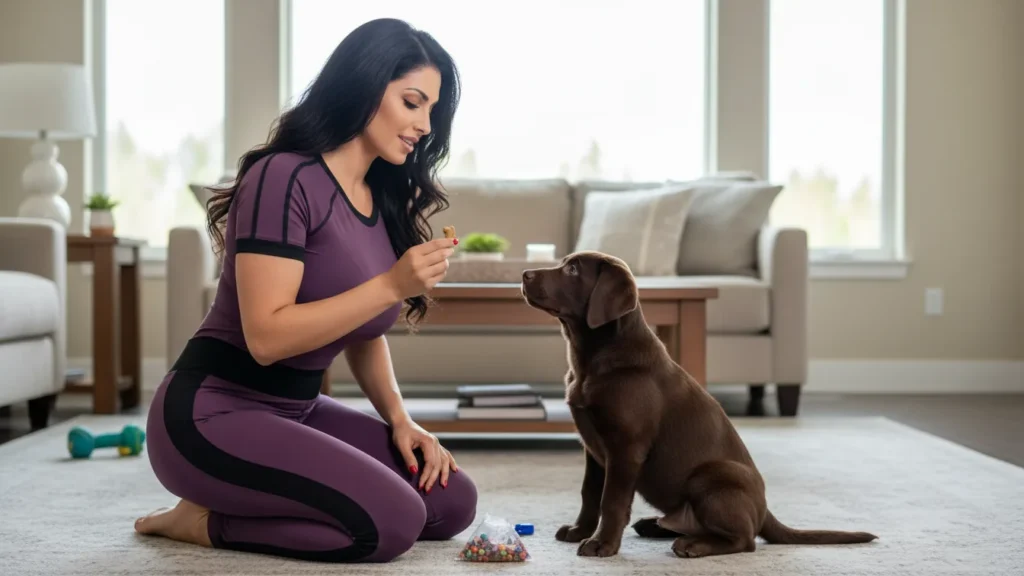
For weeks, everything was going great. Sit, stay, come — your puppy nailed it, session after session, tail wagging, treats disappearing, progress feeling steady and rewarding. You were genuinely proud.
And then, seemingly out of nowhere, it’s like someone reset the whole thing. The puppy who reliably sat now wanders off mid-command. The one who stopped jumping starts again. The one who was doing so well on the leash suddenly plants their feet and refuses to move.
It’s tempting to read this as regression — like something you did broke the progress you’d built. But in most cases, what’s actually happening is something far more encouraging, even if it doesn’t feel that way in the moment: your puppy isn’t forgetting what they learned. They’re testing whether it still applies.
“Testing” Isn’t Defiance — It’s How Learning Gets Consolidated
What looks like sudden backsliding is, more often than not, a normal and even healthy part of the learning process. Behavioral scientists studying operant conditioning — the learning framework underlying most dog training — note that newly learned behaviors go through a natural period of variability before they become fully consolidated and reliable across different contexts.
In plain terms: your puppy learned “sit” reliably in the kitchen, with you, holding a treat, during a calm training session. That’s real learning — but it’s initially tied closely to that specific context. When the context shifts even slightly (a different room, a distracted moment, no visible treat, an exciting new smell nearby), your puppy’s brain hasn’t yet fully generalized the behavior to apply everywhere, every time, regardless of circumstance. The apparent “testing” is often just this generalization gap becoming visible.
What’s Actually Going On, Developmentally
1. Generalization Takes Repeated Exposure Across Contexts
A behavior learned in one specific setting doesn’t automatically transfer to all settings — this is one of the most well-established principles in animal learning theory. Dogs (and most animals) need repeated practice across varied locations, distraction levels, and circumstances before a learned behavior becomes truly reliable regardless of context.
What can look like “testing boundaries” in a new environment or higher-distraction moment is frequently just the natural, expected gap between context-specific learning and fully generalized, reliable behavior. It’s not defiance — it’s an incomplete step in a normal learning curve.
2. Extinction Bursts Are a Real, Documented Phenomenon
When a previously reinforced behavior briefly stops being reinforced consistently (say, you get a little less consistent with treats once your puppy “has it down”), behavioral science documents a well-known pattern called an extinction burst — a temporary increase in the frequency or intensity of a behavior right as reinforcement changes, before the behavior eventually settles into its new pattern.
This is why inconsistent reinforcement during the transition away from constant treat rewards can sometimes look like the puppy is “pushing back” or regressing — they’re actually responding, quite predictably, to a genuine change in the reinforcement pattern they’d come to expect.
3. Adolescence Brings Real Neurological Changes
Many puppies show a noticeable dip in reliability around 5 to 10 months of age, coinciding with the onset of canine adolescence. This period involves significant hormonal shifts and ongoing brain development, particularly in areas related to impulse control and decision-making, which are among the last regions to fully mature.
Veterinary behaviorists describe adolescent dogs as often more impulsive, more distractible, and more prone to testing previously reliable behaviors — not because earlier training failed, but because the underlying neurological systems responsible for consistent self-control are still developing. It’s a strikingly similar pattern to adolescent behavior across many mammal species, humans very much included.
4. Increased Confidence Changes the Calculation
As puppies grow more confident and comfortable in their environment, their willingness to explore alternative options — including not immediately complying with a known cue — often increases. Early on, an unsure puppy in a new home may comply readily partly out of general caution and uncertainty. As that uncertainty resolves into genuine comfort and confidence, some puppies naturally begin exploring the boundaries of what’s actually required versus optional, which is a normal part of developing independence rather than a sign that early training was flawed.
5. Competing Motivations Become More Relevant
As puppies mature, their world becomes more interesting and complex — more enticing smells, more exciting movement to chase, more socially engaging distractions. A behavior that was easy to reinforce in a low-distraction setting now has to compete with genuinely higher-value alternatives. This isn’t the puppy forgetting the training; it’s the training facing real competition for the first time.
Why This Is Actually a Good Sign
It’s worth reframing this developmental stage in a more encouraging light: a puppy who is confident enough to test a boundary, distracted enough by an increasingly engaging world, and developed enough to be entering adolescence is, in many respects, right on track. Puppies who show zero testing behavior at any point are less common — and this stage, while sometimes frustrating, is a normal and expected part of raising a well-adjusted adult dog rather than a sign that something has gone wrong.
What Helps
- Increase reinforcement consistency during this phase, rather than decreasing it — many owners instinctively pull back on rewards once initial training seems solid, right around the time consistency actually matters most.
- Practice across varied contexts deliberately, rather than assuming a behavior learned in one setting will automatically transfer everywhere; generalization requires intentional repetition in new locations and distraction levels.
- Keep expectations aligned with developmental stage, particularly during adolescence, when some reduced reliability is expected and normal rather than a sign of failed training.
- Avoid punitive responses to testing behavior. Since much of this is a normal learning and developmental process rather than intentional defiance, patient, consistent redirection tends to be far more effective than frustration or correction-heavy approaches.
- Maintain training sessions through adolescence, even when progress feels slower or less linear; consistency during this period pays off significantly once the adolescent phase resolves, typically by 18–24 months depending on breed and size.
- Celebrate the underlying confidence. A puppy secure enough to test a boundary is often a puppy who feels safe and comfortable in their environment — which, while inconvenient in the moment, reflects positively on the overall bond and environment you’ve built.
The Bigger Picture
That frustrating stretch where your puppy suddenly seems to have forgotten everything isn’t a sign that your training failed or that something is fundamentally wrong. It’s a well-documented, entirely normal part of how learning actually consolidates — layered with genuine neurological development, a natural generalization gap, and, often, a puppy who’s simply growing more confident and more distractible at exactly the same time.
Stay consistent, stay patient, and trust the process. Most puppies come out the other side of this stage with training that’s more reliable than ever — not despite the testing, but because of what they learned by working through it.
Sources
- American Kennel Club – Understanding the Teenage Dog Phase
- American Veterinary Society of Animal Behavior – Position Statement on Humane Training Methods
- ASPCA – Positive Reinforcement Training and Behavior Generalization
- Cornell University College of Veterinary Medicine – Canine Adolescent Behavioral Development
- Journal of Veterinary Behavior – Learning Consolidation and Behavior Generalization in Dogs

Dr. Sofia Romano, DVM, is an experienced veterinarian specializing in small-animal medicine and preventive care. She has treated thousands of cases using evidence-based diagnostics and modern clinical practices. Dr. Romano is dedicated to providing science-backed pet-health guidance that helps owners make informed decisions and improve their pets’ quality of life.