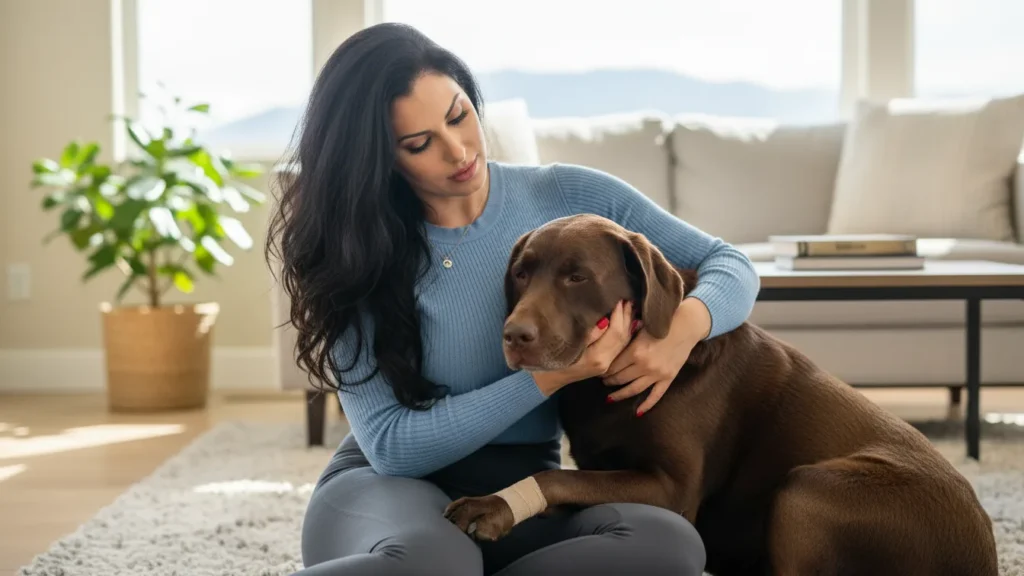
There’s a moment a lot of dog owners eventually experience, usually at the vet: a diagnosis of arthritis, a torn ligament, a dental abscess — something that’s clearly been building for a while — delivered about a dog who, as far as the owner could tell, seemed completely fine. Maybe a little slower on walks. Maybe pickier about jumping on the couch. Nothing that screamed “in pain.” That gap between what a dog is actually experiencing and what an owner can see isn’t a failure of attention. According to veterinary researchers, it’s one of the most consistent and well-documented challenges in animal care — and it’s built into dogs by evolution itself.
The Instinct Veterinary Medicine Takes Seriously
This isn’t folklore or exaggeration; it’s a recognized clinical reality that shapes how veterinarians are trained to evaluate patients. As veterinary pain researchers have put it, animals are very likely to conceal pain because pain functions, evolutionarily, as a signal of weakness — and in a wild setting, an animal that visibly showed weakness risked being targeted by predators or losing standing within its social group. That instinct doesn’t disappear just because a species has been domesticated for thousands of years; the evolutionary pressure that built it operated over a much longer timescale than domestication has existed.
The clinical consequence is significant. Veterinary pain researchers have repeatedly identified pain recognition as genuinely difficult in both acute and chronic settings, in hospital and at home — difficult enough that global veterinary pain organizations have developed formal guidelines specifically to help veterinarians and owners identify pain that would otherwise go unnoticed. It’s also well documented in veterinary literature that pain relief has historically been underused in acutely painful conditions in pet dogs and cats, in part because the pain itself simply wasn’t being recognized.
Why the Signals Are So Easy to Miss
Part of the problem is that a dog’s pain signals often don’t look like what people expect pain to look like. There isn’t reliably a yelp, a limp, or an obvious wince. Veterinary behaviorists note that dogs may vocalize more, pant excessively without an obvious cause, or become subtly restless — but just as often, the dominant sign of pain in a dog is a gradual decrease in activity or a general change in demeanor that’s easy to write off as “just getting older” or “having an off day.”
This is a well-recognized diagnostic trap for owners: gradual behavioral shifts often get reasonably (but incorrectly) attributed to normal aging rather than to an underlying, treatable source of pain. A dog that’s slower to get up, less interested in stairs, or a bit more withdrawn may be quietly compensating for arthritis or another chronic condition rather than simply “slowing down with age” in a way that requires no intervention.
There’s also a facial component researchers have started to formally study. Veterinary pain scales like the Colorado State University Canine Acute Pain Scale include specific facial indicators — a “worried” expression involving arched eyebrows, drooping ears, and darting eyes — as recognized signs that a dog is in pain, even absent more obvious behavioral cues. Interestingly, researchers studying facial pain expression across species have noted that while validated grimace scales exist for several animals, dogs remain harder to standardize this way partly because of how closely they’ve evolved to communicate with humans, alongside significant variation in facial structure across breeds — meaning the same underlying pain can look different on a Pug than on a Border Collie.
Real Tools Exist Because This Problem Is So Common
The scale of this recognition gap has led veterinary medicine to develop specific, validated instruments to catch what casual observation often misses. The Canine Brief Pain Inventory and the Helsinki Chronic Pain Index are owner-completed questionnaires, validated in peer-reviewed research, specifically designed to quantify chronic pain severity in conditions like osteoarthritis — essentially formal tools built to compensate for how unreliable casual, in-the-moment observation of a stoic dog can be.
One study evaluating an owner-reported osteoarthritis screening checklist found real diagnostic value in structured questioning: out of dogs whose owners flagged at least one positive symptom on the checklist, a substantial number were confirmed to have previously undiagnosed osteoarthritis on veterinary examination — cases that had been missed through ordinary observation alone. That’s a concrete illustration of just how easily chronic pain slips past even attentive, caring owners without a structured way of looking for it.
What This Means for You and Your Dog
- “They seem fine” is not the same as “they’re not in pain.” Given how strong and well-documented the instinct to mask pain is, the absence of obvious distress signals shouldn’t be treated as reassurance on its own, especially in older dogs or dogs with known joint or dental issues.
- Gradual changes deserve the same attention as sudden ones. A slow decline in activity, reluctance to jump or climb stairs, or a subtly different demeanor is a legitimate category of pain signal — not something to dismiss simply because it happened slowly rather than all at once.
- Structured questions can catch what casual observation misses. Tools like the Canine Brief Pain Inventory exist precisely because veterinarians recognize how unreliable a quick “how’s he doing?” impression can be; asking a vet about a formal osteoarthritis or pain screening, especially for a middle-aged or senior dog, is a legitimate, evidence-based step.
- A limping, whimpering dog is the tip of the iceberg, not the baseline. By the time pain becomes that visually obvious, it has often been present, unaddressed, for some time. Learning the subtler signs — facial tension, reduced activity, changes in appetite or sleep, altered posture — gives you a real head start on catching a problem early.
- When in doubt, it’s worth a veterinary visit rather than waiting for clearer signs. Because the entire evolutionary point of this instinct is to make injury and illness look like nothing’s wrong, waiting for unmistakable symptoms often means waiting past the point where treatment would have been easier and less costly.
Your dog’s stoicism isn’t a sign that they’re tough enough not to need help. It’s a deeply wired survival strategy doing exactly what it evolved to do — and understanding that is often the difference between catching something early and missing it until it’s much harder to treat.
Sources & Further Reading
- What Are They Hiding? Pain Assessment in Dogs and Cats — Canadian Veterinary Medical Association / WSAVA Global Pain Council
- Recognition and Assessment of Pain in Animals — Merck Veterinary Manual
- How facial expressions reveal acute pain in domestic animals with facial pain scales as a diagnostic tool — Frontiers in Veterinary Science / PMC
- Identification of canine osteoarthritis using an owner-reported questionnaire and treatment monitoring — PMC/NIH
- Pain points — American Veterinary Medical Association (AVMA)

Dr. Sofia Romano, DVM, is an experienced veterinarian specializing in small-animal medicine and preventive care. She has treated thousands of cases using evidence-based diagnostics and modern clinical practices. Dr. Romano is dedicated to providing science-backed pet-health guidance that helps owners make informed decisions and improve their pets’ quality of life.





Pingback: Why Dogs Trust Humans So Deeply — The Bond Science Can Explain
Pingback: Why Dogs Remember Emotional Events Better Than Commands — The Hidden Way Their Brains Store Memory
Pingback: Why Dogs Remember Trauma Longer Than Joy — The Survival Wiring That Never Fully Switches Off
Pingback: Why Dogs Become Emotionally Distant As They Age — The Quiet Changes Most Owners Misunderstand
Pingback: Why Dogs Become Over Attached After Illness — The Emotional Shift Most Owners Don’t See Coming
Pingback: Why Dogs Refuse Their Favourite Food Suddenly — The Quiet Reasons Most Owners Misread
Pingback: Why Labradors Suffer Silent Joint Damage Years Before Limping Ever Begins