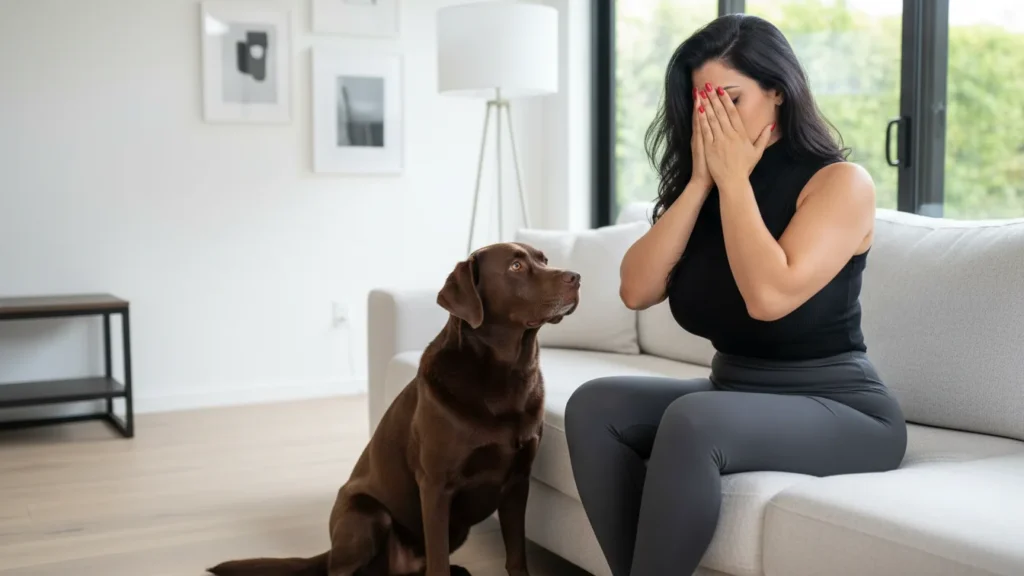
Anyone who’s lived with a dog through a genuinely stressful stretch of life — a big move, a hard breakup, a demanding new job — has probably noticed something: your dog seems to be having a rough time too. More pacing, more clinginess, maybe a change in appetite or sleep. It’s easy to assume you’re just imagining it, or that your dog is simply reacting to less playtime and attention. But a landmark study suggests something deeper and more literal may be happening — your dog’s stress physiology may actually be tracking yours over the long term.
The Study That Measured It in Hair, Not Just Behavior
In 2019, a research team led by Ann-Sofie Sundman at Linköping University in Sweden set out to test something no one had rigorously measured before: not momentary, in-the-room stress contagion, but long-term stress synchronization between dogs and their owners, tracked over months.
To do it, they used a clever biological measurement: hair cortisol concentration. As hair grows, cortisol circulating in the bloodstream gradually gets incorporated into it, effectively creating a retrospective record of someone’s average stress hormone levels over the preceding weeks and months — a much steadier measure than a single stressful moment could capture. Researchers collected hair samples from 58 dog-owner pairs (25 border collies and 33 Shetland sheepdogs, all owned by women) at two points in time, months apart.
The result: dog and owner cortisol levels were significantly synchronized. Owners with higher long-term cortisol had dogs with higher long-term cortisol; owners with lower cortisol had dogs with lower cortisol too. This wasn’t a fluke of shared environment or activity level, either — the researchers specifically checked whether physical activity explained the pattern, using activity-tracking collars, and found that a dog’s exercise level didn’t account for the correlation. The synchronization appeared to be something closer to genuine emotional and physiological transfer between owner and dog.
Whose Stress Is Driving Whose?
One of the more striking findings involved owner personality traits. The study found that a dog’s long-term cortisol level was meaningfully associated with the owner’s personality — specifically traits like neuroticism — while the dog’s own personality traits had comparatively less influence on the pairing. In other words, across this research, the owner’s emotional and psychological profile appeared to be shaping the dog’s underlying stress physiology more than the reverse.
A related follow-up study by the same research group, looking at ancient dog breeds and solitary hunting breeds, reinforced this pattern, finding that a dog’s hair cortisol concentration was tied to qualities of the human-dog relationship and the owner’s personality traits — again pointing toward the owner as an unusually strong driver of a dog’s long-term physiological stress state.
There’s a meaningful caveat worth naming here: correlation isn’t the same as confirmed direction of cause. It’s possible that a stressed owner behaves differently around their dog — less patient, less consistent, less available — in ways that raise the dog’s stress independent of anything like emotional “sensing.” But it’s also consistent with a more direct form of emotional contagion, something researchers describe as one of the most basic building blocks of empathy across species, and something increasingly well documented in the broader science of how dogs read and respond to human emotional states.
This Fits a Larger Pattern in Dog-Human Science
This finding doesn’t exist in isolation — it lines up with a growing body of research on how tightly dogs’ emotional and physiological states are coupled with their owners’. Shorter-term studies have found that dogs and their handlers show correlated heart-rate variability during shared activities like stroking and play, and that competition handlers and their dogs show parallel spikes in saliva cortisol during events like agility trials. Dogs have also been shown to display lower parasympathetic (calming) nervous system activity while gazing at their owner, suggesting the connection between a dog’s physiology and their owner’s emotional state runs through multiple channels — hormonal, behavioral, and even in real time during a shared activity — not just one.
Taken together, this research paints a consistent picture: the emotional weather in a household doesn’t stay contained to the humans living in it. Dogs appear to be steadily absorbing it, in a way measurable down to their hormones.
What This Means for You and Your Dog
- A stressful period in your own life may genuinely be affecting your dog’s baseline stress, not just their mood in the moment. This research suggests the effect isn’t limited to your dog reacting to an obviously tense day — it may compound over weeks and months.
- Managing your own stress is, in a real sense, also managing your dog’s. Given how strongly the research points to the owner’s personality and stress level shaping the dog’s cortisol pattern, your own coping strategies plausibly do double duty.
- Consistency and calm routines matter for reasons beyond training. A stable, lower-stress environment appears to correlate with lower long-term stress physiology in dogs, independent of how much exercise or activity they’re getting.
- This isn’t a reason for guilt — it’s a reason for self-care. If you’re going through something difficult, the healthiest thing for both of you is genuinely taking care of yourself, not blaming yourself for your dog picking up on it. The bond that makes this transfer possible is the same bond that makes your dog such a source of comfort in the first place.
Your dog isn’t just watching you go through a hard time from the sidelines. According to some of the most careful research done on the subject, their body may be quietly going through a version of it right alongside you.
Sources & Further Reading
- Long-term stress levels are synchronized in dogs and their owners — Scientific Reports (Nature) / PMC
- Dogs mirror owner’s stress — Linköping University
- Dogs mirror owner’s stress — ScienceDaily
- Long-term stress in dogs is related to the human–dog relationship and personality traits — PMC/NIH
- Dogs Mirror Stress Level of Their Owners, Study Suggests — Sci.News

Dr. Sofia Romano, DVM, is an experienced veterinarian specializing in small-animal medicine and preventive care. She has treated thousands of cases using evidence-based diagnostics and modern clinical practices. Dr. Romano is dedicated to providing science-backed pet-health guidance that helps owners make informed decisions and improve their pets’ quality of life.





Pingback: What Your Dog’s Eyes Reveal About Their Emotional State — The Silent Language Most Owners Miss
Pingback: Why Dogs Choose One Person As “Their Human” — The Deep Bond Science Can Finally Explain
Pingback: Why Dogs Sense Tension Before Arguments Start — The Invisible Signals They Read Before We Speak
Pingback: Why Dogs Watch You More Than You Realize — The Quiet Behavior That Explains Everything
Pingback: Why Dogs Can Smell Your Stress — The Hidden Emotional Sense That Explains Their Uncanny Bond With Humans
Pingback: Why Dogs Suddenly Avoid Eye Contact — The Quiet Signal They’re Trying To Send You
Pingback: Why Dogs Stay Close When You’re Sick — The Deep Instinct That Makes Them Your Quiet Guardian