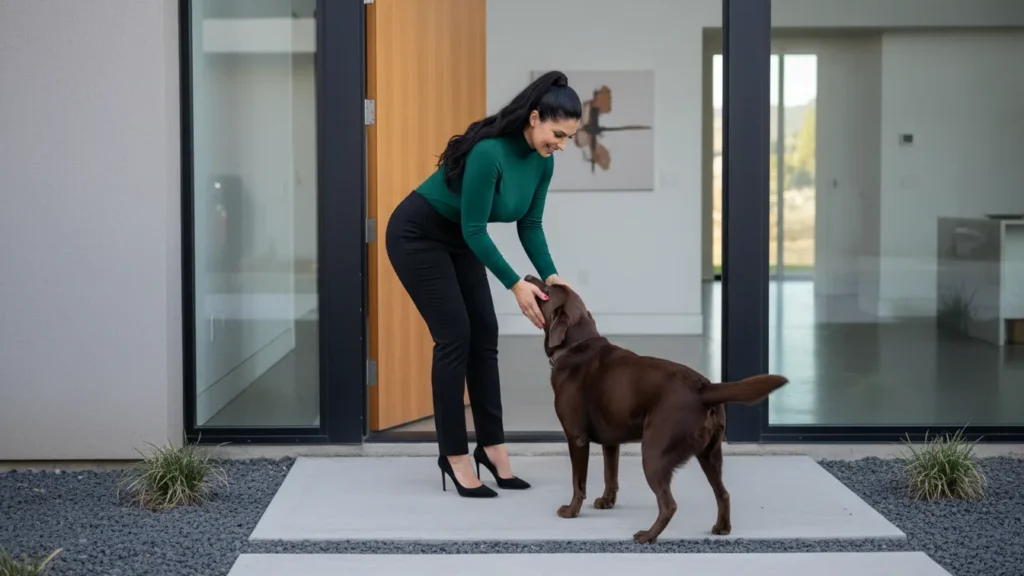
Your dog doesn’t own a clock, doesn’t check a phone, and has no concept of “5 p.m.” as a number. And yet, somehow, they’re standing by the door minutes before you actually pull into the driveway. They know dinner is close before you’ve even glanced at the time. It’s tempting to write this off as coincidence or routine alone — but the science of how dogs actually track time turns out to be stranger, and more sophisticated, than either explanation on its own.
Dogs Can Tell the Difference Between Waiting Durations — Even If They Can’t Name Them
The clearest evidence that dogs experience something like elapsed time comes from a well-known 2011 study published in Applied Animal Behaviour Science by researchers Therese Rehn and Linda Keeling. Twelve privately owned dogs, none with a history of separation-related problems, were videotaped while left alone at home for 30 minutes, 2 hours, and 4 hours.
During the separations themselves, there wasn’t much difference in behavior — the dogs mostly rested quietly regardless of how long they’d been alone. But the moment their owners returned told a different story. Dogs greeted their owners with significantly more tail wagging, more physical contact, and more lip licking after the 2-hour and 4-hour separations than after just 30 minutes. Heart rate also trended higher in the minutes right after reunion following the longer absences. The researchers were careful to note their data couldn’t confirm whether the dogs were actively aware of time passing while alone, or whether something about the length of the separation itself shaped how intensely they responded once their owner walked back in — but either way, the study demonstrated something concrete: dogs are measurably affected by how long they’ve been left alone, even when their behavior during the wait looks the same.
Dogs Can Actually Discriminate Between Timed Intervals
Beyond simply reacting differently to different lengths of absence, research using more controlled lab conditions has shown dogs can genuinely distinguish between timed durations. In interval-timing studies using what’s called a temporal bisection task, dogs were trained to associate a short tone (around 2 seconds) with one choice and a longer tone (around 8 seconds) with another. When later tested on durations in between, dogs’ choices shifted predictably based on how close the new duration was to the “short” or “long” reference points they’d learned — a pattern that closely mirrors how rats, pigeons, and even humans perform on the same kind of task.
This tells us something important: dogs aren’t simply reacting to external cues like light or hunger in a blunt, all-or-nothing way. They appear to have a working, if non-verbal, internal sense of duration — an ability to compare “this feels like a while” against “this feels short” with real precision.
The Nose Might Be a Clock
One of the more fascinating theories about canine time perception comes from cognitive scientist Alexandra Horowitz, who runs the Dog Cognition Lab at Barnard College. Horowitz has proposed that a dog’s extraordinary sense of smell may double as a kind of time-tracking tool. Scent naturally degrades and diffuses over time — a freshly laid footprint or a recently occupied chair smells strong, while the same scent hours later smells much fainter. Since dogs can detect remarkably subtle differences in odor concentration, Horowitz’s theory holds that they may be able to estimate how much time has passed simply by how “faded” a scent has become, in much the same way a burning candle tells a person roughly how long it’s been lit.
Horowitz points out that scent in a room also shifts over the course of a day as air currents and temperature change, meaning a familiar space may genuinely smell different at 8 a.m. than it does at 4 p.m. — giving a dog an ambient, olfactory sense of “what time of day it roughly is,” layered on top of light, temperature, and household sound cues. It’s worth being clear that this specific idea hasn’t yet been tested in a rigorous, published scientific study — it remains an informed hypothesis grounded in what we know about canine olfaction, rather than a confirmed finding. But it offers a compelling, biologically plausible explanation for a behavior nearly every dog owner has witnessed: a dog anticipating an owner’s return, or a routine event, with a level of accuracy that seems to go beyond simple habit.
Routine Does Real Work Too
None of this means dogs are quietly counting minutes the way a person glancing at a clock does. A large part of what looks like “knowing what time it is” comes from something simpler and well documented: dogs are extremely good at learning to associate specific events — a particular light level, a change in household sound, a rumble of hunger, a owner’s typical departure or return pattern — with what tends to come next. This kind of anticipatory learning, sometimes called time-place learning, doesn’t require an abstract concept of hours or clocks at all. It just requires a consistent pattern and a dog’s well-established talent for picking up on cues and their consequences.
In practice, dogs likely blend several of these systems together — an internal sense of elapsed duration, environmental and olfactory cues, and learned routine — rather than relying on just one.
What This Means for Living With a Dog
- Long absences genuinely register with your dog, even if their day-to-day behavior looks calm. The research shows longer separations produce a measurably different, more intense response at reunion — a sign the wait mattered to them, even if it wasn’t visibly distressing while it happened.
- Consistency is doing more work than you might realize. A predictable routine gives your dog reliable cues to anticipate meals, walks, and your return — which is part of why sudden schedule changes can be genuinely disorienting for a dog, not just inconvenient.
- “They always know when I’m five minutes away” probably isn’t superstition. Between scent-fade theories, ambient environmental cues, and learned routine, there’s a real, if not fully mapped, biological basis for a dog’s uncanny sense of an owner’s return.
- A dog’s sense of time isn’t the same as ours — and that’s fine. They’re not tracking hours on a dial. They’re tracking a rich blend of duration, scent, light, and pattern — arguably a more textured way of experiencing a day than simply watching a clock.
Your dog will never tell you it’s 3:47 p.m. But between their nose, their internal sense of duration, and their memory for routine, they may be reading the shape of your day with more precision than either of you realizes.
Sources & Further Reading
- The effect of time left alone at home on dog welfare — Applied Animal Behaviour Science / ScienceDirect
- On the clock: Interval timing and overshadowing in domestic dogs — PubMed
- Can Dogs Tell Time? — Psychology Today
- Can Dogs Smell Time? — Psychology Today
- From Fire Hydrants To Rescue Work, Dogs Perceive The World Through Smell — NPR

Dr. Sofia Romano, DVM, is an experienced veterinarian specializing in small-animal medicine and preventive care. She has treated thousands of cases using evidence-based diagnostics and modern clinical practices. Dr. Romano is dedicated to providing science-backed pet-health guidance that helps owners make informed decisions and improve their pets’ quality of life.




Pingback: Why Dogs Remember Trauma Longer Than Joy — The Survival Wiring That Never Fully Switches Off
Pingback: Why Dogs Observe Human Behaviour More Than We Notice — The Silent Intelligence Shaping Everything They Do
Pingback: Why Older Dogs Suddenly Forget Training — The Quiet Brain Changes Most Owners Don’t See Coming