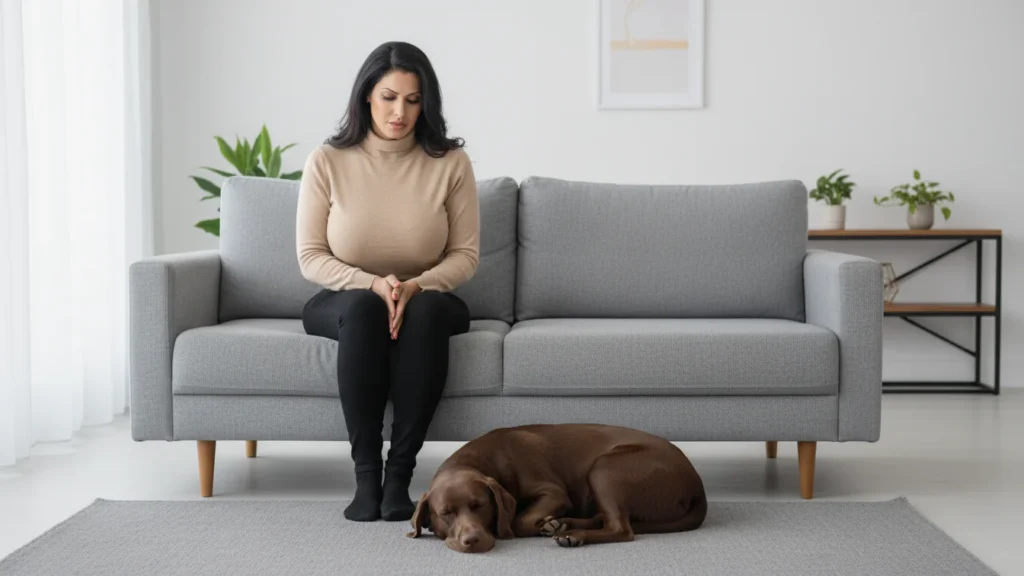
Watch your dog fall asleep tonight, and you’ll probably see the same shape they always choose — curled tight in a ball, sprawled belly-up, or tucked into a neat little loaf with paws folded underneath. It looks like nothing more than comfort. It’s actually closer to a running readout of how safe, warm, and physically comfortable your dog feels in that exact moment — and veterinarians say a genuine shift in that pattern is often the first clue something’s changed.
The Side Sleeper
Legs extended, body stretched out, belly partially exposed. According to Dr. Holmboe, cited by PetMD, this position generally means a dog feels calm and content — deep, trusting sleep, often with dreamy paw twitches along the way. It’s the canine equivalent of sleeping soundly with the covers half-kicked off. Dogs in this position tend to be relaxed and easygoing by nature, comfortable settling down almost anywhere.
The Donut, or Tight Curl
Nose tucked near the tail, body coiled into a ball. Dr. Margaret Gruen, DVM, explains that this position protects a dog’s vital organs by keeping them tucked and hidden — a posture tied to feeling the need for self-protection, common in dogs still adjusting to a new environment, or simply feeling the cold. Veterinarian Dr. Linda Simon adds that this is a favorite in cold or windy conditions, echoing how dogs would have protected themselves from the elements sleeping outdoors generations ago.
The one thing worth watching here: a dog who suddenly starts curling unusually tight, especially in a warm room where they’d normally stretch out, may be guarding a sore abdomen rather than simply feeling cold. New, persistent tight curling paired with reluctance to move is worth a vet visit rather than a shrug.
The Lion’s Pose (or Sphinx)
Head resting on extended front paws, body upright and alert-looking, like a statue outside a courthouse. Veterinarian Dr. Sarah Wooten notes that dogs often start out in this position specifically because they feel like they might need to jump up quickly. It signals rest rather than deep sleep — your dog is keeping half an eye and ear on the world, ready to react if something changes.
Superman, or Belly-Down Sprawl
Front legs stretched forward, back legs stretched out behind, body flat against the floor. This one shows up especially often on cool tile or hardwood, and it’s usually a straightforward temperature signal — your dog is actively trying to cool down by maximizing contact with a cold surface.
Belly-Up
Flat on the back, legs in the air, stomach fully exposed. This is widely considered the clearest trust signal in a dog’s entire sleeping repertoire, since the belly is the most physically vulnerable part of the body. It’s also a genuinely practical cooling strategy — the belly has thinner fur and blood vessels closer to the skin surface, making it one of the most efficient heat-release zones a dog has. A dog who flips belly-up on a hot afternoon is doing double duty: showing trust and actively regulating temperature at the same time.
The Cuddler
Sleeping pressed against you, another pet, or leaning into physical contact rather than a bed on their own. Trainer and behavior specialist Jen Jones notes this is often where you’ll see “sleep running” and twitching most clearly, since the paws are loose and unrestricted by curling. It’s a strong bonding signal — dogs who consistently choose contact over solo comfort tend to be affectionate, socially oriented dogs who genuinely prioritize closeness over having their own space.
The Burrower
Head or whole body tucked under a blanket, pillow, or piece of furniture. This tends to reflect a dog seeking extra security or warmth, and is especially common in dogs who are naturally more anxious or simply enjoy the enclosed, den-like feeling burrowing provides.
The Red Flags Worth Knowing
Most position changes are harmless and tied to something simple: room temperature, a new bed, a mood shift, getting older. A few specific patterns, though, are worth actual attention:
A sudden switch to constant tight curling, paired with reluctance to move. This combination points toward possible pain or abdominal discomfort rather than simply feeling cold, particularly if the room temperature hasn’t changed.
A new preference for sleeping with the head elevated. This can potentially indicate a respiratory or cardiac issue, since an elevated head position can make breathing easier when there’s fluid buildup or airway difficulty involved. One caveat worth knowing: brachycephalic breeds like French Bulldogs and Pugs often sleep with elevated heads simply as their normal baseline, due to their airway structure — so context matters here more than the position alone.
Sleeping noticeably more than usual. This can reflect illness, thyroid imbalance, or in some cases mood-related changes, and is worth mentioning at your next vet visit if it persists.
Sleeping less, or more restlessly than normal. Often tied to anxiety or pain rather than simple insomnia, especially if paired with pacing or difficulty settling.
Violent or unusually prolonged movement during sleep, lasting more than a few minutes, or a dog who seems disoriented upon waking. Ordinary dream-twitching is completely normal, but movement at this level is worth recording on video and showing your vet, since it can indicate a seizure rather than a dream.
The Sleep Disorders Owners Rarely Think to Check For
Beyond position alone, a few actual canine sleep disorders are worth knowing exist, since they’re easy to mistake for personality quirks:
- Sleep apnea, most common in large or overweight dogs, causing snoring and disordered breathing that prevents deep, restorative sleep
- Insomnia, which can stem from chronic pain, illness, or even something as specific as a urinary tract infection disrupting normal rest
- Narcolepsy, a genuine nervous system sleep disorder where a dog suddenly falls asleep, sometimes even mid-activity
None of these are things most owners think to rule out, but persistent, poor-quality sleep in a dog who otherwise seems fine is worth raising with your vet rather than assuming it’s simply how your dog is built.
The Bottom Line
Most nights, your dog’s sleeping position is exactly what it looks like — a comfortable, trusting animal finding the shape that suits the temperature and the moment. But because sleep posture is so consistent for most dogs, a genuine, sustained change from their normal pattern is one of the more reliable early signals that something — temperature, environment, or health — has shifted. You don’t need to analyze every nap. You just need to notice when the shape stops matching the dog you know.
Sources
- PetMD – 6 Dog Sleeping Positions and What They Mean
- Casper – 10 Dog Sleeping Positions + Their Adorable Meanings
- Tractive – 9 Dog Sleeping Positions & What They Mean
- East Perry – Dog Sleeping Positions & What They Mean
- AskAVet – Dog Sleeping Positions & What They Mean: Vet-Approved Guide

Dr. Sofia Romano, DVM, is an experienced veterinarian specializing in small-animal medicine and preventive care. She has treated thousands of cases using evidence-based diagnostics and modern clinical practices. Dr. Romano is dedicated to providing science-backed pet-health guidance that helps owners make informed decisions and improve their pets’ quality of life.


Pingback: Why Your Dog Won’t Sleep At Night Anymore — Vet Causes Most Owners Miss
Pingback: Why Dogs Bark At Nothing — Vets Explain What They’re Really Reacting To
Pingback: Why Dogs Suddenly Explode With Energy At Night — The Real Science Behind Zoomies (Every Owner Should Know)
Pingback: Why Your Dog Growls At You Randomly — The Real Message Most Owners Miss
Pingback: Why Dogs Stay Close When You’re Sick — The Deep Instinct That Makes Them Your Quiet Guardian
Pingback: Why Your Dog’s Eyes Won’t Stop Watering — Hidden Causes Most Owners Miss
Pingback: Why Your Dog Suddenly Wants To Sleep Alone (The Quiet Reasons Most Owners Miss)