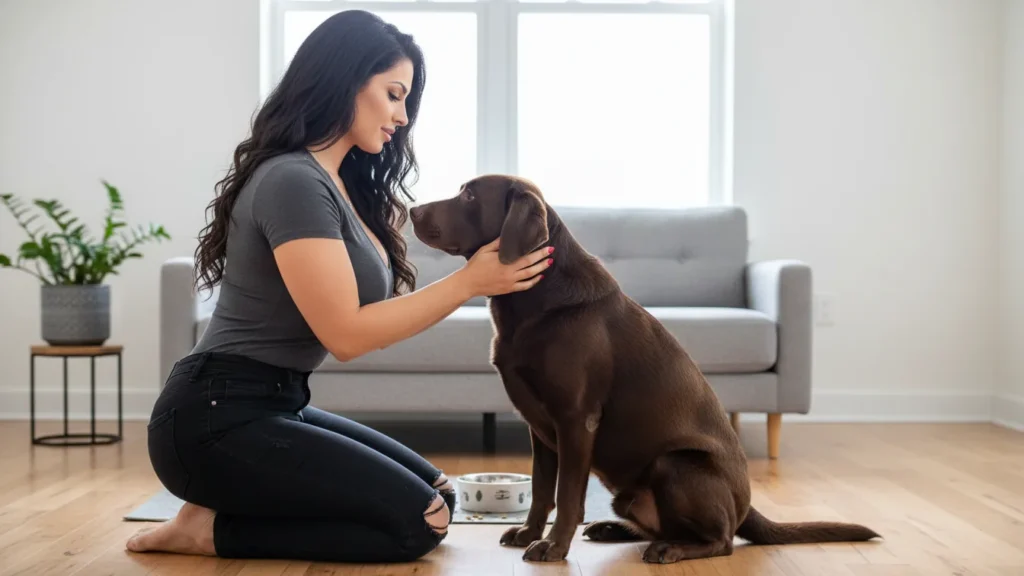
You moved the couch six inches to the left, and your dog acted like the floor had turned to lava.
You started a new work schedule, and suddenly your easygoing Labrador is pacing, whining, and chewing the doorframe.
You went on a weekend trip, came back Sunday night, and your dog greeted you like you’d been gone for a decade — then spent the next two days glued to your ankles.
If you’ve ever wondered why your dog seems to “overreact” to changes that feel small to you, the answer isn’t drama. It’s biology. Dogs are creatures of routine in a way most humans genuinely underestimate — and understanding why can completely change how you support them through life’s inevitable disruptions.
Dogs Don’t Have Calendars. They Have Patterns.
Humans manage uncertainty by thinking ahead. We know Monday means work, we know a trip is temporary, we know the new baby isn’t a threat. We have language, memory, and the ability to reason through change.
Dogs don’t have that toolkit. They don’t understand why something changed or when it will go back to normal. What they have instead is pattern recognition — a finely tuned internal clock built from repetition: when they eat, when they walk, when you leave, when you come home, who shows up and when.
That predictability isn’t a preference. According to veterinary behaviorists, predictability is one of the core pillars of a dog’s sense of safety. When the pattern breaks, the dog’s brain doesn’t interpret it as “minor inconvenience.” It interprets it as loss of control over the environment — and loss of control is one of the most reliable triggers of stress in any social mammal, humans included.
The Science of “Why This Feels So Big to Them”
1. Cortisol Doesn’t Care How Small the Change Seems
When a dog’s routine shifts unexpectedly, their body releases cortisol — the primary stress hormone — as part of a normal physiological response to unpredictability. This isn’t unique to dramatic events like moving homes or losing a companion animal. Research on captive and domestic animals has repeatedly shown that even mild, seemingly minor disruptions to routine can elevate cortisol levels, because the nervous system responds to unpredictability itself, not just to the severity of the change.
This is why a shifted feeding time can produce visible anxiety in a dog, even though nothing “bad” objectively happened. Their body doesn’t grade the change on a curve. It simply registers: the pattern I rely on is gone.
2. Dogs Are Wired for Anticipation, Not Surprise
Domestic dogs evolved alongside humans specifically because they’re skilled at reading and anticipating our behavior. That same skill, which makes them wonderful companions, also makes them highly sensitive to disruption. A dog that has learned “the leash comes out after breakfast” or “the car keys mean I get left alone” has built an entire internal model of how their day unfolds.
When that model breaks — new work hours, a different walker, furniture rearranged, a new person in the house — the dog isn’t just confused. Their predictive system, the very thing they rely on to feel safe, temporarily stops working. Some behaviorists compare this to the disorientation a person might feel if their commute, job, and home layout all changed overnight without warning.
3. The Attachment System Gets Activated
Many routine changes involve some form of separation or shifted attention — a new baby, a partner moving in, longer work hours, a household member leaving for college. Dogs form genuine attachment bonds with their caregivers, similar in structure to the attachment bonds seen in young children, according to research published in comparative psychology journals.
When routines shift in a way that changes access to their attachment figure, even temporarily, it can trigger real separation-related distress — pacing, vocalizing, destructive chewing, or clinginess. It’s not “bad behavior.” It’s an attachment system doing exactly what it evolved to do: signal alarm when a secure base feels less accessible.
4. Environmental Change Disrupts Scent Mapping
Dogs experience their environment largely through scent, and that includes their home. A dog builds a kind of scent-based mental map of their space over time. Moving furniture, introducing new items, deep cleaning with strong products, or renovating can literally alter the “map” a dog has relied on — which is part of why dogs sometimes act unsettled after something as simple as new flooring or a repainted room.
This is a lesser-known but well-documented factor in canine environmental stress, particularly during home moves or major cleaning projects.
Why Some Dogs Handle Change Better Than Others
Not every dog falls apart over a shifted schedule, and that’s not a coincidence either.
- Early life experience matters. Puppies who were gently and gradually exposed to varied routines, environments, and handling during their critical socialization period (roughly 3–14 weeks) tend to develop more flexible, resilient stress responses as adults.
- Breed and temperament play a role. Breeds developed for high vigilance or close human partnership — like many herding and companion breeds — can be more attuned, and therefore more reactive, to shifts in household rhythm.
- Age is a factor. Senior dogs, especially those with early cognitive decline, often struggle more with change because their brains process novelty and uncertainty less efficiently than they used to.
- Overall stress load matters. A dog already coping with an underlying medical issue, chronic pain, or anxiety disorder has less “buffer” available, so an added routine change can tip them into visible distress more easily than it would a dog starting from a calmer baseline.
What Actually Helps
The goal isn’t to eliminate all change — that’s impossible, and it wouldn’t be good for your dog’s resilience anyway. The goal is to make transitions predictable within the change.
- Introduce new routines gradually when you have the option, rather than switching everything at once.
- Keep at least one anchor constant — the same walk route, the same feeding ritual, the same bedtime cue — even if everything else is shifting.
- Give advance exposure. If you know a change is coming (new baby, moving homes, a schedule shift), let your dog experience small previews of it beforehand rather than encountering it all at once.
- Watch for stress signals early — lip licking, yawning out of context, pacing, excessive shedding, loss of appetite — so you can intervene with comfort and structure before stress escalates.
- Give it time. Most dogs adapt to a new routine within one to three weeks once the new pattern becomes predictable and consistent again.
- Talk to a vet or behaviorist if stress signs are severe, persistent, or paired with destructive behavior, house-soiling, or loss of appetite lasting more than a few days.
The Bigger Picture
Dogs don’t resist change because they’re stubborn, spoiled, or overly sensitive. They resist it because predictability is their sense of safety — the closest thing they have to control in a world they can’t fully explain to themselves.
Once you see routine changes through that lens, your dog’s reaction stops looking like an overreaction. It starts looking like exactly what it is: a smart, deeply social animal doing its best to make sense of a world that just stopped following the rules it knew.
Sources
- American Veterinary Society of Animal Behavior – Position Statements on Canine Stress and Behavior
- American Kennel Club – Understanding Separation Anxiety and Routine Disruption
- ASPCA – Recognizing and Managing Stress in Dogs
- Cornell University College of Veterinary Medicine – Canine Behavior and Environmental Enrichment
- Journal of Veterinary Behavior – Attachment and Stress Responses in Domestic Dogs

Dr. Sofia Romano, DVM, is an experienced veterinarian specializing in small-animal medicine and preventive care. She has treated thousands of cases using evidence-based diagnostics and modern clinical practices. Dr. Romano is dedicated to providing science-backed pet-health guidance that helps owners make informed decisions and improve their pets’ quality of life.





Pingback: Why Dogs Watch Doors Even When No One’s Coming — The Silent Vigil That Reveals How Their Brain Works