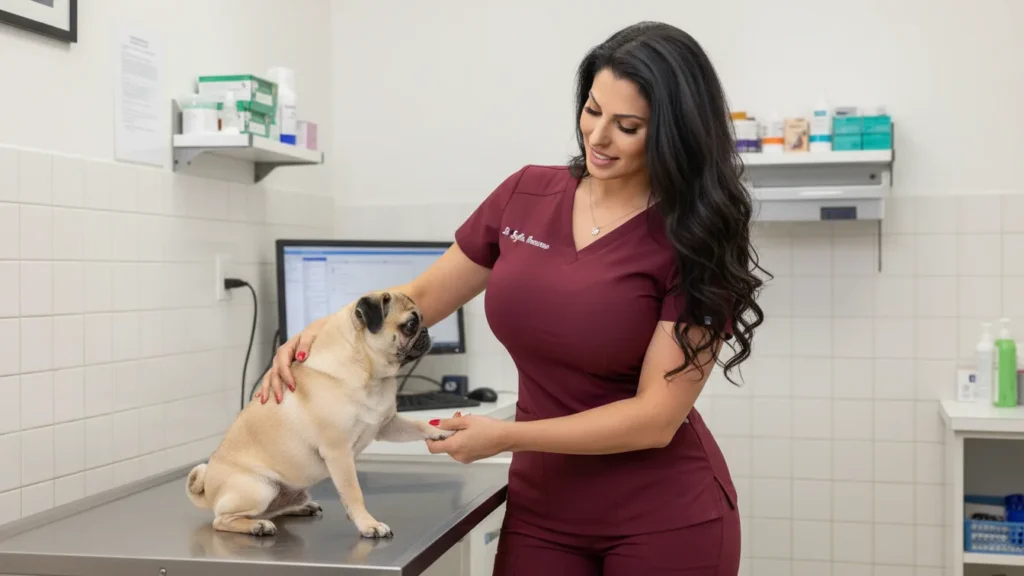
You run your hand along your dog’s back leg and it doesn’t feel like it used to. The thigh that used to fill your palm now feels thinner, a little more bone than muscle. He’s still eating his usual amount, still finishing every meal — so how is he losing muscle? Isn’t that supposed to happen when a dog isn’t getting enough food?
Not necessarily. Muscle loss in dogs can happen for reasons that have nothing to do with how much they’re eating, which is exactly what makes it so easy to miss. A dog can maintain a stable weight, clear his bowl every night, and still be quietly losing muscle mass underneath — because weight and muscle are not the same thing, and the body can lose one while holding onto (or even gaining) the other.
Why Normal Eating Doesn’t Rule Out Muscle Loss
This is the piece that trips most owners up. As dogs age, it’s common for muscle mass to decline while fat mass increases at the same time — which means overall body weight can stay steady or even climb, masking the muscle loss happening underneath. A dog can look “fine” on the scale while genuinely losing strength and lean tissue. This is one of the main reasons muscle loss is so often missed in aging or ill dogs until it’s fairly advanced — nobody’s watching for it because the weight looks normal.
There are three broad categories behind muscle loss that happens independent of appetite: aging, underlying illness, and nerve-related damage. Each behaves differently, and telling them apart matters for what comes next.
1. Sarcopenia: Muscle Loss From Aging Alone
Sarcopenia is the term for muscle loss tied purely to aging, occurring even in the complete absence of disease. It’s a slow, gradual process — <cite index=”78-1″>taking place over the course of years rather than weeks or months</cite> — driven by a mix of factors that mirror what happens in aging humans: <cite index=”82-1″>physical inactivity, increased inflammatory signaling, declining levels of hormones like growth hormone and IGF-1, changes in muscle fiber composition, insulin resistance, and reduced protein synthesis</cite>.
Research backs up just how consistent this is: one histological study found <cite index=”76-1″>muscle atrophy present in all 25 geriatric dogs studied (aged 15–20), and in none of the young control dogs under 5</cite>, along with cellular changes including mitochondrial abnormalities and markers of oxidative stress inside the muscle fibers themselves.
The practical marker of sarcopenia is that it’s gradual, generalized across the body rather than localized to one limb, and happens without any accompanying illness. It’s also, importantly, somewhat manageable — regular exercise, adequate dietary protein, and targeted supplementation can help preserve muscle mass even though the underlying aging process can’t be reversed.
2. Cachexia: Muscle Loss Driven by Underlying Disease
This is the category that most deserves a vet’s attention, because it signals something actively happening in the body — even when appetite looks completely normal. Cachexia is muscle wasting caused by chronic disease: <cite index=”79-1″>unlike typical weight loss driven by reduced appetite or calorie intake, cachexia occurs even in dogs that are still eating normally, driven by chronic inflammation and metabolic disturbances</cite> that push the body to break down its own muscle for energy regardless of what’s coming in through the bowl.
Common underlying drivers include:
- Heart disease — inefficient blood pumping increases the body’s energy demands while reducing oxygen delivery to tissues, triggering muscle breakdown even in dogs eating their full ration
- Chronic kidney disease
- Cancer — one of the most well-studied causes of cachexia, with muscle loss often appearing early, sometimes before other symptoms are obvious
- Chronic inflammatory or endocrine conditions, including some hormonal disorders
The key distinguishing feature of cachexia versus sarcopenia is pace and pattern: cachexia tends to progress faster, can affect fat stores as well as muscle, and shows up alongside other signs of illness — reduced stamina, changes in coat quality, or symptoms tied to the specific organ system involved. Because it’s inflammation-driven, cachexia is genuinely harder to reverse through diet alone, but treating the underlying disease is the most effective way to slow or stop it.
3. Nerve-Related (Neurogenic) Muscle Atrophy
This is the cause owners are least likely to consider, but it’s an important one. When a nerve supplying a muscle is damaged or compressed, the muscle it controls can lose mass relatively quickly — sometimes within weeks — regardless of the dog’s diet or overall health.
Neurogenic atrophy has a distinctive fingerprint that separates it from age- or disease-related muscle loss: it typically follows a specific nerve distribution rather than affecting the body generally, meaning it shows up in one limb, one side, or a specific muscle group rather than being spread evenly across the body. It can also come with other neurological signs — weakness, altered reflexes, or changes in proprioception (a dog’s sense of where its limbs are in space) — and can progress faster than the slow, generalized decline seen in sarcopenia.
Causes behind neurogenic atrophy include spinal disc disease, nerve injury or compression, and certain neurological conditions. Because the presentation is localized and often progresses quickly, this is a scenario that calls for prompt veterinary evaluation, sometimes including advanced diagnostics like electrodiagnostic testing or imaging to pin down exactly which nerve is involved.
How to Tell the Three Apart
| Sarcopenia (aging) | Cachexia (illness) | Neurogenic (nerve damage) | |
|---|---|---|---|
| Pace | Slow, over years | Can progress quickly | Can progress within weeks |
| Pattern | Generalized, whole body | Generalized, often with fat loss too | Localized to one limb or region |
| Other symptoms | Few, mainly reduced strength/stamina | Signs tied to underlying illness | Weakness, reflex or proprioceptive changes |
| Appetite | Normal | Often normal despite muscle loss | Normal |
| Reversibility | Not reversible, but manageable | Depends on treating underlying disease | Depends on the nerve issue and how early it’s caught |
What to Watch For at Home
- Where is the muscle loss happening — everywhere, or concentrated in one leg or side of the body?
- How fast did you notice it — has it been gradual over a long stretch, or did it seem to appear over a few weeks?
- Is your dog weaker, stumbling, or showing any change in coordination alongside the thinning?
- Are there other symptoms — reduced energy, changes in breathing, coughing, increased thirst, or a duller coat?
- Run a hand along both sides of your dog’s body — comparing symmetric muscle groups (both thighs, both shoulders) is one of the easiest ways to catch localized loss early.
When to See a Vet
Because muscle loss can be the first visible sign of something serious happening well before other symptoms show up, it’s worth a veterinary visit any time you notice it — not just when it becomes dramatic. Bring it to your vet promptly if you notice:
- Muscle loss that’s rapid or localized to one limb or side
- Any accompanying weakness, limping, stumbling, or changes in gait
- Muscle loss paired with reduced energy, coughing, increased thirst, or other signs of illness
- A senior dog with gradually thinning muscle even without other symptoms — worth a baseline check to catch sarcopenia early and start supportive management
A physical exam, bloodwork, and sometimes imaging can distinguish between these three causes fairly reliably, and catching the pattern early — especially with cachexia or nerve-related atrophy — makes a real difference in how manageable it is.
The Bottom Line
A dog eating normally and still losing muscle isn’t a contradiction — it’s one of the more important blind spots in how owners typically monitor their dog’s health. Weight on the scale and muscle underneath the coat are two different things, and a dog can hold steady on one while losing ground on the other. Whether it’s the slow, expected drift of aging, the metabolic drain of an underlying illness, or a nerve issue localized to one limb, the pattern of where and how fast the muscle is disappearing is the clearest clue to which one you’re facing — and getting it checked early gives your dog the best shot at holding onto strength for longer.
Sources & Further Reading
- Sarcopenia in Dogs — PetMD
- Cardiac Cachexia in Dogs and Cats — Animal Cardiology of Nevada
- Muscle Loss in Dogs and Cats — Preventive Vet
- Cachexia and Sarcopenia: Emerging Syndromes of Importance in Dogs and Cats — Journal of Veterinary Internal Medicine (Wiley)
- Sarcopenia and Weight Management in Older Dogs — Royal Canin Veterinary Academy

Dr. Sofia Romano, DVM, is an experienced veterinarian specializing in small-animal medicine and preventive care. She has treated thousands of cases using evidence-based diagnostics and modern clinical practices. Dr. Romano is dedicated to providing science-backed pet-health guidance that helps owners make informed decisions and improve their pets’ quality of life.




Pingback: Why Dogs Become Emotionally Distant As They Age — The Quiet Changes Most Owners Misunderstand
Pingback: Why Labradors Suffer Silent Joint Damage Years Before Limping Ever Begins
Pingback: Why German Shepherds Develop Digestive Weakness Before Other Symptoms — The Early Gut Clues That Signal Deeper Health Issues
Pingback: The Muscle Loss German Shepherd Owners Often Miss — The Quiet Physical Change That Signals Deeper Health Trouble