
You reach for your shoes, and your dog is already at the door. You sigh at your desk, and a cold nose nudges your elbow before you’ve even said a word. You haven’t spoken a sentence, yet somehow, your dog already knows what’s coming next.
This isn’t magic. It isn’t luck. It’s the result of thousands of years of quiet, relentless observation — a form of intelligence so subtle that most of us walk right past it every single day.
Dogs don’t just live with us. They study us. And the more scientists look into how they do it, the more astonishing the picture becomes.
The Watchers in Our Living Rooms
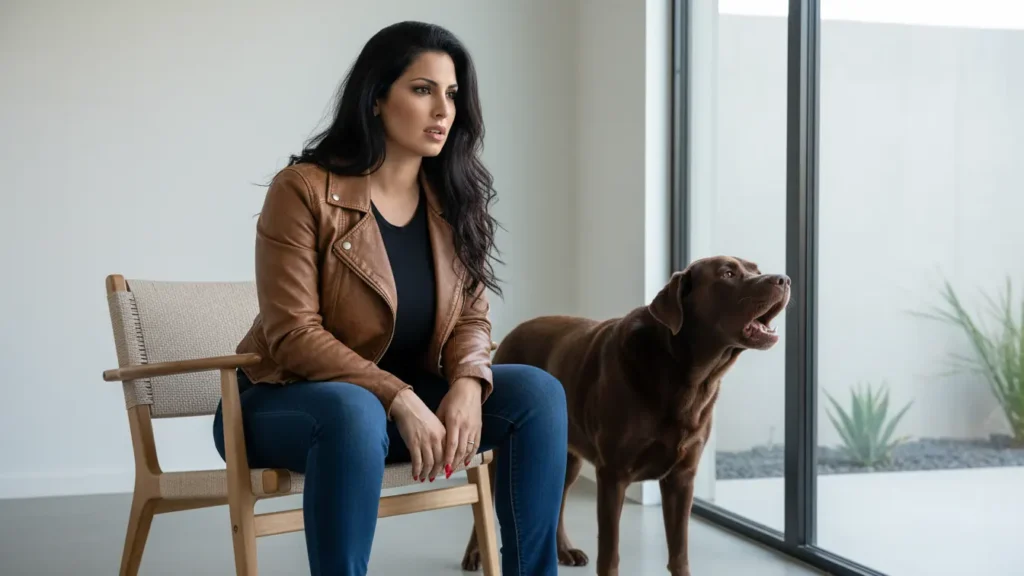
Every dog owner has had a moment that feels almost eerie — the dog that slinks away before an argument even starts, or the one that appears at your side the second you feel sad, long before a single tear falls. For years, this was written off as coincidence or “just a dog thing.” Science now tells a very different story.
Dogs have spent an estimated 30,000-plus years evolving alongside humans, and in that time they’ve developed something no other domesticated species has quite managed: a genuine, evolved sensitivity to human social signals. Researchers studying this bond note that dogs have picked up human-like communication skills largely because of the domestication process itself — the dogs that paid closer attention to us, quite literally, survived better and passed on their genes.
That means the intense way your dog watches your face isn’t a quirky personality trait. It’s baked into the species.
They’re Reading Your Body Before They Ever Hear Your Voice
Here’s something most pet owners don’t realize: your dog is probably paying more attention to your posture and movement than to your words.
Neuroscientists using MRI scans on fully awake, unsedated dogs discovered that dogs possess a dedicated brain region in the temporal lobe for processing body postures — a structure that evolved completely independently from the similar one in the human brain, yet does a remarkably similar job. In other words, evolution arrived at the same solution twice, once in primates and once in dogs, because reading a body accurately is that valuable for social survival.
This lines up with decades of behavioral research showing dogs pick up on posture, gesture, and movement with startling accuracy. A widely cited experiment at the University of Lincoln placed a dog alone in a room while its owner and a stranger walked through and exited via different doors. The dog consistently gravitated toward the door its owner used — but when both people covered their faces, the dog’s accuracy dropped sharply. That single experiment revealed two things at once: dogs track our faces closely, and they lean even more heavily on our broader body language when the face alone isn’t enough.
Real-world example: Ever notice how a dog seems to sense a walk is coming before you’ve grabbed the leash? It’s rarely one obvious cue. It’s the slight shift in your weight toward the closet, the change in your breathing, the way your shoulders relax when you’re relieved the workday is over. Your dog has been quietly cataloguing these micro-signals for years.
Puppies Arrive Pre-Loaded With This Skill
Perhaps the most remarkable discovery in recent canine science is that this ability isn’t something dogs slowly learn over a lifetime with us — many are born with it.
Researchers at the Arizona Canine Cognition Center studied 375 Labrador and Golden Retriever puppies bred for service-dog work, testing them at just eight weeks old — barely past weaning. The puppies were shown a simple pointing gesture toward one of two cups, only one of which hid a treat. Without any training, a striking number of puppies could already follow the human point to find the food, a skill that took human infants and even our closest primate relatives, chimpanzees, far longer and far more exposure to master.
Because the puppies shared a similar upbringing and known lineage, researchers could separate nature from nurture — and the results pointed strongly toward genetics. This suggests that early humans, whether intentionally or not, selected the wolves that were best at reading us, and that trait has been quietly inherited ever since.
The Empathy Nobody Expected
If reading gestures feels impressive, what happens next borders on the emotional.
Scientists studying contagious yawning — a behavior long linked to empathy in humans and primates — decided to test whether dogs could “catch” a yawn from a person. In one of the earliest studies, published out of the University of London, roughly seven out of ten dogs yawned after watching a human yawn, an even higher contagion rate than typically seen between humans.
Later research went a layer deeper. Dogs yawned significantly more often after watching their own owner yawn compared to a stranger, and this wasn’t just a copied reflex — their heart rates changed too, hinting at a genuine emotional undercurrent rather than simple mimicry. This “familiarity effect” mirrors exactly what happens between close human friends and family members, where contagious yawning is far more common than it is between strangers.
Separately, researchers have found that dogs respond physiologically to human crying — with rising stress hormones and submissive, comforting behavior — suggesting dogs don’t just notice our distress, they feel some echo of it themselves.
Why This Matters More Than It Seems
It’s easy to file all this away as cute trivia. But understanding how closely your dog observes you has real, practical value:
- Your mood leaks into your dog’s behavior. Chronic tension, frustration, or sadness at home doesn’t go unnoticed — it can shape a dog’s stress levels and behavior over time.
- Inconsistent body language confuses dogs. Saying “good dog” in a tense, clipped tone sends mixed signals your dog will pick up on, even if the words are right.
- Dogs mirror routines, not just commands. The predictability of your movements — when you get up, when you reach for keys — is often what dogs are responding to, not telepathy.
- Calm, deliberate cues train faster than words alone. Because dogs weight posture and tone so heavily, consistent body language often teaches a new behavior faster than verbal repetition.
The Humbling Twist: We’re Not Nearly As Good at Reading Them
Here’s the part that should give every dog owner pause. While dogs have become remarkably fluent in reading us, research from the Canine Science Collaboratory at Arizona State University found the reverse isn’t true. In a study led by researchers including Dr. Clive Wynne, hundreds of participants were shown videos of a dog reacting to everyday situations — a treat, a leash, a scolding, a rival cat — and asked to judge the dog’s emotional state. Most people based their answer almost entirely on the surrounding context, barely looking at the dog’s own body language at all.
In short: our dogs have spent millennia learning to read us fluently. We’re still, in many ways, learning their language.
The Bigger Picture
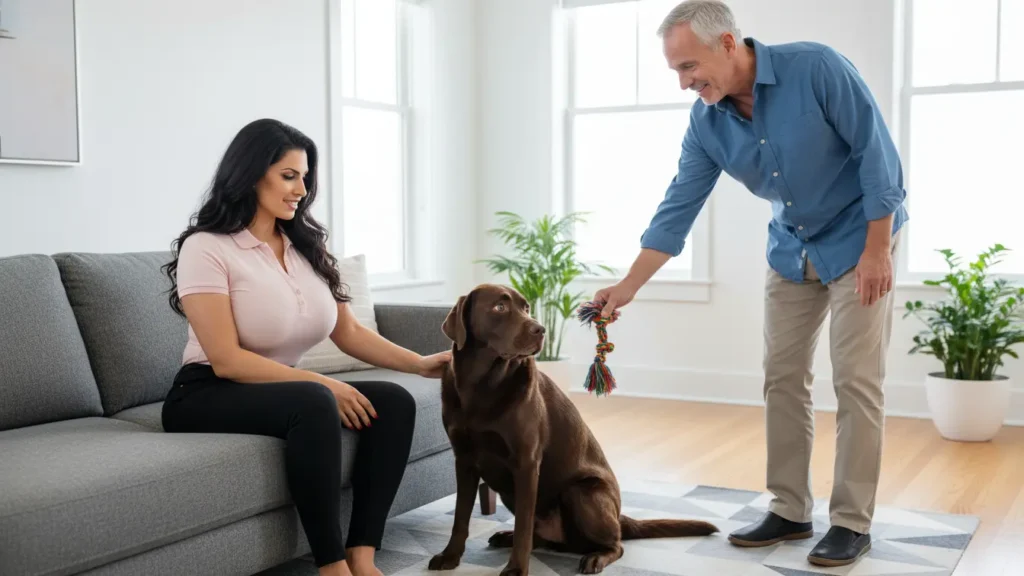
None of this means your dog is secretly plotting or manipulating you — it means dogs evolved as extraordinary social observers because their survival, for tens of thousands of years, depended on correctly predicting what humans would do next. That silent intelligence shows up in the tilt of a head at an unfamiliar tone of voice, the hesitation before an unfamiliar guest, the way a dog seems to know a bad day when it sees one.
The next time your dog seems to “just know,” remember: it isn’t guessing. It’s the product of one of the longest-running, most successful cross-species observation projects in natural history — and you’ve been the subject the entire time.
Sources and further reading:
- Communications Biology — MRI study on dogs’ brain regions for body-posture perception (via Interesting Engineering)
- Arizona Canine Cognition Center puppy body-language study (via Humintell)
- University of Lincoln face/body-language experiment (Modern Dog Magazine)
- Contagious yawning and empathy research, University of Tokyo
- Familiarity bias in dog contagious yawning, PLOS ONE
- People aren’t good at reading dog body language, Forbes / ASU Canine Science Collaboratory

Dr. Sofia Romano, DVM, is an experienced veterinarian specializing in small-animal medicine and preventive care. She has treated thousands of cases using evidence-based diagnostics and modern clinical practices. Dr. Romano is dedicated to providing science-backed pet-health guidance that helps owners make informed decisions and improve their pets’ quality of life.




Pingback: Why Dogs React Differently To Each Family Member — The Hidden Social Rules They’re Constantly Reading