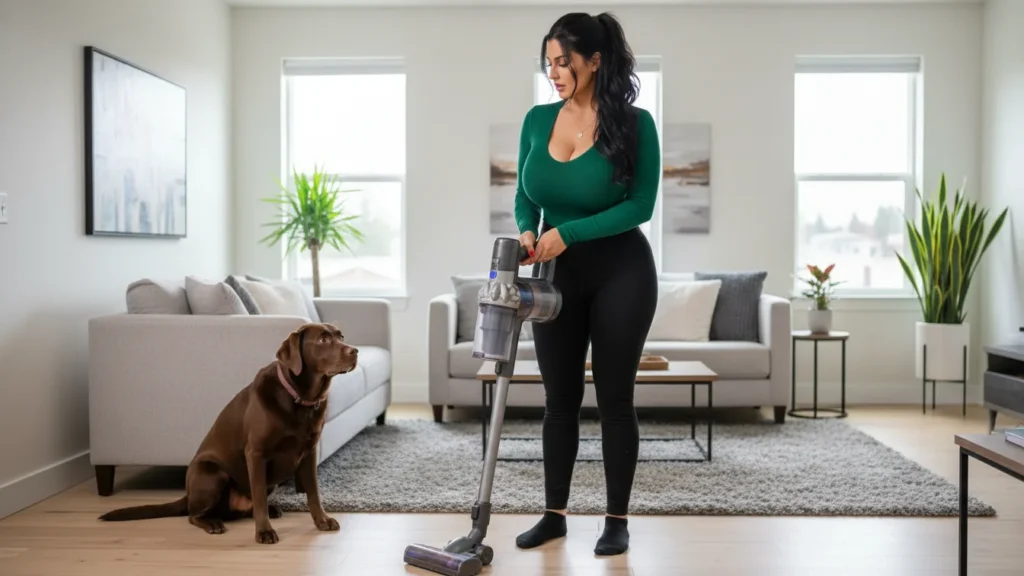
You pull the vacuum out of the closet, and before it’s even turned on, your dog has already left the room, or worse, started barking at it like it’s an intruder. It’s easy to laugh off as a quirky dog thing, but the fear is real, common, and rooted in something your dog genuinely can’t help: a nervous system that’s wired to treat a vacuum cleaner as a legitimate threat, not a household chore.
Understanding why this happens changes how you handle it. This isn’t drama, and it isn’t something to push through with reassurance alone. It’s a rational response coming from a brain that experiences the vacuum very differently than yours does.
Their Hearing Makes the Vacuum Genuinely Louder to Them
The biggest piece of this is pure biology. Dogs hear at a level humans can’t fully appreciate — they can detect frequencies far beyond the range of human hearing, and they pick up on quieter sounds at a much lower intensity than we do. A vacuum that registers to you as an annoying but tolerable household noise can register to your dog as something closer to a genuine assault on the senses. It’s not that your dog is more sensitive emotionally — their ears are physically built to register more of that noise, and at a more intense level, than yours ever will.
On top of the volume, vacuums produce a fairly unique combination of a droning hum layered with a higher-pitched whine, and that mix of frequencies is exactly the kind of unpredictable, harsh sound profile that tends to unsettle dogs the same way thunder or fireworks do.
It’s Not Just Noise — It’s Vibration Too
Even dogs with hearing loss can be afraid of vacuums, which tells you the sound isn’t the whole story. Vacuums send vibrations through the floor that a dog can feel through their paws and body, adding a second layer of sensory input that reinforces the sense that something disruptive and unnatural is happening nearby. Combine a loud, unfamiliar noise with a physical vibration moving unpredictably across the floor, and you have a sensory experience that checks almost every box a dog’s brain uses to flag “possible danger.”
The Movement Looks Like a Threat, Not a Chore
Beyond sound, the way a vacuum moves plays a huge role. It doesn’t move the way a person, another animal, or a familiar object moves — it lurches, stops, turns unpredictably, and sometimes gets pushed directly toward the dog. To a brain that’s spent thousands of years reading movement patterns to judge threat versus safety, an object moving that erratically toward them reads as something to either flee from or confront, not something to ignore.
This is also why some dogs don’t run — they attack. A vacuum’s sudden movement can trigger prey drive in dogs with strong hunting instincts, while herding breeds like Border Collies or Australian Shepherds may try to herd or redirect it, treating the appliance the same way they’d treat livestock moving out of formation. Different dogs, same root cause: their brain is interpreting an object’s motion using instincts that predate vacuums by thousands of years.
Lack of Early, Positive Exposure
Puppies who are introduced to a vacuum calmly and gradually, ideally alongside treats and a relaxed household mood, tend to grow into adult dogs who barely react to it. Puppies who never encounter one until later in life, or who encounter one for the first time in a chaotic or startling way, are far more likely to develop lasting fear. This is one of the biggest reasons rescue dogs and shelter dogs in particular tend to have stronger vacuum fears — many simply never had a calm early introduction to ordinary household appliances, so the vacuum shows up as a complete unknown with no positive history to soften the reaction.
A Genuinely Bad Past Experience
Sometimes the fear has a much simpler explanation: something actually happened. A vacuum bumping into a dog, a robot vacuum catching on fur or a tail, or someone playfully using the vacuum’s movement to “chase” the dog as a joke can create a real, specific negative memory. Once that association forms, the vacuum stops being neutral and becomes something the dog has genuine evidence to be wary of — not an overreaction, but a learned and entirely reasonable response to an actual bad encounter.
It Often Overlaps With Broader Noise Sensitivity
Dogs who are already anxious around thunderstorms, fireworks, or other loud, sudden sounds are frequently the same dogs who struggle most with vacuums. This isn’t a coincidence — it points to a more general noise sensitivity or anxiety tendency rather than something uniquely about vacuums. If your dog reacts strongly to a wide range of loud or sudden sounds, the vacuum fear is likely one expression of that broader sensitivity rather than an isolated issue.
How to Actually Help
- Never force proximity. Dragging a fearful dog closer to a running vacuum reinforces the fear rather than resolving it.
- Desensitize gradually. Start with the vacuum turned off and stationary, rewarding calm behavior near it, then slowly introduce sound and movement at a distance your dog can handle without panicking.
- Let them retreat. Allowing a dog to leave the room or crate during vacuuming isn’t giving in — it’s respecting a legitimate sensory limit while you work on desensitization separately.
- Choose a quieter model if possible. Lower-decibel vacuums are measurably easier for sound-sensitive dogs to tolerate.
- Watch for escalation. A mild startle response is very different from shaking, hiding, or panic that continues well after the vacuum is off — the latter is worth discussing with a trainer or veterinary behaviorist rather than managing alone.
The Bottom Line
Your dog isn’t being irrational when the vacuum comes out. Their ears register more of that noise than yours do, they can feel vibrations you can’t, and their brain reads erratic movement through an instinct built for predators, not machines. Once you see the fear as a legitimate sensory and instinctive response rather than a behavioral quirk, it becomes a lot easier to help your dog through it with patience instead of frustration.
Sources
- PetMD — Why Are Dogs Scared of Vacuums?
- Hill’s Pet — Why Are Dogs Scared of Vacuums?
- Homes & Gardens — What to Do if Your Dog Is Scared of Your Vacuum
- Outward Hound — Why Do Dogs Hate Vacuums?
- ECOVACS — Why Dogs Are Scared Of Vacuums (How To Help)?

Dr. Sofia Romano, DVM, is an experienced veterinarian specializing in small-animal medicine and preventive care. She has treated thousands of cases using evidence-based diagnostics and modern clinical practices. Dr. Romano is dedicated to providing science-backed pet-health guidance that helps owners make informed decisions and improve their pets’ quality of life.





Pingback: Why Dogs Hate Their Crate Suddenly — The Hidden Reason This Safe Space Stops Feeling Safe
Pingback: Why Dogs React Strongly To Certain Sounds — The Science Your Dog’s Brain Can’t Ignore