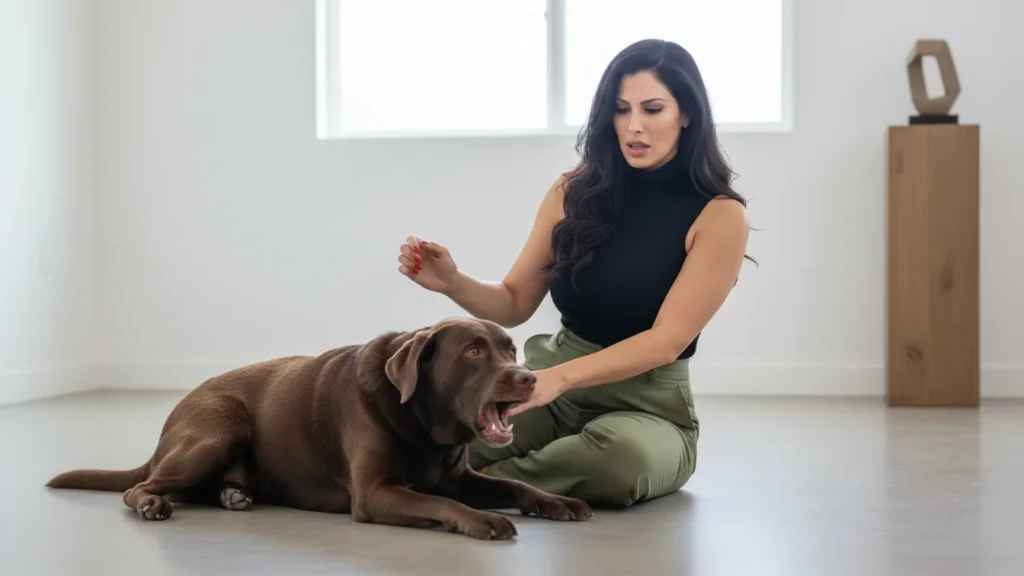
You reach down to scratch behind your dog’s ear, the same spot you’ve touched a thousand times before, and this time he snaps. Not a bite, just a fast, startled air-snap — but it’s enough to make your stomach drop. Is he turning aggressive? Did I do something wrong?
Here’s what veterinary behaviorists want owners to understand before jumping to either conclusion: a snap is communication, not a verdict on your dog’s character. And when it’s tied to a specific body part rather than happening randomly, it’s very often your dog’s way of saying something hurts — not that something has changed about who he is.
Snapping Is Rarely About Dominance
For years, aggressive-looking behavior in dogs got explained through a dominance lens — a dog “asserting itself” or “testing boundaries.” Modern veterinary behaviorists have largely moved away from that framework. Aggression is understood to be most often defensive, not a power play. A dog who snaps isn’t trying to win a status contest; he’s trying to create distance between himself and something that feels threatening or painful in that exact moment.
That distinction matters enormously for how you respond. A defensive, pain-driven snap calls for investigation and gentleness. Treating it as a discipline problem instead can make a genuinely uncomfortable dog feel like he now has to escalate further just to be heard.
The Warning Signs Before the Snap
Dogs rarely go from calm to snapping with no warning — they usually try several quieter signals first, and most owners simply miss them because they happen fast and look subtle. The typical escalation ladder looks like this:
- Tensing or stiffening the body when touched
- Lip licking or yawning outside of tiredness — both classic stress signals
- “Whale eye” — the whites of the eyes becoming visible as the dog turns its head away while keeping watch
- Ears pinned back against the head
- A low growl, the clearest and most direct warning a dog can give
- Snapping or biting, which typically only shows up once the earlier signals have gone unnoticed or unanswered
The uncomfortable truth here is that a snap often isn’t a dog “suddenly” reacting — it’s a dog whose quieter warnings were missed, escalating to the one signal that’s impossible to overlook.
The Body Map: Why Location Matters So Much
This is the piece most owners never connect, and it’s genuinely useful diagnostic information. Where on the body a dog reacts often points directly to what’s wrong:
Ears. Sudden sensitivity around the ears can point to ear infections, mites, or inflammation — areas that are already painful to the touch before you ever reach for them.
Paws and nails. Pulling away or snapping when paws are handled can signal overgrown or split nails, embedded debris, an injury between the toes, or simple past trauma from a bad nail-trim experience.
Tail base and rear. Sensitivity here is commonly linked to anal gland issues, spinal or disc problems, or hip discomfort — dogs frequently protect this area specifically when something in the lower back or pelvis is bothering them.
Hips and back legs. This is one of the most common pain-related touch reactions, especially in older or larger dogs, and is frequently tied to arthritis or hip dysplasia. A dog may tolerate a normal pat but react sharply if that same area is pressed or manipulated.
Belly and abdomen. Guarding or snapping when the stomach is touched can point toward internal discomfort — anything from gas and digestive upset to more serious organ-related pain — and deserves prompt attention rather than being brushed off as quirky behavior.
Neck and collar area. Sensitivity specifically when a collar or harness goes on or comes off can be pain-related, but is also a very common site for handling-based fear if a dog has had a rough or startling experience with collars in the past.
When It’s Fear, Not Pain — And Why the Line Blurs
Pain isn’t the only explanation, and the two often overlap. Touch sensitivity can also stem from inadequate early socialization, past trauma, or an association a dog has built between a specific kind of handling and something unpleasant — a rough grooming session, a startling vet visit, or simply never having been gently handled as a puppy. A dog who tenses every time you reach for the collar, for instance, may be reacting to memory rather than current pain.
The honest reality is that vets often can’t tell the two apart from the outside alone. That’s exactly why professionals in this field default to a simple, protective rule: any sudden or new snapping should be treated as a medical issue until proven otherwise, even if the dog seems completely fine in every other way. A short phone video of the behavior, taken safely, can also be genuinely valuable to share with your vet — dogs frequently mask pain even more at the clinic than they do at home, which means the vet may never see the reaction that prompted your visit in the first place.
What Actually Helps
Get a veterinary exam, even if nothing else seems wrong. This is the single most important step, and it should come before any behavioral training plan. Dogs are exceptionally good at hiding pain, which means “he seems fine otherwise” isn’t reliable evidence that he is.
Avoid punishment entirely. Correcting a dog for growling or snapping doesn’t remove the underlying discomfort — it just teaches the dog that warning you isn’t safe, which can push future reactions straight past the growl to the bite, skipping the warning stage altogether.
Respect the specific area. Once you know where the sensitivity lives, adjust your handling around it while the underlying cause is investigated and treated, rather than continuing to touch the same spot the same way.
Consider a Fear Free certified professional. For dogs with ongoing handling sensitivity, groomers and veterinarians trained in fear-free, cooperative-care techniques can make a genuine difference, particularly when pain management and behavior support happen together rather than separately.
The Takeaway
A snap tied to a specific body part isn’t your dog’s personality changing overnight. It’s information, delivered in the clearest way your dog has available, about something that hurts or something that scares him. Listen to it the way you’d want to be listened to if the roles were reversed — and let a vet, not a guess, tell you which one it actually is.
Sources
- Dogster – My Dog Snapped at Me: 4 Possible Reasons (Vet-Reviewed)
- Preventive Vet – When Touch Hurts: Handling Sensitivity & Pain in Dogs
- ImpriMed – Managing Aggression Due to Pain in Dogs
- Honest Paws – Touch Sensitive Dogs: Why Is My Dog Growling at Me When I Touch Him?
- Beyond the Dog – Why Does My Dog Hate the Vet? Tips for Touch-Sensitive Dogs

Dr. Sofia Romano, DVM, is an experienced veterinarian specializing in small-animal medicine and preventive care. She has treated thousands of cases using evidence-based diagnostics and modern clinical practices. Dr. Romano is dedicated to providing science-backed pet-health guidance that helps owners make informed decisions and improve their pets’ quality of life.



Pingback: Why Your Dog Suddenly Refuses Walks — Hidden Reasons Most Owners Miss
Pingback: How To Socialize A Fearful Dog Without Breaking Their Trust — What Actually Works
Pingback: How To Tell If Your Dog Is Depressed — Subtle Signs Most Owners Overlook
Pingback: Why Dogs Destroy The House When You Leave — The Real Reasons Vets And Trainers See
Pingback: The Real Reason Your Dog Won’t Listen To You — It’s Not Stubbornness
Pingback: Why Your Dog Suddenly Becomes Clingy — A Vet Explains The Triggers Most Owners Miss
Pingback: 10 Dog Training Myths That Are Completely Wrong — What Science And Trainers Actually Know
Pingback: Why Dogs Become Fearful Without A Bad Experience — The Hidden Reasons Anxiety Can Appear Out Of Nowhere
Pingback: Why Dogs Avoid Stairs All Of A Sudden — The Quiet Warning Most Owners Miss