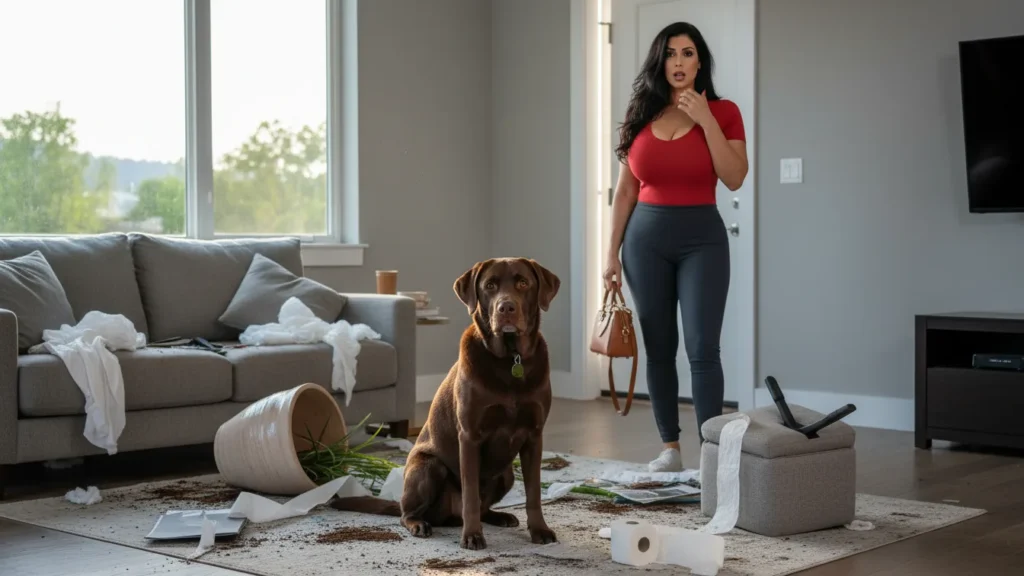
You open the front door to a couch cushion in pieces, a chewed-up shoe, maybe a scratched-up door frame — and your dog trots over wagging his tail like nothing happened. It’s tempting to read that tail wag as guilt, or worse, as revenge for being left alone. Neither one is actually what’s going on. Dogs don’t have the cognitive wiring to plan destruction as payback hours in advance, and that wagging tail is almost always just excitement that you’re home, not an admission of guilt.
So if it’s not spite, what is it? The honest answer is that “my dog destroys the house when I leave” isn’t one problem — it’s a symptom that can point to several very different causes, and treating the wrong one is why so many owners feel stuck.
The Test Trainers Actually Use First
Before assuming the worst, professional trainers and veterinary behaviorists start with the same simple diagnostic: record what your dog actually does while you’re gone. What that footage shows matters more than the aftermath you come home to.
Dr. Meredith Stepita, a board-certified veterinary behaviorist, has described the pattern she looks for: dogs destroying things purely out of boredom or exploratory play tend to look calm on camera. They might chew up a couch cushion or scattered papers, but notably, they don’t usually destroy the exact door or window their owner left through. That detail matters. A dog in genuine separation distress, by contrast, tends to fixate on exit points — the door, the window frame nearest it — while showing visible signs of panic rather than relaxed mischief.
That single distinction, calm versus frantic, and random object versus exit point, is often enough to tell you which of the following you’re actually dealing with.
When It’s Boredom, Not Anxiety
This is the more common explanation than most owners expect, and often the easier one to fix. A dog left alone for hours with nothing to do, no mental stimulation, and pent-up physical energy will frequently self-entertain in the only way available: chewing, digging, tearing. It’s genuinely not misbehavior in the way that phrase implies — it’s a dog trying to cope with having nothing meaningful to occupy an active mind and body.
Boredom-driven destruction shows up more in younger dogs, particularly those under a year old, and tends to track closely with how much exercise and mental engagement a dog gets before being left alone. A dog who’s had a proper walk, a training session, or a puzzle-feeder session beforehand is a fundamentally different animal than one who’s been sitting idle all morning.
When It’s Genuine Separation Anxiety
This is a different condition entirely, and it’s more serious than the word “anxiety” might suggest. Veterinary sources describe it as a dog becoming hyper-attached to their owner, to the point of real, measurable distress when left alone — not simple mischief, but panic. Alongside destruction, look for:
- Howling, barking, or whining that starts almost immediately after you leave
- House accidents from a dog who’s otherwise fully house-trained
- Excessive drooling, panting, or pacing before you’ve even left
- Scratching or digging concentrated specifically at doors and windows
- Visible distress when you pick up your keys or put on shoes, well before you actually leave
Separation anxiety typically develops within a dog’s first two years of life, though it’s not exclusively a young-dog issue. Known risk factors include a change in family structure or home, the loss of a companion animal or family member, a major routine disruption, or simply not having had enough safe, low-key alone-time as a puppy. Rescue dogs with unknown histories are also more prone to it, likely tied to earlier experiences of abandonment or instability that owners may never fully know about.
When It’s Neither — A Medical Issue Hiding as Behavior
This is the piece most owners skip entirely, and it shouldn’t be. Veterinary sources are clear that destructive behavior can, in some cases, be tied to something physical rather than emotional — neurological conditions, nutritional deficiencies, hormonal imbalances, or even dental pain can all produce behavior that looks identical to boredom or anxiety from the outside. This is exactly why a vet visit, including baseline bloodwork and urinalysis, is a reasonable first step before assuming the cause is purely behavioral, especially if the destructive behavior appeared suddenly in a dog who’s never had this issue before.
What Actually Helps, Once You Know the Cause
If it’s boredom: increase physical exercise and mental stimulation before you leave, introduce food puzzles or long-lasting chews to occupy the alone-time itself, and rotate toys so novelty doesn’t wear off.
If it’s separation anxiety: the fix is slower and needs more structure. Practice short departures that gradually build in length, keep both leaving and arriving low-key and unemotional so your dog doesn’t associate departure with heightened emotion, and build genuine independence and confidence over time rather than expecting an overnight change. For moderate to severe cases, a certified behaviorist can help design a structured plan, and in more serious cases, veterinarians may recommend calming aids or, in the most significant cases, prescription medication such as clomipramine — currently the only FDA-approved medication specifically for treating separation anxiety in dogs.
If it might be medical: get the vet visit done first. Behavior modification aimed at boredom or anxiety won’t resolve destruction that’s actually being driven by pain or a hormonal imbalance underneath it.
What Not to Do
Punishing your dog after finding the damage, no matter how tempting in the moment, doesn’t work and can genuinely make things worse. Dogs don’t connect a scolding to something they did hours earlier — what they actually learn is that you coming home is sometimes followed by something unpleasant, which can deepen anxiety rather than resolve it. Whatever the underlying cause turns out to be, the fix always starts with information, not consequences after the fact.
The Bottom Line
A destroyed couch cushion isn’t your dog telling you he’s angry at you. It’s your dog telling you something is missing — enough stimulation, enough security, or in some cases, enough medical attention. Figure out which one it actually is, and the destruction almost always resolves as a side effect of fixing the real problem underneath it.
Sources
- WebMD – What Is Separation Anxiety in Dogs?
- Rover – How to Stop a Dog from Destroying the House
- Positively.com (Victoria Stilwell) – Separation Anxiety
- Bark Busters – Why Does My Dog Destroy Things? Understanding Destructive Behaviour
- Dog Discoveries – Why Is My Dog Destructive When Left Alone?

Dr. Sofia Romano, DVM, is an experienced veterinarian specializing in small-animal medicine and preventive care. She has treated thousands of cases using evidence-based diagnostics and modern clinical practices. Dr. Romano is dedicated to providing science-backed pet-health guidance that helps owners make informed decisions and improve their pets’ quality of life.





Pingback: Why Your Dog Pants Even When It’s Not Hot — Hidden Causes Vets Watch For