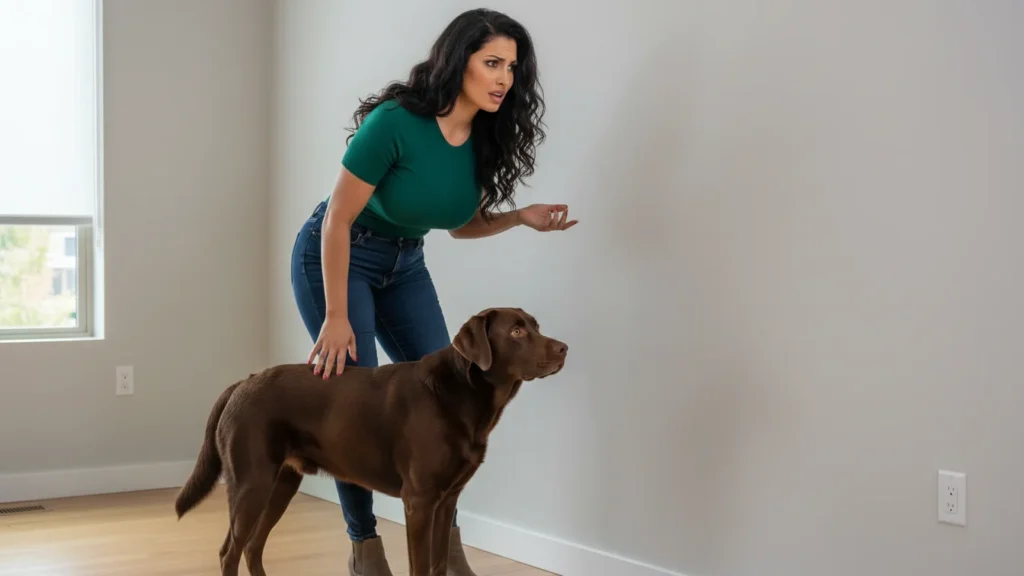
It usually happens when the house is quiet. You look over, and your dog is sitting completely still, their nose just inches from a blank wall or wedged deep into a corner of the room. They aren’t moving. They aren’t blinking.
Your first thought might be to joke about them seeing a ghost. Your second thought is usually a quiet, creeping sense of concern.
While it’s a quirky behavior that makes for great TikTok videos, veterinarians view wall-staring through a very different lens. Sometimes, it’s a completely harmless display of your dog’s incredible senses. Other times, it’s an early warning sign of a neurological or cognitive issue that requires your attention.
Here is exactly what is going on in your dog’s head when they lock eyes with the drywall, and how to know when it’s time to call the vet.
1. They Hear Something You Can’t
Before you panic about your dog’s health, consider their anatomy. A dog’s hearing is remarkably more sensitive than a human’s—they can hear frequencies ranging from 40 to 60,000 Hz, while we top out around 20,000 Hz.
If your seemingly healthy dog is intensely focused on a specific patch of drywall, they are likely tracking something moving behind it. Termites, mice, a wasp trapped in the wall cavity, or even water shifting through pipes can sound like a rock concert to your dog.
The Test: Can you easily distract them? If you say the word “walk” or shake a treat bag and your dog instantly breaks their gaze and bounds over to you, their brain is working perfectly fine. They were just eavesdropping on the local wildlife.
2. Canine Cognitive Dysfunction (Dog Dementia)
If you have a senior dog (usually over the age of 9) who begins staring blankly at walls, veterinarians immediately look for Canine Cognitive Dysfunction Syndrome (CCDS). This is the canine equivalent of Alzheimer’s disease.
As protein deposits build up in an aging dog’s brain, their spatial awareness and memory begin to fail. A dog with CCDS isn’t actually “staring” at the wall—they are lost. They walk into a corner, become deeply disoriented, and literally forget how to reverse or turn around.
Signs it might be Dementia: Along with staring at walls or getting “stuck” behind furniture, dogs with CCDS often pace endlessly at night, have sudden potty accidents indoors, or fail to recognize familiar family members.
3. Focal Seizures (The “Invisible” Seizure)
When we hear the word “seizure,” we picture a dog falling to the floor and convulsing. That is a generalized (grand mal) seizure. However, dogs can also suffer from focal seizures, which only affect a small portion of the brain.
During a focal seizure, a dog might sit completely rigid and stare into space. Some dogs will rhythmically snap at the air (often called “fly-biting”). During this episode, the brain is essentially short-circuiting.
The Test: Unlike a dog listening to a mouse in the wall, a dog having a focal seizure cannot be distracted. If you call their name, wave a hand in front of their face, or offer a high-value treat and they remain completely unresponsive, you are likely witnessing a neurological event.
4. Vision Loss and “Floaters”
Just like humans, aging dogs can develop a variety of eye issues, including cataracts, glaucoma, and Progressive Retinal Atrophy (PRA).
As a dog’s vision degrades, they may start to see shadows, specks of light, or “floaters” drifting across their field of vision. A dog staring intently at a blank wall might actually be tracking a visual artifact caused by a degrading retina.
5. The Red Flag: Head Pressing
There is a massive medical difference between a dog looking at a wall and a dog pressing against it.
If your dog stands with their physical skull pressed firmly against a wall, door, or piece of furniture, this is a medical emergency. Head pressing is a classic neurological symptom of severe trauma to the nervous system. It can be caused by:
- Hepatic Encephalopathy: Severe liver disease or a liver shunt allows toxins (like ammonia) to bypass the liver and flood the brain.
- Brain Tumors: Growths putting intense physical pressure on the brain.
- Toxin Exposure: Ingestion of severe poisons, including certain types of mold or heavy metals.
If you see your dog pressing their head against a hard surface, bypass Google and take them to an emergency veterinary clinic immediately.
Actionable Steps: What to Do Next
If your dog has started staring at walls, you need to play detective before heading to the vet. Use this checklist to gather the right information:
- Check for Triggers: Listen closely to the wall. Do you hear scratching or water?
- The Distraction Test: Call their name enthusiastically. If they snap out of it immediately, they are likely fine. If they are locked in a trance, take note.
- Record a Video: Veterinarians rely heavily on video evidence. If your dog is stuck in a corner or staring blankly, pull out your phone and record a 30-second video of the behavior, including your attempts to distract them.
- Schedule a Senior Panel: If your dog is over the age of 8, book a vet appointment for a neurological exam and a blood panel to check liver function and screen for CCDS.
Your dog’s bizarre habits are their only way of communicating with you. By paying close attention to the context of their staring, you can figure out whether you need to call a pest control expert—or your veterinarian.
High-Authority Sources & Veterinary References
To ensure the safety and health of your pet, the information in this article is grounded in established veterinary science. For further reading, consult these trusted resources:
- American Kennel Club (AKC): Clinical signs and management of Canine Cognitive Dysfunction (Dog Dementia).
- Cornell University College of Veterinary Medicine: Neurological disorders and recognizing Seizures in Dogs.
- PetMD (Authored by DVMs): The critical difference between staring and the emergency symptom of Head Pressing in Dogs.
- Veterinary Information Network (VIN): In-depth clinical breakdown of Hepatic Encephalopathy and Neurological Symptoms.

Dr. Sofia Romano, DVM, is an experienced veterinarian specializing in small-animal medicine and preventive care. She has treated thousands of cases using evidence-based diagnostics and modern clinical practices. Dr. Romano is dedicated to providing science-backed pet-health guidance that helps owners make informed decisions and improve their pets’ quality of life.




Pingback: Why Senior Dogs Act Confused — Early Dementia Warning Signs Most Owners Miss