A dog that starts limping after a run may have a minor paw injury or muscle strain. But a sudden limp can also signal a torn ligament, a fracture, a painful joint problem, or an injury that is not visible from the outside.
The difficulty is that how badly a dog limps does not always tell you exactly how serious the underlying problem is. Some dogs continue walking despite significant pain, while others may briefly favor a leg after a relatively minor injury.
For pet owners, the most useful question is not simply what caused the limp. It is whether the dog needs emergency treatment, a veterinary appointment today, or a short period of restricted activity and observation.
When Is a Limping Dog an Emergency?
Certain situations are too serious to monitor at home. Contact an emergency veterinary hospital immediately if your dog has an obvious fracture, cannot stand or walk without assistance, or begins limping after major trauma, such as being struck by a vehicle or attacked by a much larger animal. These situations may involve injuries beyond the affected leg.
Severe pain, substantial bleeding, a serious open wound, or a limb that looks visibly deformed also warrants urgent veterinary assessment. Do not attempt to straighten a leg, push a joint back into place, or apply a makeshift splint.
Pay attention to what your dog can do comfortably. A dog that is still walking on three legs may not need the same emergency transport as one that cannot stand at all, but refusing to put weight on a limb is not a sign to ignore. Contact a veterinarian or urgent-care service promptly rather than waiting overnight to see what happens.
Seek emergency help rather than continuing to observe your dog if the limp accompanies collapse or a sudden, profound loss of the ability to move or stand.
When Can You Briefly Monitor a Limp at Home?
Short-term observation may be reasonable when all of the following are true:
- The limp is mild, and your dog can still put weight on the affected leg.
- Your dog is comfortable at rest and is otherwise behaving normally.
- There is no obvious deformity, significant swelling, bleeding, or serious wound.
- There was no major accident or other significant trauma.
- The limp improves quickly rather than remaining unchanged or becoming worse.
Even in this situation, observation should mean rest and careful monitoring, not allowing your dog to resume normal exercise to see whether the problem has disappeared.
Keep your dog on a leash for bathroom breaks and prevent running, jumping, rough play, and unnecessary stair climbing. If the limp returns, worsens, or does not clearly resolve, contact your veterinarian. For a newly developed limp that continues after a brief period of rest, veterinary urgent-care guidance recommends assessment rather than prolonged observation.
There is no single waiting period that is appropriate for every dog. A mild, rapidly resolving limp is different from sudden, persistent pain or an inability to use the leg normally.
If you are unsure how serious the limp is, calling your veterinary practice for triage is safer than relying on a fixed number of hours.
Why Is My Dog Limping? Common Possibilities
Limping, also called lameness, describes a change in how a dog stands, walks, or bears weight. It is a clinical sign, not a diagnosis. Several different conditions can produce a similar-looking gait.
A problem with the paw or nails
Sometimes the source is lower down than owners expect. A torn nail, cut paw pad, thorn, splinter, or small foreign object between the toes can make a dog reluctant to place the foot on the ground.
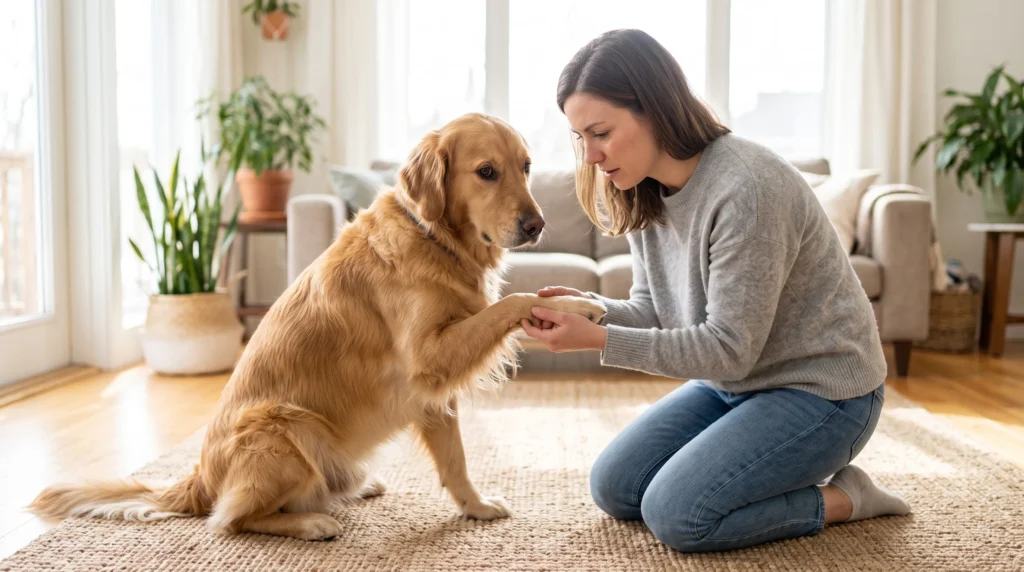
If your dog allows it, look at the paw in good light. Check the pads, nails, and spaces between the toes for an obvious injury or visible object. However, avoid probing a wound or pulling out anything deeply embedded. Stop if your dog appears painful or defensive.
A muscle strain or soft-tissue injury
Running, jumping, slipping on a smooth floor, or landing awkwardly may injure muscles, tendons, or ligaments. These injuries can cause pain without leaving a visible mark on the skin.
A dog may initially limp only slightly, making a minor strain seem likely. But similar symptoms can occur with more substantial soft-tissue damage, so the appearance of the limp alone cannot confirm the diagnosis.
A joint or bone injury
Fractures, dislocations, ligament injuries, and developmental or other joint disorders can all affect walking. Some cause obvious swelling or an unusual limb position; others are less apparent.
A dog with a knee ligament injury, for example, may still attempt to walk while putting less weight on the affected leg. Continuing to bear some weight does not reliably rule out an important injury.
Arthritis or another ongoing condition
Limping is not always the result of a single accident. Dogs with osteoarthritis may show stiffness after resting, move more slowly, hesitate before jumping, or become less willing to take long walks. Their mobility may vary from one day to another.
It is tempting to interpret these changes as an inevitable part of ageing. However, reduced mobility can indicate pain that deserves assessment and management.
A problem involving the nerves or spine
Not every abnormal gait originates in a paw, muscle, bone, or joint. Spinal and neurological problems can affect limb movement and coordination. A dog that drags a paw, knuckles over its toes, or appears weak or uncoordinated may need a different assessment from a dog with a straightforward painful limb.
The same principle applies across all these possibilities: identifying which leg looks affected is useful, but it does not establish what is wrong.
What Should You Do Before Your Dog Sees a Vet?
The safest first step is to reduce movement and gather useful information without trying to diagnose the injury yourself.
1. Restrict activity. Keep your dog in a quiet area and use short, controlled leash walks for bathroom breaks. Avoid running, jumping, playing fetch, and testing the leg repeatedly. Restricting activity can reduce further strain while you arrange appropriate care.
2. Look, but do not force an examination. If your dog is calm and comfortable, visually inspect the paw pads, nails, and spaces between the toes. Do not force a painful leg to bend, massage a swollen joint, or attempt to manipulate the affected limb. A dog in pain may bite unexpectedly, even if it is normally gentle.
3. Take a short video if it is safe. A brief recording of your dog walking naturally on a level surface may help your veterinarian assess the gait, particularly if the limp becomes less noticeable before the appointment. Do not make your dog walk or trot for the sake of getting footage. Veterinary lameness assessments use gait observation alongside a physical examination, and video can be helpful when direct observation is limited.
4. Note when the problem started. Was the limp sudden or gradual? Did you notice it after exercise, a fall, or a jump? Is your dog keeping the foot off the ground, or simply taking shorter steps? Also note any swelling, changes in appetite or behaviour, and whether the limp becomes more apparent after rest.
These observations can help your veterinarian distinguish among possible causes, although they cannot replace an examination.
5. Do not give human pain medication. Medicines such as ibuprofen and naproxen can cause serious adverse effects in dogs, including damage to the digestive tract and kidneys. Acetaminophen can also be harmful. Do not give human pain relievers, leftover medication, or another pet’s prescription unless your veterinarian specifically instructs you to do so.
When Should You Book a Veterinary Appointment?
Not every limp requires an emergency hospital, but persistent or recurring lameness deserves attention.
Arrange prompt veterinary assessment when your dog continues to limp after a brief period of rest, repeatedly favours the same leg, develops swelling, or shows signs of pain when moving. Seek same-day advice for sudden or persistent limping, particularly if your dog is not bearing weight normally.
If the limp is accompanied by severe pain, a serious wound, or an obvious structural injury, the need for immediate assessment becomes more pressing. Major trauma or an inability to stand or walk without assistance warrants emergency care.
An examination may involve watching your dog stand and walk, assessing the limbs and joints, and reviewing the history of the problem. Depending on the findings, the veterinarian may recommend X-rays or other diagnostic tests. The appropriate investigation depends on the suspected source of the lameness; not every dog requires the same tests.
If an older dog has gradually become less active, or a younger dog develops recurring lameness, avoid assuming the change is simply age-related or a temporary strain. A veterinary assessment can help identify treatable causes and guide an appropriate plan.
The Most Important Clue Is How the Limp Changes
A limp is useful information, but it is not a reliable measure of the injury’s full severity. A dog that can still walk may have an important ligament or joint injury, while a mild, short-lived limp may settle with rest.
The safest decision comes from considering the entire picture: whether the dog can bear weight, how suddenly the problem began, whether pain persists, whether other signs are present, and whether normal movement returns.
Brief observation is appropriate only for a genuinely mild problem that resolves quickly. When the limp persists, returns, worsens, or prevents normal use of the leg, veterinary advice should take priority over waiting for it to disappear.
Sources
1. Merck Veterinary Manual — Lameness in Dogs. Pet-owner guidance on lameness, examination, diagnosis, and pain management. Last updated December 2025. https://www.merckvetmanual.com/dog-owners/bone-joint-and-muscle-disorders-of-dogs/lameness-in-dogs
2. Merck Veterinary Manual — Overview of Lameness in Small Animals. Veterinary reference covering the assessment of abnormal gait, musculoskeletal conditions, and neurological causes. Last updated May 2026. https://www.merckvetmanual.com/musculoskeletal-system/lameness-in-small-animals/overview-of-lameness-in-small-animals
3. VCA Animal Hospitals — Urgent Care for Pain or Limping. Guidance distinguishing urgent veterinary assessment from emergency care for limping pets. https://vcahospitals.com/urgent-care/health-concerns/pain-or-limping
4. PDSA — Limping and Stiffness in Dogs. Veterinary charity guidance on common causes, symptoms, and when to contact a veterinarian. Published July 2019. https://www.pdsa.org.uk/pet-help-and-advice/pet-health-hub/symptoms/limping-and-stiffness-in-dogs
5. U.S. Food and Drug Administration — Get the Facts About Pain Relievers for Pets. Official guidance explaining the potential risks of human pain relievers and the importance of veterinary advice. https://www.fda.gov/animal-veterinary/animal-health-literacy/get-facts-about-pain-relievers-pets

Dr. Sofia Romano, DVM, is an experienced veterinarian specializing in small-animal medicine and preventive care. She has treated thousands of cases using evidence-based diagnostics and modern clinical practices. Dr. Romano is dedicated to providing science-backed pet-health guidance that helps owners make informed decisions and improve their pets’ quality of life.