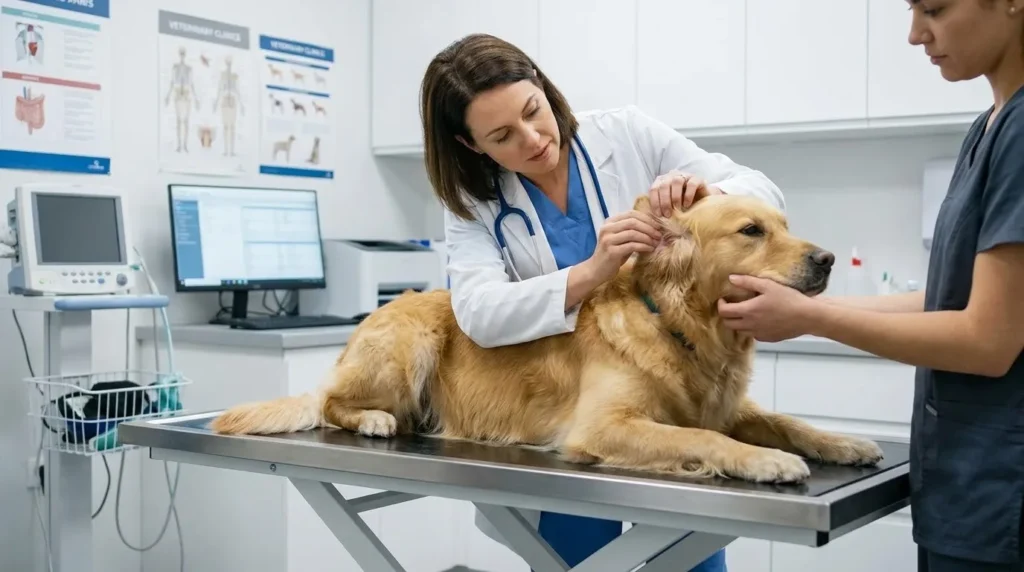
Before a veterinarian listens to your dog’s heart, checks its ears, or reaches for a stethoscope, the examination has often already begun.
A dog walking into the consultation room offers useful clues through its posture, breathing, movement, alertness, and behavior. A veterinarian may notice whether the dog rises comfortably, favors a leg, struggles to settle, or appears unusually withdrawn. These observations can help guide what deserves closer attention during the physical examination.
The phrase first 10 seconds is a way of describing these early observations, not a fixed clinical rule. Every dog is different, and no veterinarian can determine its overall health from a brief glance. However, observing an animal before touching it is a recognized part of veterinary examination, and it can reveal details that become less apparent once the animal is being handled.
Here is what those first moments can tell a veterinarian—and what they cannot.
1. Your Dog’s Breathing
Breathing is one of the first things a veterinarian may observe, especially if the dog seems uncomfortable or unwell.
The veterinarian looks at the rate, rhythm, and effort of breathing. Is the chest moving comfortably? Does the abdomen appear to be working unusually hard? Is the dog panting despite resting in a reasonably cool environment?
These details matter because breathing can change with excitement, anxiety, heat, pain, and illness. Panting alone does not establish that a dog has a medical problem, particularly when the animal has just arrived after a car journey or an energetic walk.
The pattern and context make the difference.
A dog that is panting but gradually settling may simply be excited or nervous. A dog that appears unable to get comfortable, stretches its neck to breathe, or uses pronounced abdominal effort needs closer assessment.
Labored breathing is not something to watch casually at home. If your dog is struggling to breathe, seek emergency veterinary care immediately. Do not wait to see whether the breathing settles.
During a routine appointment, early observation of breathing can also give the veterinarian a useful baseline before excitement or handling changes the dog’s normal resting pattern.
2. How Your Dog Walks, Stands, and Sits
Movement can reveal problems that are difficult to spot when a dog is standing still.
As a dog enters the room, the veterinarian may watch for an uneven stride, stiffness, reluctance to turn, shortened steps, or an apparent preference for one leg. They may also notice whether the dog sits smoothly, struggles to stand, or repeatedly shifts its weight.
These observations can provide clues about pain, joint discomfort, muscle weakness, or a neurological problem affecting movement.
The distinction is important: an unusual gait does not identify its cause. A limp might involve a paw, muscle, joint, bone, or nerve. Further examination is needed to determine what is happening.
Some signs are subtle. A dog with chronic joint discomfort might continue walking without an obvious limp but move more cautiously, hesitate before sitting, or take longer to rise after lying down.
The American Animal Hospital Association’s pain-management guidance specifically recognizes posture, gait, and spontaneous behavior as useful parts of pain assessment, rather than relying exclusively on what a veterinarian finds by touching the animal.
For owners, this is one reason to mention small changes you have noticed at home—even when your dog still walks and plays.
3. Your Dog’s Alertness and Awareness
A veterinarian also pays attention to how a dog responds to its surroundings.
Does it appear alert and aware? Does it look toward people, explore the room, or respond in a way that seems typical for that individual dog? Is it unusually quiet, confused, restless, or difficult to engage?
A healthy dog does not necessarily have to be outgoing. Some dogs are naturally reserved, and others become fearful in unfamiliar surroundings. What matters is whether the dog’s behavior appears appropriate for its circumstances and consistent with what the owner knows about its normal personality.
A sudden change in alertness deserves more attention than a dog that has always been shy during veterinary visits.
Reduced responsiveness can have several explanations, ranging from fear and exhaustion to pain or systemic illness. A brief observation cannot distinguish among them, but it can help the veterinarian decide what to investigate next.
This is particularly valuable when an owner reports that a dog, usually active and interested in its surroundings, has recently become unusually quiet or difficult to engage.
4. Body Language That May Signal Fear or Pain
Dogs communicate a great deal through body posture and small behavioral changes. Veterinarians look beyond obvious signs such as growling, trembling, or trying to escape.
A dog may lick its lips repeatedly, turn its head away, lower its body, freeze in place, or become unusually still. Some dogs move closer to their owners, while others attempt to create distance.
These behaviors can indicate stress or discomfort, but none is specific to one emotional state or medical condition.
For example, lip licking can occur for several reasons, and a dog that freezes may be frightened rather than physically unable to move. Similarly, a dog that growls is communicating discomfort or a desire for distance; the behavior alone does not establish that it is aggressive by nature.
The AAHA Canine and Feline Behavior Management Guidelines describe a range of behavioral signs associated with anxiety and distress and emphasize the value of recognizing them during veterinary care.
Observing these signals helps the veterinary team choose an appropriate approach to handling the dog. A frightened animal may need more time, space, treats when suitable, or a low-stress examination strategy.
That is not merely a courtesy. Reducing fear can support safer handling and make the examination more informative.
5. Your Dog’s Overall Body Condition
A veterinarian may form an initial impression of body condition before touching the dog.
They might notice whether the waist is visible, whether the abdomen has a natural upward tuck, or whether the dog’s body appears unusually thin or rounded. Muscle definition and the prominence of certain bones may also attract attention.
These visual impressions are only the beginning. A proper body-condition assessment includes feeling the ribs and evaluating fat coverage, while a separate muscle-condition assessment helps identify muscle loss that might otherwise be overlooked.
Breed, coat thickness, body shape, and age all affect appearance. A naturally lean dog may have a different outline from a broad-chested breed, and a thick coat can conceal changes in body condition.
A rounded abdomen does not automatically mean obesity, either. Depending on the individual dog and the circumstances, abdominal enlargement can have explanations other than excess fat.
This is why veterinarians combine visual observation with hands-on examination, medical history, and weight measurements rather than relying on appearance alone.
6. The Condition of the Coat and Skin
The coat and visible skin can provide additional clues during the initial assessment.
A veterinarian may notice patchy hair loss, excessive scratching, redness, visible wounds, unusual discharge, or a coat that appears markedly different from what the owner describes as normal.
These findings can help guide questions about grooming, parasites, allergies, nutrition, medications, and recent changes in the dog’s environment.
However, the appearance of the coat does not tell the whole story. Some skin problems require closer inspection, skin sampling, or other diagnostic tests. A dog may also have an internal health problem without any obvious change in its coat.
The history matters here. A veterinarian may ask whether the change appeared suddenly or developed gradually, whether the dog is scratching, and whether the problem is limited to one area or affecting the body more generally.
You can help by mentioning changes even if they seem cosmetic. Persistent itching, unexplained hair loss, or recurrent skin irritation may warrant investigation beyond routine grooming.
7. Changes That Are Abnormal for That Particular Dog
Perhaps the most useful early observation is not a single physical feature, but whether something seems different from the dog’s usual state.
A young dog that is normally eager to explore but now refuses to move may deserve a different assessment from a dog that has always been cautious in unfamiliar places. An older dog that takes longer to stand may need a closer mobility assessment, especially if the change is new or progressing.
This is where the owner’s knowledge becomes essential.
Veterinarians see the animal during a short appointment. Owners see its everyday routines: how it gets out of bed, climbs stairs, plays, eats, drinks, and interacts with familiar people.
A brief description of a change can help the veterinarian interpret what they observe in the room.
Useful details include when the change began, whether it is getting worse, what seems to trigger it, and whether it occurs consistently or only in certain situations. If an unusual movement happens intermittently, a video recorded safely at home may help demonstrate what the veterinarian needs to assess.
No video or observation replaces an examination, but it can provide information that is difficult to reproduce in a clinic.
What Those First Moments Cannot Tell a Veterinarian
Early observations help establish what deserves attention, but they do not provide a diagnosis.
A dog that pants may be anxious, hot, excited, painful, or unwell. A dog that walks stiffly may have joint disease, a paw injury, muscle discomfort, or another problem. Even an animal that appears completely comfortable can have a condition that is not visible during an initial observation.
The veterinarian still needs to review the dog’s history and perform an appropriate physical examination. Depending on the findings, further investigation might include blood tests, imaging, or other diagnostic procedures.
Routine examinations also differ from emergency assessments. If a dog arrives with obvious breathing difficulty, collapse, or another immediately concerning sign, the veterinary team may prioritize rapid assessment and stabilization rather than proceed with the usual examination sequence.
How You Can Help Your Dog Get a Better Examination
You do not need to prepare your dog to behave perfectly at the veterinary clinic. Instead, make it easier for the veterinarian to understand what is normal for your pet.
Before the appointment, think about any recent changes in appetite, thirst, energy, sleep, mobility, toileting, or behavior. Mention changes even if they appear minor, particularly when they are new or persistent.
During the examination, let the veterinary team guide your dog’s positioning and handling. If your dog is frightened, say so rather than attempting to restrain it yourself. The team may be able to adjust the environment or examination approach to reduce stress.
You can also share short videos of unusual movements or behaviors that do not occur reliably at the clinic. Describe what you see rather than trying to diagnose the cause yourself.
These small details help connect what the veterinarian observes in a few minutes with what you have noticed over days or weeks.
Frequently Asked Questions
Can a veterinarian tell if my dog is sick just by looking at it?
A veterinarian may recognize visible abnormalities or signs that require immediate attention, but observation alone cannot determine every underlying cause. A history, physical examination, and sometimes diagnostic testing are needed to assess the dog’s health properly.
Why does my veterinarian watch my dog before touching it?
Observing movement, posture, breathing, alertness, and spontaneous behavior can provide information that may become less obvious once the dog is being handled. It can also help the veterinarian identify discomfort or fear and choose an appropriate examination approach.
Should I worry if my dog is nervous at the vet?
Not necessarily. Some dogs find unfamiliar places, smells, people, or handling stressful. Nervousness does not automatically mean that something is medically wrong, but it can affect examination findings. Tell the veterinary team about your dog’s behavior so they can adapt the visit when appropriate.
What should I tell my vet if my dog seems different?
Describe the specific change, when it began, how often it happens, and whether it is becoming more noticeable. Changes in mobility, breathing, appetite, energy, or behavior can help guide the assessment. If your dog has severe breathing difficulty, collapses, or becomes unable to stand, seek emergency veterinary care rather than waiting for a routine appointment.
The Examination Begins Before the First Touch
Those first moments are valuable because a dog does not need to be placed on an examination table for a veterinarian to begin gathering information. Its breathing, movement, posture, alertness, and behavior can all help shape the next steps.
But experienced assessment is not about drawing a sweeping conclusion in 10 seconds. It is about noticing useful details, interpreting them in context, and deciding what needs a closer look.
For owners, the most helpful contribution is often knowing what has changed. Your observations at home, combined with the veterinarian’s examination, provide a fuller picture than either one could offer alone.
Sources
- University of Guelph, Clinical Medicine 1: Small Animal Clinical Skills Textbook. General Observational Examination. Explains the role of distant observation and the assessment of alertness, posture, gait, behavior, coat, body condition, and breathing. https://books.lib.uoguelph.ca/vetm3430/chapter/3-1-general-observational-distance-examination/
- American Animal Hospital Association (AAHA). Guiding Principles of Pain Assessment. 2022 AAHA Pain Management Guidelines for Dogs and Cats. Discusses the significance of posture, gait, behavior, and observations made before and during physical handling. https://www.aaha.org/resources/2022-aaha-pain-management-guidelines-for-dogs-and-cats/guiding-principles-of-pain-assessment/
- American Animal Hospital Association (AAHA). Incorporating Behavioral Assessments Into Every Examination. May 10, 2019. Describes behavioral assessment and common signs of fear and distress in dogs and cats. https://www.aaha.org/resources/2015-aaha-canine-and-feline-behavior-management-guidelines/incorporating-into-examinations/
- American Animal Hospital Association (AAHA). Canine Life Stage Guidelines. Provides recommendations for comprehensive canine examinations, including vital signs, nutritional assessment, and evaluation of gait and other clinical findings. https://www.aaha.org/globalassets/02-guidelines/canine-life-stage-2019/2019-aaha-canine-life-stage-guidelines-final.pdf
- Merck Veterinary Manual. Initial Triage and Resuscitation of Small Animal Emergency Patients. Covers assessment of breathing difficulty and other important findings in emergency patients. https://www.merckvetmanual.com/emergency-medicine-and-critical-care/evaluation-and-initial-treatment-of-small-animal-emergency-patients/initial-triage-and-resuscitation-of-small-animal-emergency-patients

Dr. Sofia Romano, DVM, is an experienced veterinarian specializing in small-animal medicine and preventive care. She has treated thousands of cases using evidence-based diagnostics and modern clinical practices. Dr. Romano is dedicated to providing science-backed pet-health guidance that helps owners make informed decisions and improve their pets’ quality of life.