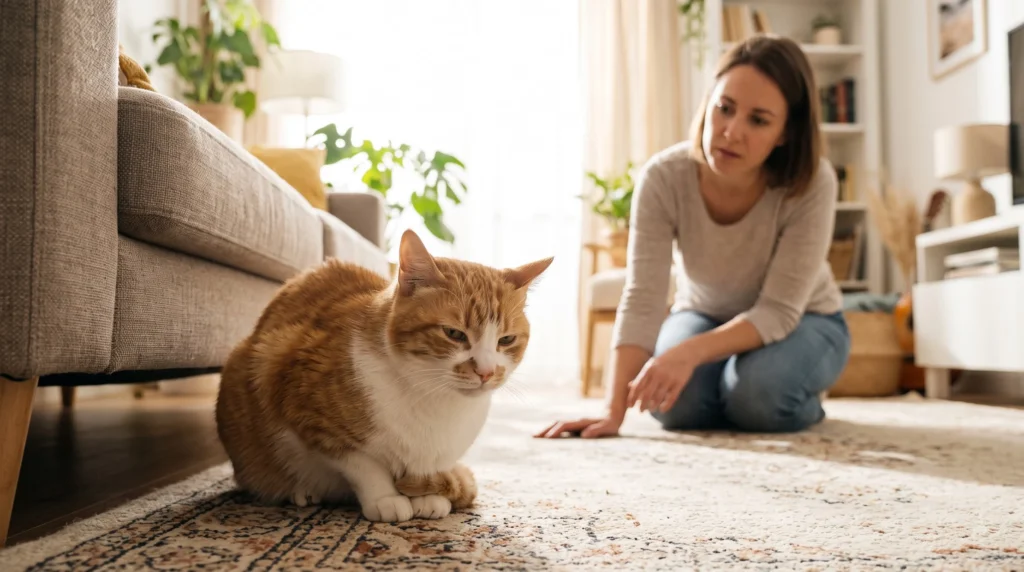
Your cat is eating, using the litter tray, and walking around the house. Nothing seems obviously wrong. Yet lately, they have stopped jumping onto their favourite windowsill, spend more time alone, or become unusually irritated when you stroke their back.
These changes are easy to dismiss. Cats can be independent, sleep for long periods, and occasionally prefer solitude. But a change in familiar behaviour can also be one of the earliest clues that a cat is uncomfortable.
Cats in pain do not always cry, limp, or resist being touched. Often, the first clues are changes in how they move, interact, groom themselves, eat, or use their surroundings. Veterinary guidance emphasizes observing these behavioural changes, particularly when pain is chronic or develops gradually.
The challenge is not to interpret every unusual behaviour as a medical problem. It is to recognize when a change is persistent, unusual for your cat, or accompanied by other signs that deserve attention.
Why Cats Can Have Pain Without Showing Obvious Signs
Cats communicate differently from people. They cannot explain where something hurts, how severe the discomfort is, or whether a particular movement makes it worse. Their outward behaviour may reveal very little unless you know what is normal for them.
Their natural response to vulnerability also matters. Cats may withdraw, become less active, or avoid interactions when they are unwell. These responses can make illness or injury less obvious to an owner.
However, it would be misleading to assume every cat deliberately conceals pain. The more useful clinical point is that pain in cats may produce subtle changes rather than dramatic reactions. These changes can be mistaken for stress, ageing, pickiness, or a shift in personality.
Chronic pain can be particularly difficult to recognize because it may develop gradually. A cat that has become less willing to jump over several months may simply appear to have settled into a quieter routine. Yet reduced jumping, increased isolation, and declining activity can occur in cats with painful joint conditions, including osteoarthritis.
This is why a cat’s usual habits provide such valuable information. An isolated behaviour may mean little; a meaningful change from the cat’s own baseline can tell a different story.
The Subtle Signs of Pain Cat Owners Often Miss
1. Hiding more than usual
A cat that has always slept under the bed may simply be following its normal preference. The concern arises when a normally sociable cat suddenly starts spending most of the day behind furniture, avoids familiar people, or stops appearing during routines it once enjoyed.
Withdrawal can accompany pain, illness, or fear. It is not specific enough to identify the cause, but a new pattern of hiding is a reason to look more closely, particularly if it occurs alongside changes in appetite, mobility, or grooming.
Do not repeatedly pull a hiding cat out of its safe place to inspect it. Instead, observe whether it is eating, drinking, using the litter tray, and moving normally when undisturbed.
2. Jumping less, climbing cautiously, or moving stiffly
This is one of the easiest changes to overlook because it can happen gradually.
Your cat may begin jumping onto a chair instead of a high shelf, hesitate before climbing stairs, use intermediate surfaces to reach a windowsill, or stop jumping altogether. You may also notice stiffness after sleeping or difficulty getting comfortable when lying down.
These changes can be associated with painful joints or other mobility problems. Cats do not necessarily develop an obvious limp, even when their movement has become uncomfortable.
Notice how your cat gets around the home rather than testing its physical abilities. Repeatedly encouraging a reluctant cat to jump will not help establish whether pain is present.
3. Changes in grooming and coat condition
Grooming is part of a cat’s normal daily routine, so changes in it can provide useful clues.
A painful cat may groom less because movement is uncomfortable or because it feels unwell. The coat may become greasy, unkempt, or matted, especially over areas the cat can no longer reach easily.
The opposite can also happen. Repeated licking or chewing at one specific area may signal local pain, irritation, or another skin problem. Overgrooming is not proof of pain, but it should not automatically be attributed to a behavioural issue.
The distinction is between ordinary grooming variation and a noticeable shift in the cat’s usual pattern.
4. Irritability that seems to come out of nowhere
A previously affectionate cat may begin moving away when touched, swatting when picked up, or reacting defensively when someone strokes a particular part of its body.
Owners sometimes interpret this as a change in temperament. But discomfort can make familiar interactions unpleasant, especially when handling puts pressure on a painful area.
Dental disease, joint pain, abdominal discomfort, and other conditions may produce different behavioural responses. A cat that resists being touched does not necessarily have an injury at the spot where it reacts, and the cause cannot be established from behaviour alone.
Avoid punishing the behaviour or forcing contact. Record what happens, what type of touch or movement precedes it, and whether the reaction is new.
5. Eating differently, even without refusing food
A cat does not have to stop eating altogether for a change in health to become apparent.
Watch for a cat that approaches food but walks away, eats smaller amounts, chews differently, drops food from its mouth, or becomes hesitant about lowering its head toward a bowl. These changes may accompany dental or oral pain, nausea, or other illness.
A particularly deceptive sign is a cat that continues to eat despite oral discomfort. According to the AAHA’s 2026 guidance on recognizing feline pain, cats with significant dental disease may continue eating while displaying less obvious changes, such as scooping food from the dish before eating.
A persistent or marked reduction in food intake deserves prompt veterinary advice. Do not assume a cat is merely fussy if its appetite has changed, especially when other symptoms are present.
6. Litter-box habits that suddenly change
Changes in toileting can reflect several different problems, including urinary disease, constipation, discomfort with movement, or difficulty accessing the litter tray.
Your cat may enter the tray repeatedly, strain, vocalize, pass small amounts of urine, defecate outside the tray, or appear uncomfortable while squatting. A cat with mobility problems may also find a high-sided tray harder to enter.
The important distinction is that a litter-box problem should not automatically be treated as a behavioural problem. Medical causes need to be considered before assuming that a cat is avoiding the tray out of dislike or stress.
Repeated attempts to urinate with little or no urine coming out are an emergency, not a reason to wait for a routine appointment. Urinary obstruction can become life-threatening without immediate treatment, and male cats are at greater risk because of their narrower urethra.
7. A different sleeping position or a tense facial expression
A relaxed cat often rests with a loose body and a comfortable posture. A cat experiencing pain may instead remain hunched, keep its head lowered, appear unusually tense, or repeatedly change position as it tries to get comfortable.
The face can offer additional clues. The Feline Grimace Scale, developed at the Université de Montréal, assesses five facial features associated with acute pain:
- Ears: rotated outward or flattened.
- Eyes: narrowed or partly closed.
- Muzzle: appearing tense rather than relaxed.
- Whiskers: becoming straighter or more forward-pointing.
- Head position: held lower than usual, relative to the shoulders.
These features are useful because pain is not always accompanied by vocalization or limping. However, the scale is an assessment aid, not a diagnosis. Facial appearance can also be influenced by sleepiness, fear, and the circumstances in which the cat is observed. It should be interpreted in context rather than used to decide that a cat is healthy or ill based on one photograph.
8. Purring, silence, or unusual vocalization
Purring is often associated with contentment, but it does not prove that a cat is comfortable. Some cats may purr when distressed or in pain, so the sound needs to be interpreted alongside posture, behaviour, and other signs.
Likewise, the absence of crying is not reassuring by itself. Other cats may become more vocal, growl, hiss, or make sounds while moving or using the litter tray.
Pay attention to changes from your cat’s normal communication style. A normally quiet cat that starts vocalizing repeatedly, or a vocal cat that becomes unusually withdrawn, may be signalling that something has changed. Neither pattern identifies a specific condition, but both can help guide a veterinary assessment.
When Should You Contact a Veterinarian?
Not every behavioural change is caused by pain. Stress, environmental changes, fear, and non-painful illnesses can produce similar signs. What matters is the nature of the change, how long it has been happening, and whether additional symptoms appear.
Arrange a veterinary appointment promptly
Contact your veterinarian if your cat develops persistent hiding, reduced grooming, new irritability, stiffness, reluctance to jump, a change in eating habits, or altered litter-box behaviour. Recurring or gradually worsening changes are particularly important, even when your cat still appears active.
Seek same-day veterinary advice
Contact a veterinarian promptly for a marked reduction in food intake, persistent vomiting, obvious discomfort, sudden weakness, a painful-looking eye, or a sudden change in normal behaviour accompanied by other signs of illness. The urgency depends on the cat’s condition, age, medical history, and the symptoms involved.
Seek emergency veterinary care immediately
Difficulty breathing, collapse, major trauma, seizures, severe or rapidly worsening pain, or an inability to pass urine require emergency assessment. Repeated straining in the litter tray with little or no urine is especially urgent. Do not wait for other signs to develop.
A cat that hides more, sleeps longer, or becomes less playful may not need emergency treatment, but a new or persistent change should not be dismissed simply because it seems mild. Early veterinary assessment can help identify a problem before more obvious signs appear.
How to Recognize Changes Before They Become Obvious
You do not need to examine your cat like a veterinarian to notice useful clues. The most effective approach is to become familiar with your cat’s ordinary behaviour and observe what changes over time.
Pay attention to your cat’s normal routine
Notice whether your cat usually greets you, follows you around the house, jumps onto favourite surfaces, finishes meals, grooms after sleeping, or uses the litter tray in a predictable way.
These everyday patterns form a baseline. If several of them change together, the pattern may be more informative than any one sign.
Keep a simple record
When you notice something unusual, record when it began, how often it occurs, and whether it is getting better or worse. Note changes in food intake, water consumption, litter-box activity, movement, grooming, and social interaction.
Short videos can be particularly useful for changes in gait, jumping, posture, or interactions at home. The AAHA’s feline pain guidance recommends sharing photographs and videos with the veterinary team because behaviour observed at home may not be reproduced during a clinic examination.
Do not deliberately provoke a painful response to obtain a recording.
Make the journey to the vet less stressful
If your cat is painful or frightened, avoid forcing unnecessary handling. Use a secure carrier, keep the environment as calm as possible, and contact the practice for advice on transporting a distressed cat.
Never give human pain medication or leftover prescriptions without specific veterinary instructions. Paracetamol, also called acetaminophen, and ibuprofen can cause severe illness or death in cats. A veterinarian needs to select appropriate pain relief based on the individual animal and the suspected cause.
Why Older Cats Deserve Particular Attention
Ageing can make pain easier to overlook. An older cat that sleeps more, climbs less, or avoids jumping may appear to be adjusting naturally to a slower pace of life.
Sometimes that interpretation is correct. But arthritis and other health problems can also change mobility and daily behaviour. Cats with chronic joint pain may gradually adapt their routines, leaving owners to notice the difference only when they compare current habits with those from months earlier.
Do not assume that reduced activity is inevitable or untreatable simply because a cat is older. A veterinary assessment can help determine whether pain is involved and whether medication, environmental adjustments, or other management options may improve comfort.
This principle applies to younger cats, too. Age alone should not be used to explain away a persistent behavioural change.
The Most Useful Question to Ask Yourself
When your cat starts behaving differently, it is tempting to ask whether the behaviour is normal. A more useful question is: Is this normal for my cat?
A cat that has always preferred quiet corners may be behaving exactly as expected. A cat that suddenly withdraws from family life, stops jumping, grooms less, or reacts painfully to familiar handling is giving you a different kind of information.
No single sign confirms pain, and not every change signals a serious condition. However, persistent changes deserve attention, and certain symptoms require immediate treatment.
You do not have to identify the cause yourself. Your role is to notice the change, recognize when it matters, and share what you have observed with a veterinarian. For cats, those small observations can be an important part of recognizing pain that might otherwise go unnoticed.
Sources
1. AAHA — Signs of Pain in Cats: How to Tell If Your Cat Is Hurting. By Liz Devitt, DVM. Published February 27, 2026. Discusses behavioural changes, subtle pain signs, chronic pain, and the value of home observations.
2. International Society of Feline Medicine — 2022 ISFM Consensus Guidelines on the Management of Acute Pain in Cats. Published in the Journal of Feline Medicine and Surgery in 2022. Provides evidence-based guidance on recognizing, assessing, and managing acute feline pain.
3. Cornell University College of Veterinary Medicine — Is Your Cat Slowing Down?. Explains how reduced activity and withdrawal can be associated with joint pain in cats.
4. Cats Protection — Signs of Pain in Cats. Veterinary-reviewed educational guidance on behavioural, mobility, grooming, appetite, and other possible pain indicators.
5. Université de Montréal — Feline Grimace Scale. A validated tool for assessing acute pain using changes in five facial action units.
6. Cornell University College of Veterinary Medicine — Feline Lower Urinary Tract Disease. Explains urinary symptoms and why suspected urethral obstruction requires immediate veterinary attention.
7. International Cat Care — Treating Chronic Pain with NSAIDs: Cat Carer Guide. Guidance on veterinary-directed pain medication and the risks of human pain relievers in cats.

Dr. Sofia Romano, DVM, is an experienced veterinarian specializing in small-animal medicine and preventive care. She has treated thousands of cases using evidence-based diagnostics and modern clinical practices. Dr. Romano is dedicated to providing science-backed pet-health guidance that helps owners make informed decisions and improve their pets’ quality of life.