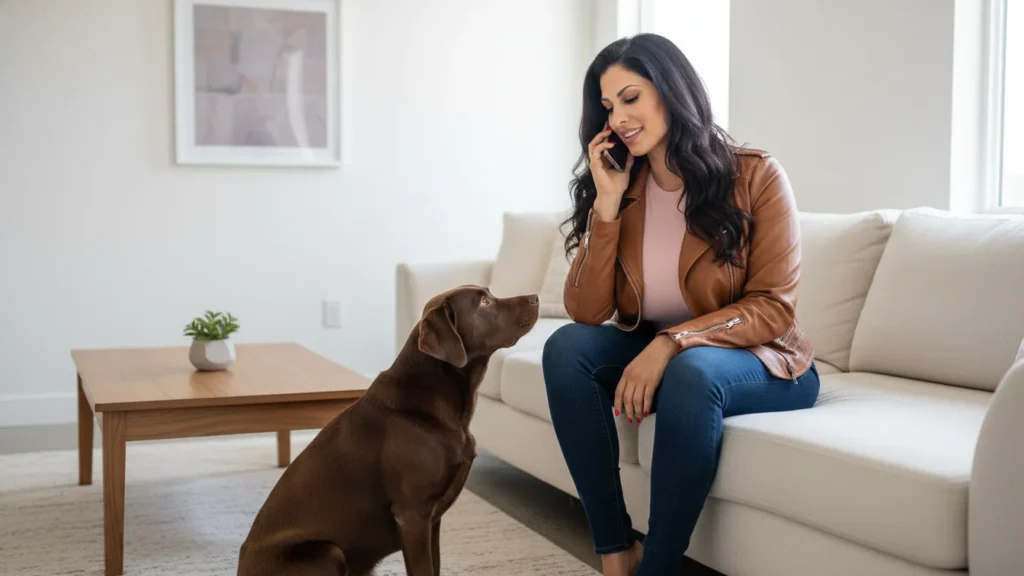
You pick up the phone, say “hey, how’s it going,” and settle into your call — and within seconds, your dog is up. Ears forward. Eyes on you. Maybe pacing a little, maybe letting out a low huff, maybe just staring like you’ve suddenly become the most interesting thing in the room.
You weren’t yelling. You weren’t excited. To you, it was just a normal conversation. So why does your dog react like something’s happening?
Turns out, from your dog’s point of view, something is happening — they just can’t make sense of it the way you can, and that gap is exactly what puts them on alert.
Your Dog Is Hearing Half a Conversation
When you talk to someone in the room, your dog gets the full picture: your tone, the other person’s tone, body language, context, resolution. It’s a complete social event, and dogs are remarkably good at reading the emotional temperature of a room.
A phone call breaks that entirely. Your dog hears your voice — your tone shifting, your pace changing, maybe laughing, maybe going quiet and serious — but none of the other half. No visible person to match the voice to. No body language to explain the tone. No back-and-forth they can visually track.
Dogs rely heavily on multimodal cues — voice, posture, facial expression, and context together — to understand what’s happening in a social interaction, according to canine cognition researchers. A phone call strips most of that away and leaves your dog with an incomplete, slightly confusing signal: your voice is doing something, but the reason isn’t visible anywhere in the room.
That ambiguity itself is enough to trigger alertness. It’s not that your dog thinks something is wrong — it’s that their normal method of “reading the room” isn’t giving them enough information, so their nervous system defaults to paying closer attention until it resolves.
Tone of Voice Matters More Than Words
Dogs don’t understand most of what we say, but they are extraordinarily sensitive to how we say it. Studies using canine brain imaging have found that dogs process emotional tone of voice in a region of the brain similar to where humans process vocal emotion, and they respond differently to happy, neutral, and stern intonations regardless of the actual words used.
Phone conversations often involve exaggerated tonal shifts — a brighter, more animated “customer service voice,” a flatter and more clipped tone during a difficult call, laughter that comes in sudden bursts, or a serious, lowered voice during a tense conversation. These shifts, especially when they happen without any visible triggering event, can read to a dog as unpredictable emotional signal — worth monitoring closely, even if nothing is actually wrong.
The One-Sided Rhythm Feels Unnatural
Normal conversation has a rhythm dogs have learned to recognize: one person talks, pauses, the other responds, and so on. It’s a rhythm they’ve absorbed simply by living around us.
A phone call breaks that rhythm from their perspective. They hear you talk, then silence — but no visible response from anyone. Then you talk again, sometimes reacting to something (laughing, sighing, changing subject) that seemingly comes from nowhere. To a dog watching without access to the other end of the line, this can look like you’re reacting to invisible cues, which is exactly the kind of pattern-breaking event that draws sustained attention from an animal whose survival strategy depends on noticing when things don’t add up.
Some Dogs Are Reading You, Not the Call
For dogs with a strong attachment to their owner, alertness during phone calls can be less about the call itself and more about picking up on subtle physical tension that phone conversations often produce — tighter shoulders, faster speech, pacing while talking, gripping the phone harder during a stressful call.
Dogs are highly attuned to human stress cues, including shifts in breathing rate, posture, and micro-movements that most people aren’t even consciously aware they’re making. If a call involves even mild stress — a work issue, a difficult family conversation, bad news — your dog may be responding to you, not the phone itself. The call is simply the context in which that stress happened to occur.
Why Some Dogs React and Others Don’t
Just like with any behavioral pattern, individual variation is normal:
- Highly attuned or velcro-type dogs tend to monitor their owner’s emotional and physical state closely in general, so phone-related alertness is often just one visible expression of a broader watchfulness.
- Dogs with past experience of loud or emotional phone calls (arguments, distressing news) may have learned an association between phone behavior and household tension, making them quicker to go on alert during any call.
- Under-socialized or naturally anxious dogs may simply be more reactive to any ambiguous, unresolved social signal — phone calls being one of many.
- Confident, well-socialized dogs often show mild curiosity rather than sustained alertness, glancing over and settling back down once nothing further happens.
None of these variations mean anything is wrong. They reflect differences in temperament and learning history, not a behavioral problem to fix.
Should You Be Concerned?
In most cases, no. A dog glancing over, perking their ears, or briefly getting up during a phone call is simply healthy environmental awareness — the same instinct that makes dogs excellent companions in the first place.
It’s worth paying closer attention if the behavior includes:
- Persistent whining, barking, or pacing that doesn’t settle once the call ends
- Attempts to physically intervene (pawing, jumping, blocking) during most or all calls
- Signs of stress unrelated to your own tone — panting, drooling, hiding — suggesting a broader anxiety issue rather than simple curiosity
These patterns are less about the phone itself and more likely tied to broader separation-related anxiety or hyper-attachment, both of which are manageable with structured support from a trainer or veterinary behaviorist.
What Helps
- Stay relaxed in your own posture during calls when possible — your dog is picking up more from your body than your voice.
- Give them a job. A stuffed food toy or chew during calls channels their attention productively instead of toward you.
- Don’t reinforce the alert with attention. Calmly continuing your call without engaging teaches your dog that phone-alertness doesn’t lead to anything eventful.
- Build in predictable calm. Dogs settle faster around behaviors they’ve seen repeated calmly many times, so consistency helps more than any single training session.
The Bigger Picture
Your dog isn’t overreacting to your phone call. They’re doing exactly what evolution shaped them to do: closely monitoring an incomplete social signal from the person they care about most, in a species that has spent thousands of years learning to read us better than almost anything else in the animal kingdom.
The phone isn’t the mystery to your dog. You are — mid-sentence, mid-emotion, and only half-visible to them. Of course they’re watching.
Sources
- American Kennel Club – How Dogs Understand Human Speech and Tone
- American Veterinary Society of Animal Behavior – Position Statements on Canine Behavior
- ASPCA – Understanding Canine Body Language and Stress Signals
- Cornell University College of Veterinary Medicine – Canine Cognition Research
- Journal of Veterinary Behavior – Canine Perception of Human Vocal Cues

Dr. Sofia Romano, DVM, is an experienced veterinarian specializing in small-animal medicine and preventive care. She has treated thousands of cases using evidence-based diagnostics and modern clinical practices. Dr. Romano is dedicated to providing science-backed pet-health guidance that helps owners make informed decisions and improve their pets’ quality of life.




Pingback: Why Dogs Seem “Jealous” Of Attention — The Emotional Signal Most Owners Misread