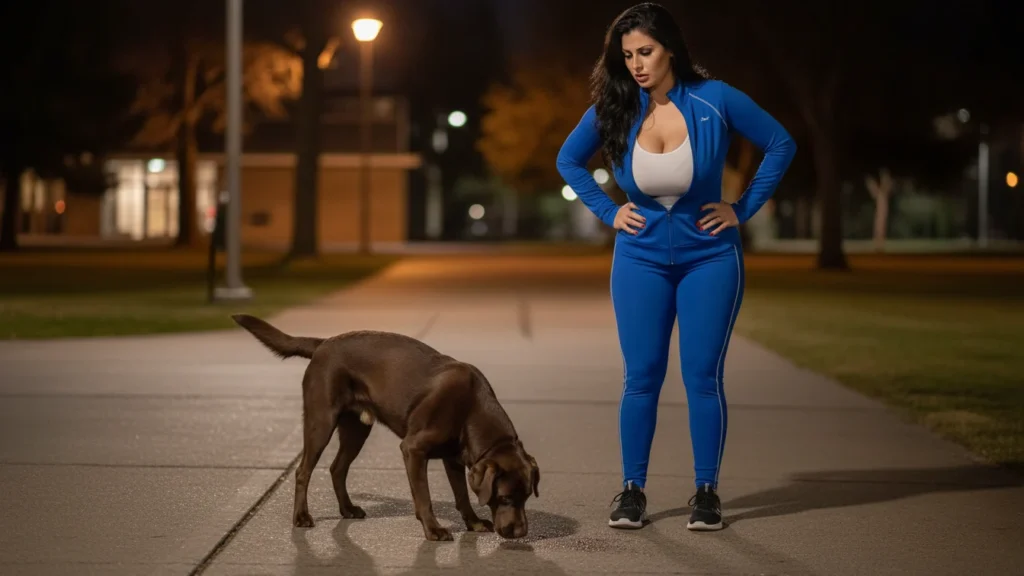
A dog who trots along on a relaxed afternoon walk can turn into a completely different animal after dark — stopping mid-stride, nose locked onto a patch of grass, tracking something invisible with total focus. It’s tempting to assume this is just about darkness making a dog more alert or more nervous. But the bigger reason is far more physical: the air itself behaves differently at night, and a dog’s nose is sensitive enough to notice.
Nighttime Air Actually Holds Scent Differently
During the day, sunlight heats the ground, and that warm air rises steadily upward, carrying scent molecules along with it and dispersing them into a wide, thin plume. At night, that process reverses. The ground loses heat quickly once the sun goes down, cooling faster than the air sitting above it. Meteorologists call the result a nocturnal, or radiational, temperature inversion — a layer of cooler air trapped near the surface, with warmer air sitting above it like a lid. Instead of rising and thinning out, scent molecules released near the ground stay concentrated close to where they started, held in place by that still, cool layer.
For a nose as capable as a dog’s, that’s a meaningfully different environment to work with. Scent that would have dispersed and thinned out within minutes on a warm afternoon can instead sit low to the ground, concentrated, for much longer after dark.
Humidity and Temperature Change What the Nose Picks Up
Search-and-rescue dog handlers rely on exactly this kind of atmospheric detail, because their dogs’ performance depends heavily on it. Cool, humid, and relatively still air is widely considered close to ideal scenting weather, since moisture helps keep scent particles intact and airborne long enough to be detected, while hot, dry, and windy conditions cause scent to break down and disperse much faster. Nighttime conditions frequently line up with the more favorable end of that range: temperatures drop, wind often calms, and humidity climbs as dew begins to form.
None of this is exclusive to professional detection dogs. Any dog’s nose is working with the same physics on an ordinary evening walk — it’s just that most pet owners never have a reason to think about why the neighborhood suddenly smells so “busy” to their dog after sunset.
With Vision Reduced, Smell Becomes the Dominant Channel
Dogs already lean on scent more than sight to make sense of the world, and that balance shifts even further once the light fades. Canine eyes trade away some sharpness and color range for better motion detection and low-light sensitivity, but they still can’t match daylight vision for fine detail. With less visual information available, a dog’s brain naturally leans harder on the sense that’s already doing most of the interpretive work — smell — to build a mental picture of the surrounding environment, in much the same way dogs use scent to track where they’ve been, what’s changed, and who has passed through an area.
Put a richer, more concentrated scent environment together with a dog that’s already relying more heavily on its nose, and it’s easy to see why nighttime walks can turn into a completely different sensory experience than the same route at noon.
Thermals: Why the Same Trail Smells Different by Time of Day
There’s one more layer to this, and it’s why the exact same stretch of yard or sidewalk can smell dramatically different to a dog depending on the hour. As the sun warms the ground in the morning, rising thermal currents lift scent up and away from the surface, often carrying it out of a dog’s nose-height range entirely. In the evening, as the ground cools, that airflow reverses — air sinks and drains downhill, pulling scent down and along the ground with it, often pooling it in low spots like ditches, garden beds, or the base of a fence line.
That’s part of why a dog might walk past a spot without a second glance in the afternoon, then stop and investigate that same spot intensely after dark — the scent trail hasn’t necessarily gotten fresher, it’s simply sitting where the dog’s nose can actually reach it.
What This Means for Your Dog’s Nighttime Behavior
Translated into ordinary evening-walk terms, this explains a handful of common patterns owners notice:
- Longer, more intense sniffing sessions on night walks compared to daytime ones, since there’s genuinely more concentrated scent information available at nose height.
- Alerting to things you can’t perceive at all — a raccoon that passed through the yard hours earlier, a neighbor’s cat, or wildlife well outside your own senses, all of which may still be sitting in a low, still layer of night air.
- More focused tracking behavior, following a trail in a straight, deliberate line rather than the more scattered daytime sniffing pattern.
- Stopping abruptly at a spot that seems unremarkable to you, simply because that’s where a pooled scent happens to be strongest.
In most cases, this is just a dog fully using the sense it’s built around, not a sign of fear or distress. Letting a dog take extra time to investigate on a nighttime walk — rather than hurrying them along — respects what’s actually a richer, more informative environment from their point of view. The exception is if intense sniffing is paired with other signs of stress, like pacing, whining, or reluctance to continue the walk at all; that combination is worth mentioning to your veterinarian, since it may point to anxiety rather than ordinary sensory engagement.
Your dog isn’t spooked by the dark. They’re simply working with a nose that was built to notice exactly the kind of chemical landscape that only shows up once the sun goes down.
Sources
- NOAA National Weather Service — Glossary: Nocturnal/Radiational Inversion
- VCA Animal Hospitals — Search and Rescue Dogs
- VCA Animal Hospitals — How Dogs Use Smell to Perceive the World
- American Kennel Club — A Vet’s Take on Canine Vision
- IAABC Foundation Journal — A Review of Detection Distance for Search Dogs Based on Environment and Target Odor

Dr. Sofia Romano, DVM, is an experienced veterinarian specializing in small-animal medicine and preventive care. She has treated thousands of cases using evidence-based diagnostics and modern clinical practices. Dr. Romano is dedicated to providing science-backed pet-health guidance that helps owners make informed decisions and improve their pets’ quality of life.