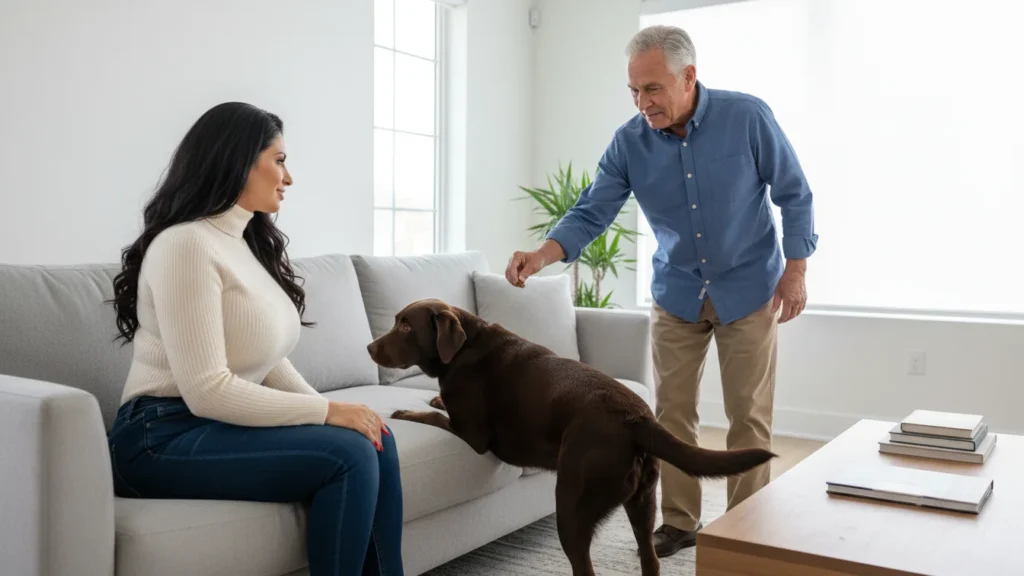
The Same Dog. The Same House. Completely Different Reactions.
With one person, your dog is calm and obedient.
With another, playful and wild.
With someone else, distant or cautious.
Same dog.
Same home.
Different responses.
This isn’t moodiness.
It isn’t favoritism in the human sense.
Once you understand how dogs perceive each family member, these differences stop feeling personal—and start making perfect sense.
Dogs Don’t See “Family” the Way Humans Do
Humans group people by roles: parent, child, partner.
Dogs group people by:
- Emotional energy
- Predictability
- Scent profile
- Reinforcement history
- Safety signals
To a dog, every person is a unique environment.
That’s why dogs don’t generalize behavior across people—even within the same household.
Scent: The First and Strongest Differentiator
A dog’s sense of smell is their primary social filter.
Each family member has:
- A distinct scent profile
- Unique hormone signatures
- Stress and emotion markers
Dogs can detect:
- Who is calm vs tense
- Who is sick or stressed
- Who is predictable
- Who feels emotionally “safe”
This is why dogs may approach one person gently and another cautiously—before a word is spoken.
Emotional Energy Shapes Behavior More Than Commands
Dogs don’t respond to what you say first.
They respond to:
- Tone
- Body tension
- Breathing rhythm
- Movement speed
- Emotional regulation
A calm, grounded person often gets a calm dog.
An anxious or excitable person often gets heightened reactions.
This phenomenon—often discussed in canine behavior research summarized by the American Kennel Club—explains why training success varies by handler.
Reinforcement History: Dogs Remember Who Does What
Dogs are excellent pattern learners.
They remember:
- Who feeds them
- Who walks them
- Who enforces rules
- Who allows exceptions
- Who gives attention freely
- Who ignores unwanted behavior
Even small differences matter.
A person who laughs at jumping teaches one lesson.
A person who turns away teaches another.
The dog adapts—not out of defiance, but efficiency.
Why Dogs Often “Choose” One Favorite Person
Dogs don’t choose favorites emotionally.
They choose anchors.
A primary attachment figure is usually:
- The most predictable
- Emotionally regulated
- Consistent in responses
- Associated with safety and routine
This doesn’t mean other family members are less loved.
It means one person provides the strongest sense of stability.
Children, Adults, and Authority Signals
Dogs react differently to children for good reason.
Children:
- Move unpredictably
- Have higher-pitched voices
- Emit different stress signals
- Break rules inconsistently
Many dogs respond with:
- Playfulness
- Caution
- Overexcitement
- Avoidance
Adults who move calmly and consistently signal leadership—not dominance, but reliability.
Dogs adjust behavior accordingly.
Body Language Differences Humans Don’t Notice
Each person’s body language is unique.
Dogs notice:
- Eye contact duration
- How quickly you approach
- How often you reach over their head
- Whether you block or invite space
- How you respond to stress
A person who leans forward quickly may trigger avoidance.
A person who moves sideways slowly may feel safer.
Dogs read bodies faster than words.
Real-Life Example: “He Only Listens to My Partner”
This is one of the most common complaints.
But it’s rarely about respect.
It’s usually about:
- Consistency
- Timing
- Emotional neutrality
Dogs respond best to people whose signals are clear and predictable.
Not louder.
Not stricter.
Clearer.
Comparison: Why One Dog Acts Differently With Different People
| Factor | Person A | Person B |
|---|---|---|
| Emotional state | Calm | Anxious |
| Consistency | High | Variable |
| Reinforcement | Clear | Mixed |
| Body language | Predictable | Fast |
| Dog response | Calm, obedient | Excited, reactive |
The dog isn’t choosing sides.
They’re responding to inputs.
Common Mistakes Families Make
When dogs act differently, families often:
- Take behavior personally
- Compete for affection
- Blame the dog
- Increase inconsistency
- Undermine each other’s rules
This confuses dogs and increases stress.
Consistency across humans creates clarity for dogs.
Actionable Steps to Balance Dog Behavior at Home
If you want more even behavior across family members:
- Align basic rules together
- Standardize responses to jumping, barking, and attention-seeking
- Match tone and timing, not volume
- Allow the dog choice and space
- Avoid forcing bonding
Dogs bond naturally when safety is consistent.
Hidden Insight: Dogs Respond to Who You Are, Not Who You Think You Are
Dogs don’t react to intention.
They react to:
- What actually happens
- How it feels
- How predictable you are
This makes dogs excellent mirrors—but also misunderstood companions.
Why This Matters Today
Modern households are busy, emotional, and inconsistent.
Understanding canine social perception helps:
- Reduce frustration
- Improve training success
- Prevent behavior labeling
- Strengthen family harmony
- Support dogs emotionally
Dogs aren’t judging.
They’re adapting.
Key Takeaways
- Dogs perceive each family member uniquely
- Scent and emotional energy matter most
- Consistency beats authority
- Different reactions are adaptive, not personal
- Unified human behavior creates calm dogs
Frequently Asked Questions
1. Why does my dog listen to one person more than others?
That person is likely more consistent and emotionally predictable.
2. Do dogs love one family member more?
Dogs form primary attachments, but they bond with multiple people.
3. Can dogs change how they react to family members?
Yes—with consistent cues, calm energy, and shared rules.
4. Why is my dog calmer with adults than kids?
Children’s unpredictability changes how dogs regulate themselves.
5. Should we force equal bonding?
No. Allow relationships to develop naturally and safely.
Conclusion
Dogs don’t divide families into favorites and non-favorites.
They divide the world into:
- Safe signals
- Unclear signals
- Predictable patterns
- Emotional noise
When a dog reacts differently to each family member, they’re not being difficult.
They’re being deeply perceptive.
And when humans learn to meet dogs where they are—calm, consistent, and clear—those differences begin to soften.
Disclaimer: This article is for educational purposes only and does not replace professional veterinary or behavioral guidance.

Dr. Sofia Romano, DVM, is an experienced veterinarian specializing in small-animal medicine and preventive care. She has treated thousands of cases using evidence-based diagnostics and modern clinical practices. Dr. Romano is dedicated to providing science-backed pet-health guidance that helps owners make informed decisions and improve their pets’ quality of life.



Pingback: Why Dogs Suddenly Avoid Eye Contact — The Quiet Signal They’re Trying To Send You
Pingback: Why Dogs Watch You Sleep — The Quiet Instinct That Keeps Them Awake While You Rest
Pingback: Why Dogs Sense Illness In Other Pets — The Invisible Biological Signals Humans Can’t Detect