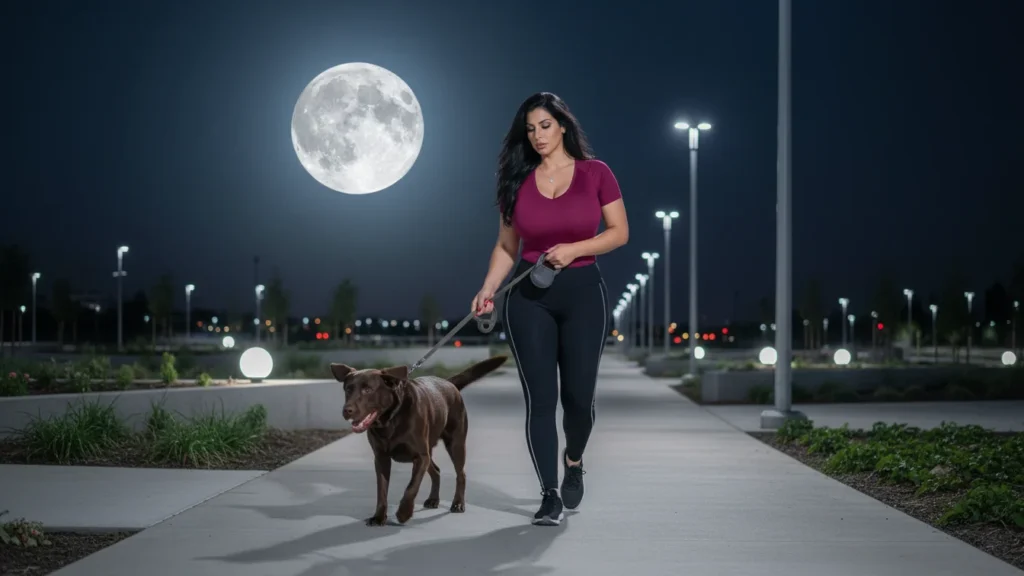
Ask anyone who’s worked a shift at an emergency vet clinic, and you’ll probably hear some version of the same line: “It must be a full moon tonight.” Dogs pacing, barking at nothing, refusing to settle — plenty of owners notice it too, and it’s tempting to chalk it up to some mystical lunar pull on our pets.
The real story is less about moonlight magic and more about biology, light, and a little bit of human perception playing tricks on all of us. Here’s what’s actually going on.
The Data Point Everyone Cites
There is a real, published study behind this belief, and it’s worth understanding exactly what it did and didn’t find. In 2007, veterinarians at Colorado State University analyzed 11,940 emergency visits at their veterinary medical center over an 11-year period, checking whether visit rates lined up with the lunar calendar. They found a statistically real pattern: emergency visits were about 23% higher for cats and 28% higher for dogs on “fuller moon” days — spanning waxing gibbous through waning gibbous, not just the single night of the full moon itself.
That sounds dramatic, but the researchers themselves cautioned against over-reading it. In practical terms, the increase amounted to roughly one extra dog or cat emergency per fuller-moon period at a single busy veterinary hospital — a difference so small that, as the study’s lead author noted, an individual clinician on shift would be unlikely to even notice it. The emergencies themselves — bites, seizures, trauma, cardiac events — weren’t a special “full moon” category of illness either; they were the same emergencies that happen year-round, just occurring slightly more often during that lunar window.
What’s Actually Different on a Full Moon Night: Light, Not Magnetism
If something real is happening, the most likely explanation isn’t gravitational or magnetic — it’s visual. Dogs are built with far more light-sensitive rod cells in their retinas than humans, along with a reflective layer behind the eye called the tapetum lucidum, both adaptations that make canine night vision considerably better than ours. A full moon dramatically increases outdoor ambient light compared to other lunar phases, which means a dog’s motion-tuned eyes suddenly have a lot more to work with after dark — moving shadows, distant animals, shifting shapes in the yard — all things that would otherwise be lost in near-total darkness.
More visible stimuli outside can easily translate into more barking, more pacing at windows and doors, and more general alertness, simply because there’s more for a dog to notice and react to. On top of that, brighter nights tend to change human behavior too: owners are more likely to walk dogs later, let them stay outside longer, or leave doors and curtains open, all of which adds up to more opportunity for excitement, encounters with wildlife, or accidents — without the moon itself doing anything to a dog’s body or brain.
Why “Moon Magnetism” Doesn’t Hold Up Under Scrutiny
The broader idea that the moon’s gravitational pull directly influences behavior — the so-called “lunar effect” or “Transylvania effect” — has been tested extensively in humans, and it consistently fails to hold up. Large meta-analyses combining dozens of studies on crime rates, psychiatric hospital admissions, crisis-line calls, and emergency room visits have found no meaningful relationship with the phases of the moon. The physics don’t support it either: the moon’s gravity is far too weak to meaningfully affect a body of water as small and enclosed as a mammal’s bloodstream, unlike the ocean tides it does influence.
There’s no comparable large body of rigorous research specifically testing gravitational effects on dog physiology, but there’s also no known biological mechanism by which it could work — nothing about a dog’s nervous system responds to lunar gravity any differently than a human’s does.
Why It Still Feels So Real
If the actual effect is this small and mostly explained by light and routine, why is the belief so widespread among pet owners and even veterinary staff? Researchers point to a well-documented quirk of memory called illusory correlation — people tend to notice and remember the chaotic full-moon nights and forget all the equally chaotic nights that happened when the moon was nowhere near full. Centuries of folklore about werewolves and “lunacy” primed everyone to expect strange behavior at the full moon, so when something odd happens, the moon gets the credit, while identical behavior on an ordinary Tuesday gets chalked up to nothing in particular.
What To Actually Watch For
None of this means a genuinely restless dog should be ignored — it just means the moon probably isn’t the cause worth investigating.
- Increase supervision on bright nights, since more visible outdoor activity can mean more barking, digging, or attempts to get outside — manageable with a consistent evening routine rather than any special “full moon plan.”
- Use reflective gear on night walks, since brighter moonlight can create a false sense of visibility for both dogs and drivers.
- Track the actual pattern, not just the date. If restlessness shows up consistently regardless of the moon phase, it’s more likely tied to noise, changes in routine, anxiety, or an underlying medical issue like pain or a seizure disorder.
- Call your veterinarian for persistent or sudden restlessness, especially if it comes with pacing, vocalizing, disorientation, or changes in appetite — these are worth investigating on their own merits, moon or no moon.
Your dog isn’t answering to the moon. He’s answering to a brighter yard, a longer walk, and a nervous system built to notice exactly that kind of change.
Sources
- Journal of the American Veterinary Medical Association — Wells et al. (2007), “Canine and Feline Emergency Room Visits and the Lunar Cycle: 11,940 Cases (1992–2002)”
- PubMed — Study Abstract and Citation
- Colorado State University News — “Bad Moon Rising? Lunar Cycle May Be Linked to More Veterinary Visits”
- Scientific American — “Lunacy and the Full Moon”
- American Kennel Club — “A Vet’s Take on Canine Vision”

Dr. Sofia Romano, DVM, is an experienced veterinarian specializing in small-animal medicine and preventive care. She has treated thousands of cases using evidence-based diagnostics and modern clinical practices. Dr. Romano is dedicated to providing science-backed pet-health guidance that helps owners make informed decisions and improve their pets’ quality of life.