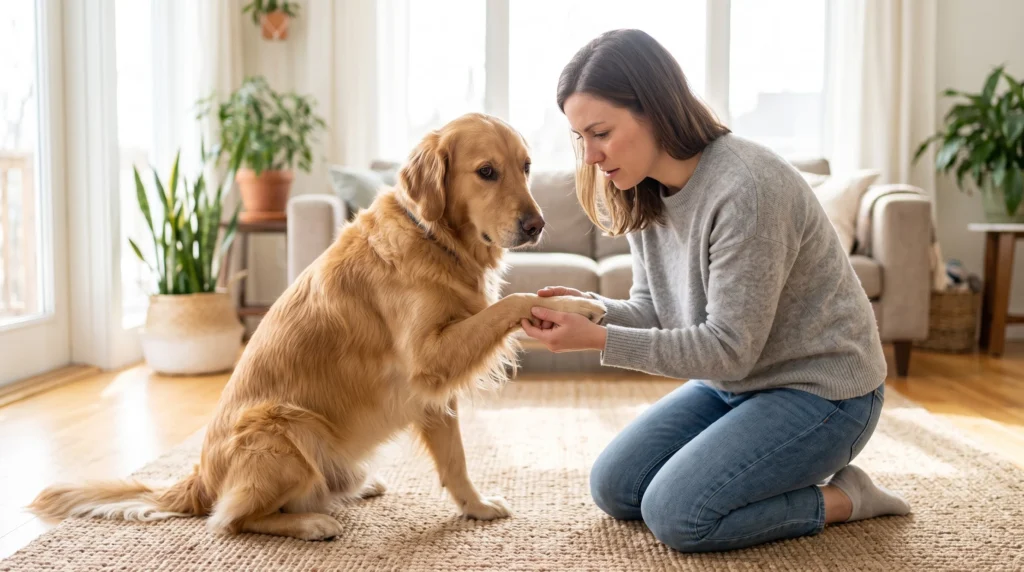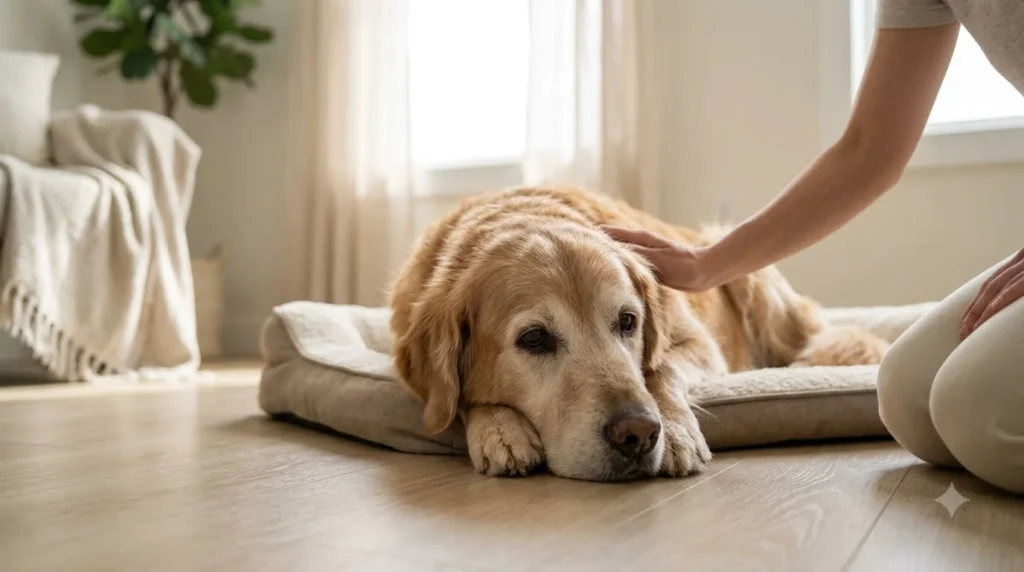
Your older dog still comes to greet you, eats its meals, and curls up in its usual spot at night. Nothing seems seriously wrong. But walks have become shorter, getting up takes longer, and your dog no longer jumps onto the sofa to sit beside you.
It is tempting to attribute these changes to age. After all, an older dog is expected to slow down eventually.
Yet that gradual change in everyday routines can be one of the most important clues that a dog is experiencing pain. Unlike an obvious injury, chronic discomfort may develop so slowly that neither the dog nor its owner seems to have a clear moment when things changed.
One of the quietest signs of pain in a senior dog is not crying or limping. It is a growing reluctance to do things that were once easy.
Arthritis is a common cause of chronic pain in older dogs, but it is not the only possibility. Spinal problems, dental disease, and other medical conditions can also make ordinary activities uncomfortable. Veterinary guidance from Cornell University and the American Animal Hospital Association (AAHA) stresses that subtle changes in movement and behaviour deserve attention rather than being dismissed as inevitable ageing. (Cornell University College of Veterinary Medicine; AAHA Senior Care Guidelines)
Learning to recognise these small changes can help you arrange an assessment earlier, before discomfort takes more of your dog’s independence away.
1. Your Dog Has Quietly Stopped Doing Things It Used to Love
One of the most revealing changes is a shrinking range of activities.
Perhaps your dog still enjoys walks but turns toward home sooner. It may stop following you upstairs, hesitate before getting into the car, or watch family members from its bed rather than coming over to join them.
These changes are easy to overlook individually. Together, especially when they persist or gradually worsen, they may suggest that movement has become uncomfortable.
Osteoarthritis, a progressive disease involving the joints, can cause pain, stiffness and reduced mobility. Affected dogs may be reluctant to walk, run, climb stairs or jump onto furniture. The changes do not necessarily appear as an obvious limp. (Cornell University College of Veterinary Medicine, Osteoarthritis)
Pay attention to what your dog avoids, not just what it can still manage.
A dog that walks around the neighbourhood but no longer takes the longer route may be adapting to discomfort. A dog that stops playing halfway through a familiar game may be telling you something through its behaviour.
Of course, reduced activity can also reflect heart or respiratory disease, weakness, sensory changes, or other problems. The change is a reason to investigate, not proof of a particular diagnosis.
2. Getting Up After a Nap Has Become an Effort
Watch your dog after it has been resting for a while.
Does it take several attempts to stand? Does it pause before putting weight on its hind legs? Does it stretch repeatedly, move stiffly for the first few steps, or appear reluctant to rise from a favourite bed?
Joint pain can be particularly noticeable when a dog moves from rest to activity. Some dogs gradually loosen up after walking for a little while, which can make the problem less obvious later in the day.
Others struggle more consistently, especially when the affected joints have become significantly painful.
You may also notice that your dog no longer sits squarely, shifts its weight from one side to the other, or takes a longer time to settle into a comfortable lying position. Changes in posture and difficulty rising are recognised signs of possible pain in dogs. (Cornell University College of Veterinary Medicine)
Do not repeatedly ask your dog to get up or perform movements to test whether it hurts. Simply observe the movements that happen naturally during the day.
If rising has become noticeably harder, tell your veterinarian when you first observed it and whether the difficulty seems worse after rest, exercise, or both.
3. Your Dog Is Restless at Night Rather Than Sleeping Comfortably
Pain does not always make a dog move less. Sometimes it makes settling down difficult.
An uncomfortable dog may change sleeping positions repeatedly, get up and lie down several times, pace around the room, or seem unable to find a comfortable place to rest. Some dogs pant when they are not hot or have not recently exercised.
These behaviours are not specific to pain. Anxiety, respiratory or heart problems, medication effects, and age-related cognitive changes may also affect sleep and restlessness.
The important clue is a change from your dog’s usual pattern, particularly when it appears alongside stiffness, reduced mobility, or a new reluctance to be handled.
Keep track of when the restlessness occurs and what else you notice. For example, does your dog repeatedly get up after lying on one side? Does it seem uncomfortable when lowering itself onto the bed? Does panting occur even in a cool room while resting?
Such details can help a veterinarian distinguish between possible causes.
Persistent panting at rest, especially when accompanied by breathing difficulty, weakness, or sudden distress, should not simply be attributed to age or arthritis. Seek urgent veterinary assessment when symptoms are severe or rapidly worsening.
4. Your Normally Affectionate Dog Has Become More Sensitive to Touch
A senior dog that once enjoyed being petted may begin moving away when you touch its back, hips, paws, or shoulders.
It might flinch when you help it stand, become tense when you lift it into a car, or growl when someone touches a particular area. Other dogs become unusually clingy, staying close to their owners because they feel vulnerable or unsettled.
Pain can change how a dog responds to handling. A growl or snap from a dog that has never behaved this way may be an attempt to prevent a painful movement rather than a sudden change in its underlying temperament. Cornell lists new sensitivity to touch, irritability, social withdrawal and uncharacteristic aggression among possible signs of pain. (Cornell University)
Do not punish a dog for communicating discomfort, and do not repeatedly press the suspected painful area to confirm your suspicion. Give it space and arrange a veterinary assessment.
Until you know what is happening, supervise interactions with children and avoid asking anyone to hug, lift or restrain the dog unnecessarily.
5. The Grooming Habit You Have Never Thought About Is Suddenly Different
Small grooming changes can be easy to miss because they rarely look like an emergency.
A dog with joint discomfort may find it harder to turn its body or lift a leg comfortably to groom itself. You might notice a coat becoming untidy in certain areas, longer nails because walks have become shorter, or increased licking around a joint or limb.
Repeated licking or chewing at one particular area can also indicate pain, irritation or a skin problem. It is not a reliable way to identify the cause on its own.
Dental pain deserves particular attention. An older dog that drops food, chews on one side, avoids hard treats, develops bad breath, or becomes reluctant to have its face touched may have an oral health problem. You may not see an obvious injury from the outside.
Do not assume that changes in grooming or eating are simply part of getting older. Tell your veterinarian what has changed, even if the problem seems minor.
6. Your Dog’s Personality Seems to Have Changed
Perhaps your dog has become irritable, withdrawn, unusually dependent, or less interested in greeting familiar people.
Behavioural changes can accompany chronic pain, particularly when activities that once felt enjoyable have become uncomfortable. A dog that anticipates pain when getting up may start avoiding interaction because greeting someone means having to move.
However, personality changes have many potential causes, including sensory loss, cognitive dysfunction, and other illnesses. In senior dogs, these conditions can occur alongside painful disease.
AAHA’s senior-care guidance specifically warns that owners may interpret changes in behaviour as normal ageing when chronic pain may be contributing. The guidelines recommend assessing movement, behaviour, daily habits, and the animal’s overall health rather than evaluating these signs in isolation. (AAHA Senior Care Guidelines)
A change in personality is worth mentioning at a veterinary appointment, especially when it appears alongside changes in walking, sleep, appetite or tolerance of touch.
7. Your Dog Is Eating Differently or Having Accidents Indoors
Pain can affect ordinary routines beyond movement.
A dog with dental disease may approach its food bowl but eat more slowly, drop pieces of food, or refuse certain textures. A dog experiencing discomfort while squatting may appear reluctant to urinate or defecate in its usual posture.
An older dog may also have accidents indoors because of mobility limitations or another medical condition. It may not reach the door quickly enough or may struggle with the steps required to go outside.
These signs should not automatically be attributed to pain. Changes in appetite or thirst, urinary accidents, and altered bowel habits can indicate diseases that require their own investigation.
A sudden inability to urinate, repeated straining with little or no urine, or severe abdominal pain requires emergency veterinary care. Do not assume your dog is constipated or simply too old to go outside.
The useful question is whether a familiar daily habit has changed and whether that change is accompanied by other signs of discomfort or illness.
What Looks Like Normal Ageing May Be Treatable Pain
One reason chronic pain can go unnoticed is that it often develops gradually.
A dog might first avoid jumping onto the sofa, then stop climbing stairs, and eventually become reluctant to get up for a walk. Because each change happens slowly, an owner may adjust the household routine without recognising that the dog’s comfort is declining.
Ageing itself is not a disease, and not every older dog will develop the same problems. But reduced activity, stiffness and changes in behaviour should not automatically be accepted as unavoidable consequences of getting older.
Osteoarthritis is one common cause of pain and impaired movement in senior dogs. Other causes can include spinal disease, injuries, dental problems and a range of internal illnesses. Identifying the actual cause matters because the appropriate management depends on the condition and the individual dog.
Early assessment can help establish what is causing the change and whether treatment, rehabilitation, medication or adjustments at home could improve comfort and function. (Cornell University, Osteoarthritis; AAHA Senior Care Guidelines)
When Should You Take Your Senior Dog to the Veterinarian?
Do not wait until your dog cries, refuses to walk, or develops an obvious limp. A persistent change in movement, behaviour, sleep, appetite or tolerance of touch is a good reason to book a veterinary appointment.
The urgency depends on what you observe.
| What you notice | Appropriate next step |
|---|---|
| Gradual stiffness, shorter walks, reluctance to jump, or persistent changes in sleep and behaviour | Arrange a veterinary appointment to investigate the cause. |
| New limping, a marked increase in discomfort, or reluctance to bear weight | Contact your veterinarian promptly for advice on how quickly your dog should be examined. |
| Sudden inability to stand or walk, severe or rapidly worsening pain, collapse, breathing difficulty, or major trauma | Seek emergency veterinary care. |
These are general guidance categories, not a substitute for assessment. If you are unsure how serious a new symptom is, call your veterinary practice and describe what you have observed.
What to record before the appointment
You do not need to diagnose the problem at home. Your observations can help the veterinarian understand what has changed.
For several days, where practical, record:
- How easily your dog gets up after resting.
- Whether the usual walk is shorter or slower.
- Changes in stairs, jumping, play, or willingness to move.
- Night-time restlessness, panting, or repeated repositioning.
- Changes in appetite, drinking, grooming, toileting, or reaction to touch.
Short videos of your dog walking naturally, getting up from a bed, or moving around the home may be particularly useful. Do not provoke painful movements or make your dog attempt stairs or jumps just to obtain a recording.
AAHA recommends using videos of pets moving and interacting in their normal environment because pain-related changes may be less apparent during a veterinary visit. (AAHA Senior Care Guidelines)
How a Veterinarian Can Help
A veterinary assessment generally starts with your dog’s history and a physical examination. Depending on what the veterinarian finds, further investigations may include blood tests, X-rays or other diagnostic procedures.
For suspected joint pain, the examination may focus on posture, gait, muscle condition, joint movement and areas of tenderness. If the signs suggest dental disease, spinal problems or another condition, additional investigations may be appropriate.
Treatment is not the same for every older dog. Depending on the cause, the plan may involve veterinary pain medication, weight management, rehabilitation, appropriate exercise, dental treatment or changes to the home environment.
For dogs with mobility problems, relatively simple adjustments can also help. Non-slip mats can improve footing on smooth floors. Ramps or steps may reduce the need to jump, while an accessible bed and shorter, more manageable walks may help a dog remain comfortable.
These measures support comfort, but they do not replace treatment of the underlying cause.
Never give your dog human pain medication unless your veterinarian specifically directs you to do so. Ibuprofen, naproxen and other medicines intended for people can cause serious adverse effects in dogs; acetaminophen also carries risks and should only be used in dogs under veterinary direction. Do not use leftover medication prescribed for another animal. (U.S. Food and Drug Administration, Get the Facts about Pain Relievers for Pets)
The Most Helpful Thing You Can Do Is Notice the Change
Your senior dog does not need to limp dramatically or cry out for its discomfort to deserve attention. Sometimes the clues are smaller: taking longer to rise, abandoning a favourite activity, sleeping restlessly, or becoming uncomfortable when touched.
You know your dog’s usual habits better than anyone. That familiarity can help you recognise changes that might otherwise seem like ordinary ageing.
If your dog is becoming less willing to move, interact, or follow familiar routines, do not wait for the signs to become unmistakable. Arrange a veterinary assessment, share what you have noticed, and ask about ways to protect your dog’s comfort and mobility.
Growing older may mean doing things differently. It should not mean assuming that living with untreated pain is inevitable.
Sources
1. Cornell University College of Veterinary Medicine — “Recognizing Pain in Dogs.” Updated October 21, 2025. Describes mobility changes, altered activity, behavioural changes, sleep disturbances, appetite changes, and practical ways to document concerns for a veterinary appointment. https://www.vet.cornell.edu/departments-centers-and-institutes/riney-canine-health-center/canine-health-topics/recognizing-pain-dogs
2. American Animal Hospital Association (AAHA) — “Pain Management,” 2023 AAHA Senior Care Guidelines for Dogs and Cats. Published December 13, 2022. Discusses underrecognition of chronic pain, video monitoring, multimodal treatment, rehabilitation, and home modifications. https://www.aaha.org/resources/2023-aaha-senior-care-guidelines-for-dogs-and-cats/pain-management/
3. Cornell University College of Veterinary Medicine — “Osteoarthritis.” Explains the progressive nature of osteoarthritis, its effect on joints, and common signs such as stiffness, reluctance to exercise, and difficulty rising. https://www.vet.cornell.edu/departments-centers-and-institutes/riney-canine-health-center/canine-health-topics/osteoarthritis
4. American Animal Hospital Association (AAHA) — “2022 AAHA Pain Management Guidelines for Dogs and Cats.” Clinical guidance on assessing and managing acute and chronic pain, individualised treatment, and ongoing monitoring. https://www.aaha.org/resources/2022-aaha-pain-management-guidelines-for-dogs-and-cats/
5. U.S. Food and Drug Administration — “Get the Facts about Pain Relievers for Pets.” Explains why human pain medications can be unsafe for dogs and why analgesic decisions should be made with a veterinarian. https://www.fda.gov/animal-veterinary/animal-health-literacy/get-facts-about-pain-relievers-pets
6. American Animal Hospital Association — “2023 AAHA Senior Care Guidelines for Dogs and Cats.” The broader clinical guidelines explain why changes in older pets should not automatically be attributed to age and outline an individualised approach to senior veterinary care. https://pubmed.ncbi.nlm.nih.gov/36584321/

Dr. Sofia Romano, DVM, is an experienced veterinarian specializing in small-animal medicine and preventive care. She has treated thousands of cases using evidence-based diagnostics and modern clinical practices. Dr. Romano is dedicated to providing science-backed pet-health guidance that helps owners make informed decisions and improve their pets’ quality of life.