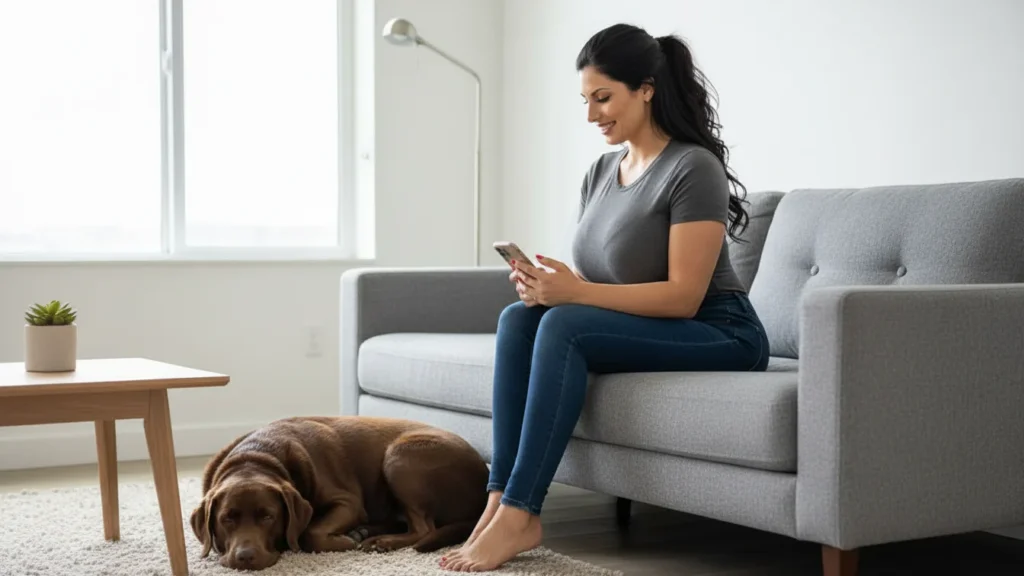
There’s a spot in nearly every home that belongs to the dog, and not because anyone assigned it. Maybe it’s the gap between the couch and the side table. Maybe it’s the cool tile just inside the back door, or the exact center of the hallway where foot traffic has to step around him. Move his bed somewhere else — somewhere nicer, even — and he’ll drag himself right back to that same unremarkable patch of floor.
It’s easy to laugh this off as one of those small, harmless dog quirks. But the choice isn’t arbitrary, and it isn’t really about the floor. It’s a running calculation your dog is making, mostly without either of you noticing, about temperature, safety, and how much of the room he can see from any given angle.
The Body Doesn’t Cool the Way You’d Expect
Start with the part that’s easiest to test yourself: put a hand on the tile by the back door on a warm afternoon, then on the carpet six feet away. There’s usually a noticeable gap, and your dog feels it far more acutely than you’d guess, because he’s working with a much smaller toolkit for managing heat.
People sweat across most of their skin. Dogs, by contrast, have functional sweat glands mainly in their paw pads, and those don’t move nearly enough heat to matter much on a warm day. Veterinary sources note that panting is really doing the heavy lifting — as a dog inhales and exhales rapidly, moisture evaporates off the tongue and airway, pulling heat out of the body in the process. It’s an effective system, but not an especially efficient one, and it means dogs are more sensitive to ambient surface temperature than most owners assume. A 2025 review of canine heat physiology in Frontiers in Animal Science pointed out that once the surrounding air gets close to a dog’s own skin temperature, this evaporative cooling becomes the dominant — sometimes the only — mechanism keeping the body from overheating.
That’s the boring, practical explanation for the dog who abandons an expensive orthopedic bed for bare hardwood in July. It’s not an insult to the bed. It’s a dog with limited cooling equipment doing the math on where heat actually leaves his body fastest.
A Den That Isn’t Quite a Den
The instinct explanation gets thrown around constantly — dogs are den animals, so they seek enclosed spaces — and it’s worth pausing on, because it’s not quite as tidy as it sounds. Some behavioral literature actually pushes back on the phrase itself: dogs aren’t true den-dwelling animals in the way, say, foxes are. What their wild relatives actually do is build a temporary nest, often for whelping pups, that serves as a home base rather than a permanent enclosed shelter — somewhere to retreat to, not somewhere sealed off from the world.
Still, the underlying pull toward smaller, partially enclosed spaces is real enough that trainers and veterinary behaviorists rely on it constantly. It’s the entire logic behind crate training — the idea, as the AKC puts it, that dogs have spent thousands of years seeking out small, enclosed spaces for shelter and security, and that a well-introduced crate can tap into that same pull rather than fight it. Whether you call it a “den instinct” in the strict biological sense or something looser — a general preference for partial cover and a defined edge to lean against — the practical result looks the same in most living rooms: the space under the desk, the gap behind an armchair, or the corner where two walls meet tends to win out over the wide-open middle of the floor.
Watching the Door Without Watching the Door
Then there’s the dog who does the opposite — skips the cozy corner entirely and stations himself somewhere with a clear sightline to the front door, the stairs, or the kitchen. This isn’t a contradiction of the enclosed-space instinct so much as a different priority taking precedence: visibility.
A resting spot with a wide vantage point lets a dog register movement and sound the moment they happen, rather than reacting a half-second late from around a corner. Dogs who take on this kind of informal watch — near an entryway, at the top of the stairs, angled toward a window — are often balancing two competing needs at once: enough enclosure to feel some cover, and enough sightline to feel some control. Which need wins on a given day depends on the dog, the household, and honestly the moment. A dog might sleep tucked against the couch during a quiet afternoon and then relocate to the hallway the second unfamiliar footsteps pass outside.
The Room Remembers Him, Even When He’s Not In It
Scent plays a bigger role here than most owners give it credit for. A resting spot accumulates a dog’s own smell over time — on the carpet fibers, in the corner of a rug, on a blanket that’s been slept on for months — and that buildup functions as a kind of low-grade reassurance. It’s his smell, layered with the household’s familiar scent, in a spot that has reliably been quiet and undisturbed before. That combination of “smells like me” and “nothing bad has happened here” is a large part of why a dog will return to the same unremarkable square of floor for years, long after a nicer bed has been offered and ignored.
This is also why a resting spot can fall out of favor for reasons that look invisible to a person. A new piece of furniture, a cleaning product used nearby, a draft from a window that wasn’t there last winter — any of it can quietly break the pattern that made a spot feel safe, and a dog will simply relocate without any obvious explanation, because from his side, the explanation was never obvious to begin with. It happened in a sense he has and you mostly don’t.
What a Sudden Change Is Actually Telling You
Most of the time, a shift in resting spot is exactly this ordinary: the seasons changed, the room got busier, something about the old spot stopped smelling or feeling the way it used to. But there’s a version of this pattern worth paying closer attention to — a dog who abruptly stops using a spot he’s favored for a long time, particularly if the change comes with other shifts like reduced appetite, low energy, or obvious discomfort getting up and down.
A resting spot, after all, is partly a physical decision. A dog managing early joint pain may quietly start avoiding a favorite low, hard-surfaced spot in favor of something softer, or start choosing locations that require less effort to get in and out of. That kind of change tends to be gradual and easy to miss precisely because it happens one small adjustment at a time — which is exactly why it’s worth noticing when it happens quickly instead.
None of It Is Really About the Spot
What makes this behavior interesting isn’t the location itself — it’s that a dog is running the same three-part calculation, more or less constantly, that his wild ancestors needed to survive: how do I stay at a comfortable temperature, how exposed am I here, and does this place still feel the way it’s supposed to feel. Domestication changed almost everything about how dogs live, but it didn’t rewrite that particular piece of math. It just moved the whole equation indoors, onto your living room floor, where it’s easy to mistake for nothing more than a quirky habit.
The dog curled into the six inches of space behind your armchair isn’t being strange. He’s just still, in a small and mostly harmless way, doing exactly what dogs have always done — choosing the spot that feels safest, and trusting that instinct over whatever bed you bought him.
Sources
- Frontiers in Animal Science – Heat Stress in Domestic Dogs: Morphological and Environmental Risk Factors for Dog Welfare in a Warming World
- PetMD – Do Dogs Sweat?
- American Kennel Club – 4 Ways to Use Crate Training
- GoodRx Health – Do Dogs Sweat? Plus, How Dogs Cool Themselves Down
- Wikipedia – Crate Training (citing Lindsay’s Handbook of Applied Dog Behavior and Training)

Dr. Sofia Romano, DVM, is an experienced veterinarian specializing in small-animal medicine and preventive care. She has treated thousands of cases using evidence-based diagnostics and modern clinical practices. Dr. Romano is dedicated to providing science-backed pet-health guidance that helps owners make informed decisions and improve their pets’ quality of life.