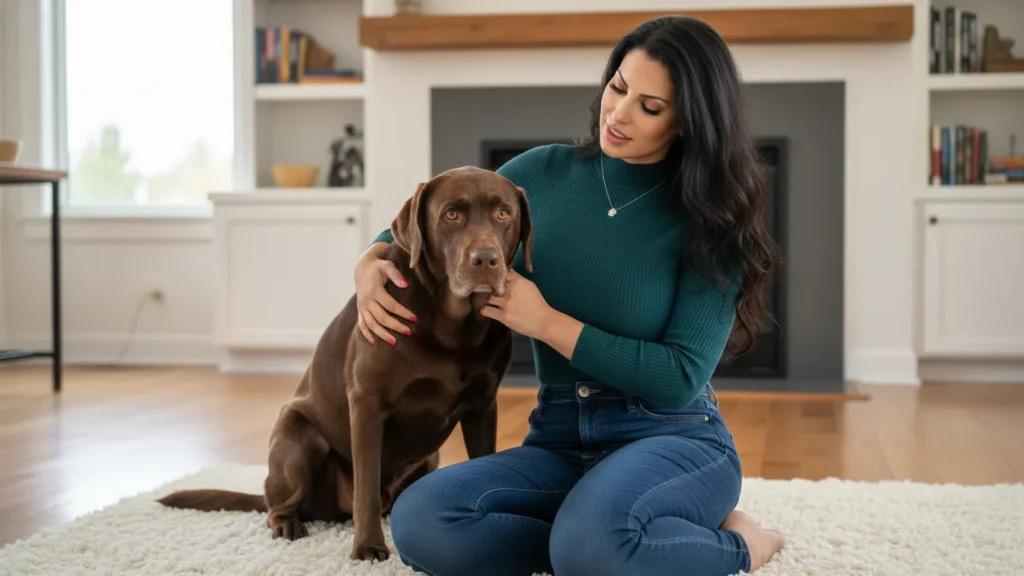
I still remember the Tuesday afternoon a dog named Biscuit refused to get in the car.
His owner, Maria, had come in for what was supposed to be a routine nail trim. Biscuit, a nine-year-old Beagle mix who normally dragged her toward my clinic door like it was a bakery, planted all four feet on the driveway and wouldn’t budge. Maria was confused — nothing seemed different. Same leash, same route, same tone of voice.
It wasn’t until we were sitting in the exam room that she mentioned, almost as an afterthought, that she’d gotten a phone call twenty minutes earlier. Her mother’s biopsy results had come back concerning. She hadn’t cried. She hadn’t told anyone. She’d barely let herself think about it.
Biscuit knew before she did.
This isn’t a one-off story. In two decades of practice, I’ve lost count of how many times a dog’s behavior told me something was wrong in the house before the owner said a single word about it. And the more I’ve read the research alongside my own clinical observations, the more convinced I am that dogs aren’t just reacting to our tone of voice or body language — they’re picking up on chemical and physiological signals we don’t even know we’re sending.
It’s Not a Sixth Sense — It’s a Superior Nose
For a long time, the idea that dogs can “sense” our emotions sounded more like folklore than science. That’s changed. Researchers at the University of Bristol and Queen’s University Belfast have shown that dogs can reliably distinguish the smell of a stressed human from a relaxed one — and they don’t need to know the person to do it.
In one well-designed study, scientists collected breath and sweat samples from volunteers before and after a stressful mental arithmetic task. Dogs were able to detect the odor changes associated with the stress response with roughly 93.75% accuracy. What’s striking is that these samples came from strangers, which suggests dogs are picking up on a shared chemical signature of stress rather than simply learning to recognize their own owner’s scent.
Veterinary researcher Dr. Zoe Parr-Cortes, who led follow-up work on this topic, put it simply: nobody had really looked closely at how detecting our stress affects a dog’s own emotional state — until now. Her team found that when dogs were exposed to the scent of a stressed stranger, it didn’t just register as information. It changed how the dogs behaved, making them more likely to make pessimistic choices in a decision-making task, similar to how a person might feel more on edge after walking into a tense room.
That detail matters for pet parents. It means our stress doesn’t just get noticed by our dogs — it can genuinely rub off on them. If you’ve ever wondered why your usually easygoing dog seemed clingy or unsettled during a rough week at work, this research offers a plausible biological explanation.
What Dogs Are Actually Detecting
When people ask me “how” dogs sense emotional shifts, I usually break it into three layers, because it’s rarely just one thing:
1. Scent (Volatile Organic Compounds). When we’re anxious, our body chemistry shifts — cortisol rises, sweat composition changes, and our breath carries different compounds. A dog’s nose, which has been estimated to be tens of thousands of times more sensitive than ours, can pick this up in seconds. This is the same underlying mechanism used to train medical detection dogs that alert diabetic patients to dangerous blood sugar drops or warn Addison’s disease patients when their cortisol falls too low.
2. Body language, down to the micro-movements. Long before I studied veterinary behavior formally, I noticed that dogs track posture, gait, and even breathing rhythm with an intensity most humans reserve for reading a close friend’s face. A slightly stiffer walk, a held breath before opening a bad email, a longer-than-usual pause before sitting down — dogs register these cues, often before we’re consciously aware we’re doing them.
3. Tone and pacing of voice, independent of the words. Dogs don’t understand most of our vocabulary, but they are remarkably tuned in to pitch, tempo, and tension in our voice. A flat, clipped “hey” lands very differently on a dog’s radar than the same word said warmly.
None of these are magic. They’re the product of roughly 15,000 years of co-evolution alongside humans, during which dogs that were better at reading our emotional and physical state were, quite literally, more likely to be fed, protected, and kept close.
A Story From the Exam Room
A few years ago, a client named Tom brought in his Labrador, Duke, for a wellness check. Duke was fine — completely healthy — but Tom mentioned something odd. For about a week, Duke had taken to lying against Tom’s legs every evening, something he’d never really done before. Tom joked that maybe Duke could tell he’d been having chest tightness and skipping his blood pressure medication.
I didn’t dismiss it. I asked Tom to get checked by his physician that week. It turned out his blood pressure was, in fact, dangerously elevated, and he’d been quietly ignoring the warning signs for days.
Was Duke diagnosing hypertension? No — dogs aren’t doctors, and I want to be careful not to overstate what’s going on here. But Duke was almost certainly picking up on subtle physiological cues: elevated cortisol, changes in Tom’s scent, tension in his movements, maybe even shifts in his breathing pattern while resting. Dogs are exceptionally good at noticing when something in their person’s baseline has shifted, even if they can’t tell us what that shift means.
This is a distinction worth sitting with as a pet parent: your dog can often tell that something is different before you say anything — but that’s not the same as your dog understanding what’s happening or why. Treat behavioral changes as a signal worth paying attention to, not as a diagnosis.
Signs Your Dog May Be Picking Up on Your Emotional State
In practice, I tell owners to watch for these patterns, especially if they appear as a cluster rather than in isolation:
- Increased shadowing or following you room to room
- Leaning against you or seeking more physical contact than usual
- Unusual clinginess at bedtime or refusal to settle in their normal spot
- Whining, pacing, or panting with no obvious physical cause
- Avoidance behavior — some dogs actually withdraw rather than seek closeness when they sense tension
- Changes in appetite that track with a stressful period in the household
- Hypervigilance, such as reacting more strongly than usual to doors, sounds, or car keys
It’s worth noting that dogs vary enormously in how they express this. Some become velcro dogs. Others become quieter and more watchful. Knowing your individual dog’s normal baseline is far more useful than any general checklist.
When It’s More Than Just “Sensing” You
Here’s where I want to offer a caution, because this is a topic that gets romanticized online in a way that can occasionally do a disservice to dogs. Not every behavior change is your dog empathically absorbing your mood. Sometimes it’s:
- Pain or an underlying medical issue that has nothing to do with your emotional state
- Separation anxiety that has been building independently
- Noise phobia or a trigger you haven’t identified
- Age-related cognitive changes in senior dogs
- A simple change in routine, diet, or environment
If clinginess, pacing, or withdrawal is persistent — lasting more than a few days, or showing up even during calm periods — it deserves a vet visit rather than an emotional explanation. I’ve seen owners attribute weeks of a dog’s lethargy to “picking up on my stress” when the actual cause was early-stage arthritis or a thyroid imbalance. Emotional attunement is real, but it should never be the default explanation for a health change.
How to Support a Dog Who’s Attuned to You
If you’re going through a genuinely stressful period — a job loss, a health scare, grief — and you notice your dog responding to it, here’s what I generally recommend to clients:
- Keep the physical routine steady. Walk times, meal times, and bedtime matter more to a stressed dog than usual. Predictability is calming even when your own schedule feels chaotic.
- Give them a job. Sniff walks, food puzzles, or short training sessions redirect a dog’s nervous energy into something structured.
- Don’t suppress affection, but don’t force it either. Let your dog choose how close they want to be. Some dogs want to be near you; others need a little space to settle.
- Watch for secondary stress behaviors like excessive licking, changes in bowel habits, or destructive chewing, and address them early rather than assuming they’ll pass.
- Talk to your vet if it persists. A short course of gentle reassurance from a professional — for both of you — is never a bad idea.
The Bigger Picture
What research like the Bristol and Queen’s University Belfast studies confirms is something many long-time dog owners have suspected for years: dogs are reading us constantly, through channels we can’t consciously access ourselves. It’s part of why the human-dog bond has endured for millennia — dogs became remarkably good at understanding a species that doesn’t speak their language.
Biscuit, by the way, was fine that day. Nail trim went smoothly. But I’ve thought about him often over the years, mostly because he reminded me that the quietest, most overlooked signals in a veterinary exam room are rarely coming from the dog’s file. They’re coming from the dog.

Dr. Sofia Romano, DVM, is an experienced veterinarian specializing in small-animal medicine and preventive care. She has treated thousands of cases using evidence-based diagnostics and modern clinical practices. Dr. Romano is dedicated to providing science-backed pet-health guidance that helps owners make informed decisions and improve their pets’ quality of life.





Pingback: Why Dogs Seem “Jealous” Of Attention — The Emotional Signal Most Owners Misread