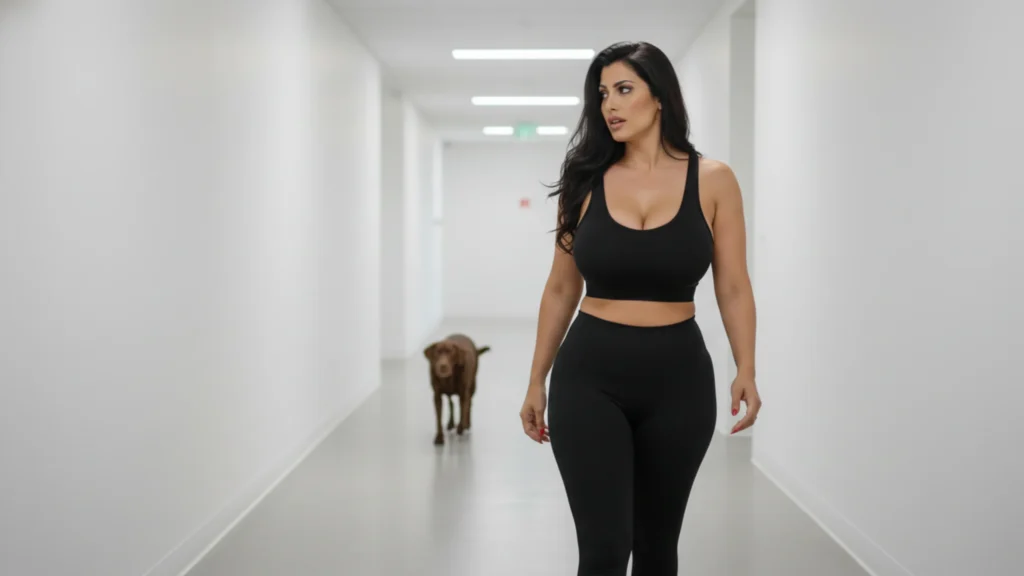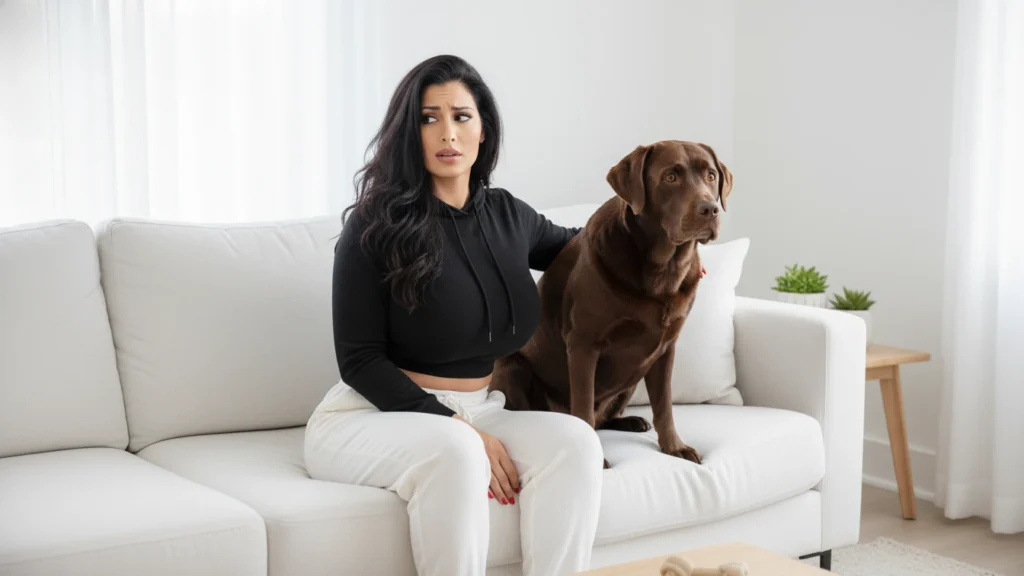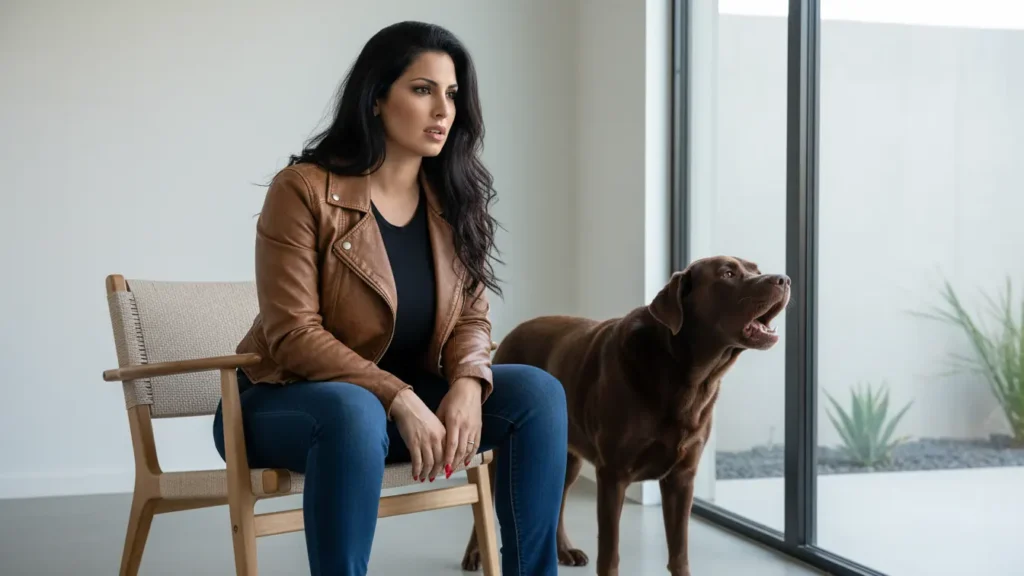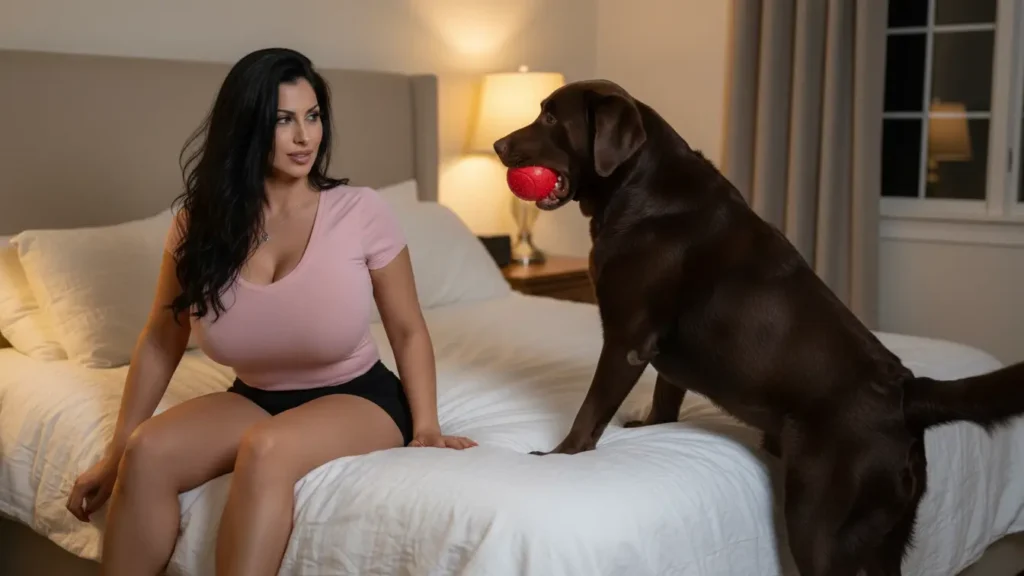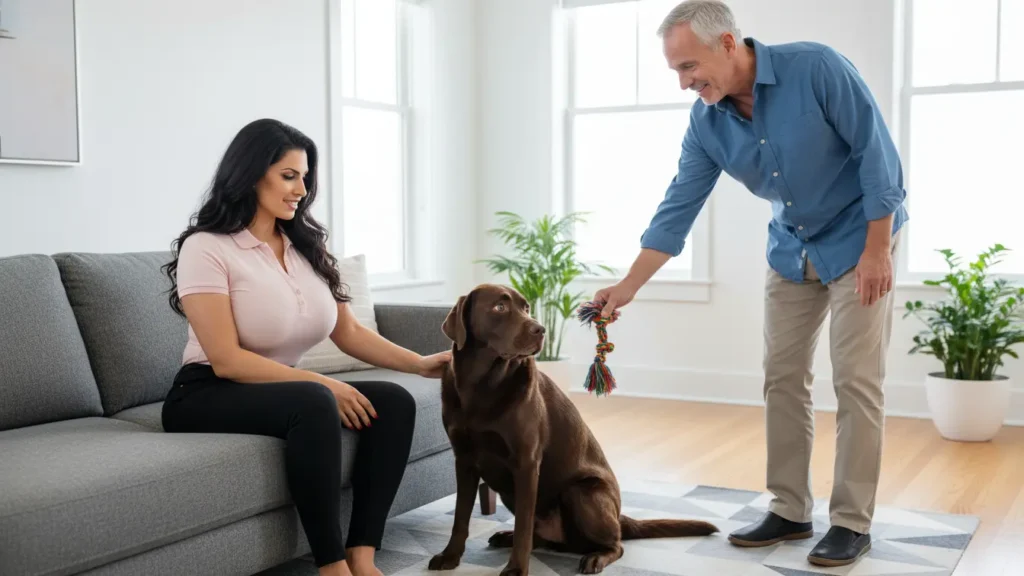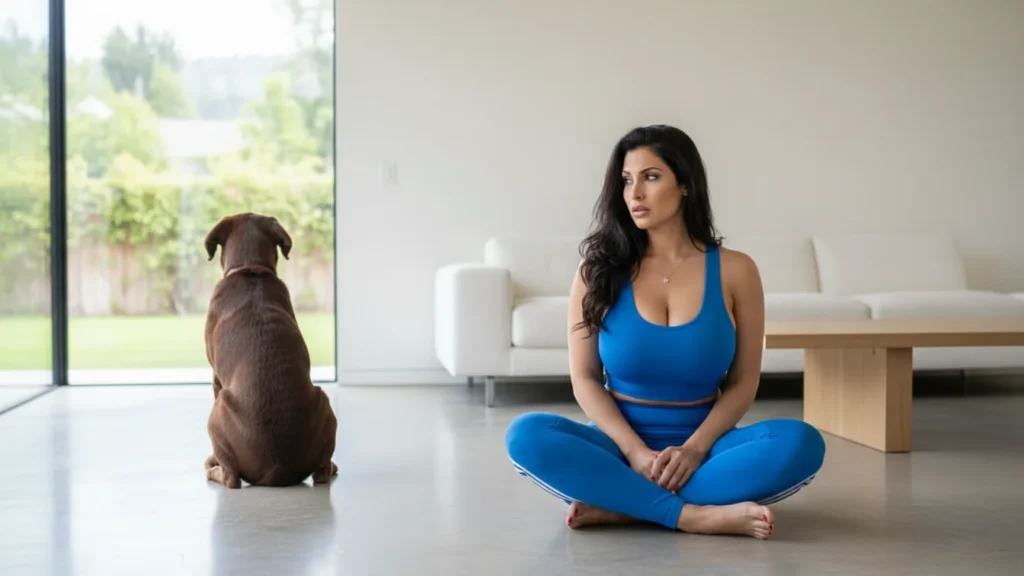
You’re on the couch, your dog hops up, circles once, and settles down — butt against your leg, nose pointed at the room instead of at you. If you didn’t know any better, it might feel a little like being snubbed. In human terms, turning your back on someone mid-conversation is about as close to “I’m done talking to you” as body language gets.
Dogs, thankfully, are not sending that message. In fact, a dog sitting with its back to you is very often doing the opposite of ignoring you — it’s one of the clearest compliments in the canine playbook. But like most dog behavior, context matters, and there’s a real difference between “facing away because he trusts you completely” and “facing away because he needs space.” Here’s how to tell which one you’re looking at.
The Trust Explanation: Why Turning a Back Is a Compliment, Not a Snub
To understand why this behavior means the opposite of what it would in a human interaction, it helps to think about vulnerability. A dog’s teeth, eyes, and the ability to react quickly to a threat are all at the front of its body. Turning that front end away from something means giving up your best defenses and your best warning system, all at once.
Animals don’t do that around things they’re worried about. They do it around things they’ve already decided are safe.
So when your dog sits with his back to you on the couch, or lies down facing away while you’re in the room, he’s essentially saying: I don’t need to watch you. I already know you’re not a threat. It’s the four-legged equivalent of someone falling asleep on your shoulder — a small, physical act of letting their guard down that only happens once trust is already established.
This lines up with how veterinary behavior experts describe canine trust signals more broadly: <cite index=”35-1″>a trusting dog shows relaxed body language, soft eyes, and comfort around the person they’re with</cite>, and that ease often extends to not feeling the need to keep visual tabs on you. A dog who’s unsure of you, by contrast, tends to do the opposite — watching closely, keeping some distance, and staying angled so they can react quickly if needed.
There’s often a practical bonus layer to this too. Many dogs learn that presenting their back — or their rear end — reliably earns a scratch in a hard-to-reach spot, so the behavior can become partly habit as well as pure trust signaling. Either way, the underlying message is the same: comfort, not distance.
The Other Explanation: When Facing Away Means Something Different
Here’s where context becomes essential, because a dog turning its body away from you can also be a stress or avoidance signal — just in a very different setting than “curled up on the couch.”
Canine body language researchers classify a deliberate body turn — rotating the body or just the head away from a person, following something like being looked at, approached, or spoken to — as a recognized avoidance behavior, especially when paired with a low or tense posture, ears back, or a tucked tail. This is a dog trying to create a little distance or lower the intensity of an interaction that feels like too much, not a dog settling in for a nap.
The giveaway is almost always the setup and the accompanying body language:
Likely trust and comfort if:
- It happens during calm, low-stakes moments — relaxing on the couch, lying near you on the floor
- The body is loose, the breathing is easy, and the tail (if you can see it) is neutral or gently moving
- Your dog backs into you or leans against you while facing away
- Nothing prompted it — no approach, no reach, no direct stare from you beforehand
Possibly stress or avoidance if:
- It happens right after you reached toward them, stared at them, or gave a command
- The posture is tense, low, or crouched, with ears pinned back
- It’s paired with lip-licking, yawning, or a stiff, still body
- It follows a scolding, an unwelcome interaction, or an approach from a stranger or another dog
- Your dog moves away from you specifically, rather than just settling with their back toward you
The core difference: comfortable back-turning happens with a soft, loose body in a relaxed setting. Avoidance-based turning happens with a tense body, usually right after something triggered it.
Other Related Behaviors Worth Knowing
A few close cousins of this behavior are worth being able to recognize, since they often show up in the same conversation:
- Backing into your legs when greeting you or asking for attention — almost always a friendly, affectionate gesture, not a defensive one.
- “Whale eye” — where a dog turns its head away but keeps its eyes locked on whatever’s bothering it, showing the whites of the eyes in a half-moon shape. This is a stress signal, distinct from a fully relaxed back-turn, and it’s a useful one to recognize because it often precedes a dog needing space.
- Leaning rather than turning — a dog who leans their full weight into you while facing any direction is showing a related but slightly different form of trust: physical reliance on you for comfort or security.
Why This Distinction Actually Matters
It’s easy to lump all “dog turns away” moments into one bucket, but they call for opposite responses. If your dog is facing away from you in a relaxed, comfortable setting, there’s nothing to do — you’re simply being trusted, and that’s worth appreciating rather than second-guessing. If your dog is turning away from you specifically after an approach, a stare, or a correction, that’s useful feedback: they’re telling you, as clearly as they can, that something about the interaction needs to ease off. Respecting that signal — backing off, softening your approach, giving them space — tends to build exactly the kind of trust that leads to more of the relaxed, back-turned couch-cuddling in the first place.
The Bottom Line
A dog sitting with its back to you isn’t tuning you out — in most everyday settings, it’s one of the more understated ways dogs say “I trust you completely.” The exception is when that same movement shows up as a reaction to something specific, paired with a tense body and other stress signals — in which case it’s less about comfort and more about needing a little room. Learning to tell the two apart is less about memorizing rules and more about watching the whole picture: the setting, the posture, and what happened right before your dog turned away.
Sources & Further Reading
- Canine Communication – Interpreting Dog Language — VCA Animal Hospitals
- Signs Your Dog Is Stressed and How to Relieve It — VCA Animal Hospitals
- 6 Signs Your Dog Trusts You — PetMD
- Ethogram for Stress-Related Behaviors in Dogs — PLOS ONE (PMC/NIH)
Dr. Sofia Romano, DVM, is an experienced veterinarian specializing in small-animal medicine and preventive care. She has treated thousands of cases using evidence-based diagnostics and modern clinical practices. Dr. Romano is dedicated to providing science-backed pet-health guidance that helps owners make informed decisions and improve their pets’ quality of life.