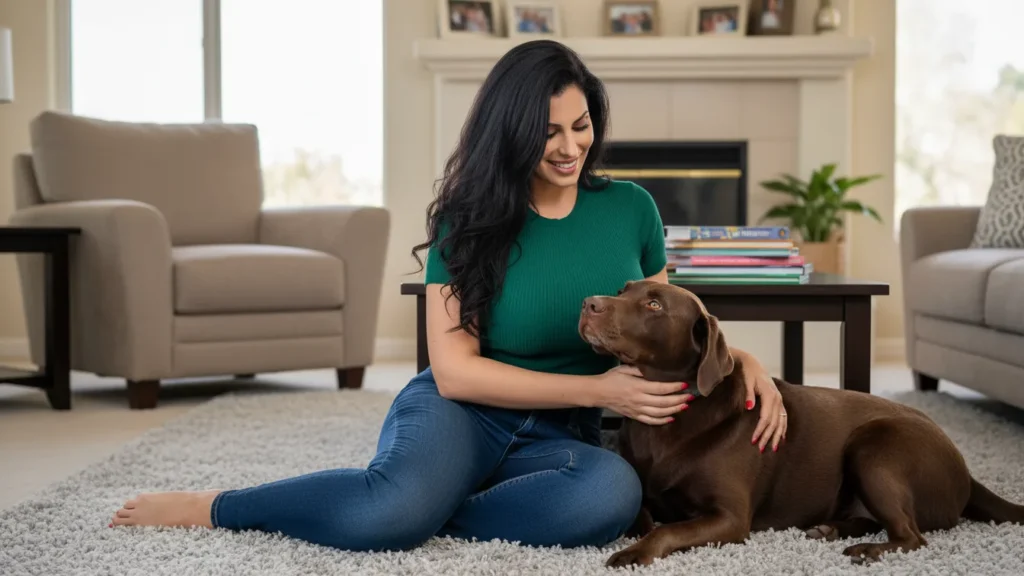
There’s one person the dog waits for at the window. One person whose car engine it recognizes from three houses away. One person it follows from room to room to room, even into the bathroom, even when nothing interesting is happening at all.
Everyone else in the house gets a wag. That one person gets everything.
It feels flattering — and it often is a sign of real love. But veterinary behaviorists have learned that this kind of single-person devotion can sit on a spectrum, and on the far end of that spectrum is something far less charming: a dog that cannot function without that one person in the room.
The Bond Is Real — And It’s Not “Just” Loyalty
Dogs don’t form generic affection for “the household.” They form specific, individual attachment bonds, and researchers have found these bonds behave remarkably like the ones between human infants and their caregivers. A dog with a secure attachment to its person will use that person as a psychological home base — a safe point to return to before confidently exploring anything unfamiliar, whether that’s a new park, a strange dog, or an unfamiliar house.
This isn’t sentimentality dressed up as science. Behavioral researchers have adapted the “Strange Situation” test — originally designed by psychologists to study attachment in human toddlers — for use with dogs, and found that dogs reliably seek more contact with their familiar person than with a stranger, especially when reunited after a brief separation. In multiple studies, dogs have even been shown to persist longer at difficult puzzle toys when their owner is nearby, using that person’s presence as quiet reassurance to keep trying.
So the tendency to fixate on one person isn’t a flaw in the dog. It’s the attachment system working exactly as evolution designed it — the same system, biologically speaking, that keeps a toddler close to a parent in an unfamiliar place.
Why One Person Specifically?
If attachment is universal, why do so many dogs pick a favorite rather than distributing that devotion evenly across a household? A few overlapping reasons show up again and again in behavioral research and clinical observation:
- Who did the early caregiving. Feeding, house-training, and comforting a dog through its early weeks and months build the foundation of trust — whoever does that heavy lifting early on often becomes the anchor for life.
- Consistency over time. Dogs gravitate toward whoever is most predictable — the person with the steadiest routine, tone, and presence, since predictability is what a dog’s nervous system is quietly scanning for.
- Breed tendencies. Certain breeds, including Akitas, German Shepherds, and Dobermans, were selectively bred for close, singular working partnerships with one handler, and that history still echoes in their temperament today.
- Oxytocin feedback loops. Physical affection and mutual gaze release oxytocin in both dog and human, and the person who engages in this the most often becomes the person the dog is, quite literally, chemically bonded to most strongly.
- Life stage and circumstance. A dog adopted during a specific life chapter — a single person’s apartment, a child’s early years — often imprints hardest on whoever was present and attentive during that formative window.
Where Devotion Quietly Becomes a Problem
Here’s the part that catches many owners off guard: the same bond that feels like the ultimate compliment can, in a subset of dogs, tip into what veterinary behaviorists call hyper-attachment — and hyper-attachment is one of the most common underlying patterns seen in dogs diagnosed with separation anxiety.
Veterinary behavior researchers describe hyper-attached dogs as excessively focused on one person — following them from room to room, needing constant physical contact, and becoming distressed the moment that person is out of sight, sometimes even refusing food in their absence. Clinical estimates suggest true separation anxiety affects somewhere between roughly 13% and 28% of pet dogs seen in veterinary behavior practices, while owner-reported concern runs considerably higher — recent surveys have found around a third of owners believe their dog struggles when left alone, and post-pandemic surveys pushed that self-reported number even further.
That gap between clinical diagnosis and owner perception matters. Not every clingy dog has a disorder. But the warning signs are worth knowing, because they show up gradually, often mistaken for “just being affectionate” until they aren’t:
- Pacing, whining, or barking that starts before you’ve even left the house
- Destructive chewing or scratching concentrated near doors and windows
- Drooling, panting, or trembling tied specifically to your departure
- Refusing to eat, drink, or rest unless you’re in the room
- Following you to literally every room, including ones with no reason to enter
Researchers note this isn’t always purely about attachment strength. Frustration, general anxiety, and even a dog’s underlying temperament can all tangle together with attachment to produce the same visible behaviors, which is part of why veterinary behaviorists are cautious about treating every clingy dog as a textbook case.
The Human Side of the Equation
Interestingly, research on human-pet bonds has found something worth sitting with: people with a more anxious attachment style in their own human relationships often form unusually intense attachments to their dogs, sometimes leaning on that bond to fill a gap left by less secure human relationships. That’s not a criticism — dogs are wonderful sources of comfort — but researchers have flagged that when a dog becomes someone’s primary or only source of emotional security, both ends of that relationship can end up more anxious, not less.
In other words: hyper-attachment can be a two-way street. A dog’s clinginess and a person’s own reliance on that dog can quietly reinforce each other.
What Actually Helps
The good news is that a securely attached, deeply bonded dog and an anxiously over-attached one often look identical on a good day — the difference only shows up in how the dog copes with distance. A few evidence-informed habits make a real difference:
- Practice “invisible” departures and returns. Keep leaving and coming home low-key. Dramatic goodbyes and excited reunions teach a dog that your departure is a big event worth being anxious about.
- Build independence in small doses. Short, calm separations — even just a closed door for a few minutes — help a dog learn that alone time isn’t dangerous, before it’s ever tested by a real absence.
- Spread the caregiving. Let other members of the household handle feeding, walks, and play sometimes. A dog that has multiple trusted people has more emotional flexibility, not less love for its favorite.
- Give your dog a job while you’re gone. Puzzle feeders, chew toys, and scent-based enrichment redirect nervous energy into something productive rather than distress.
- Talk to a vet or veterinary behaviorist if signs escalate. True separation anxiety is a recognized clinical condition, and structured behavior modification — sometimes alongside veterinary guidance — has a strong track record of improving it.
The Takeaway
A dog that adores one person above all others isn’t malfunctioning — it’s doing exactly what its species has always done, forming a focused, protective bond with the person it trusts most. The goal isn’t to talk your dog out of loving you fiercely. It’s to make sure that love comes with enough security, structure, and independence that being your dog’s whole world doesn’t quietly become the thing that scares it most: being without you, even for a moment.
Sources and further reading:
- Attachment to dogs and mental health — PMC / NIH
- Evaluating the Strange Situation Procedure to assess dog-human bonds — PMC / NIH
- Attachment style and quality of life for assistance dog owners — PMC / NIH
- Separation Anxiety in Pets — Texas A&M College of Veterinary Medicine
- Home alone: Canine separation anxiety — dvm360
- A descriptive study of 215 dogs diagnosed with separation anxiety — ScienceDirect

Dr. Sofia Romano, DVM, is an experienced veterinarian specializing in small-animal medicine and preventive care. She has treated thousands of cases using evidence-based diagnostics and modern clinical practices. Dr. Romano is dedicated to providing science-backed pet-health guidance that helps owners make informed decisions and improve their pets’ quality of life.




Pingback: Why Dogs Can Smell Your Stress — The Hidden Emotional Sense That Explains Their Uncanny Bond With Humans
Pingback: Why Dogs Stay Alert During Owner Phone Calls — The Subtle Signals Your Dog Is Reading Before You Notice