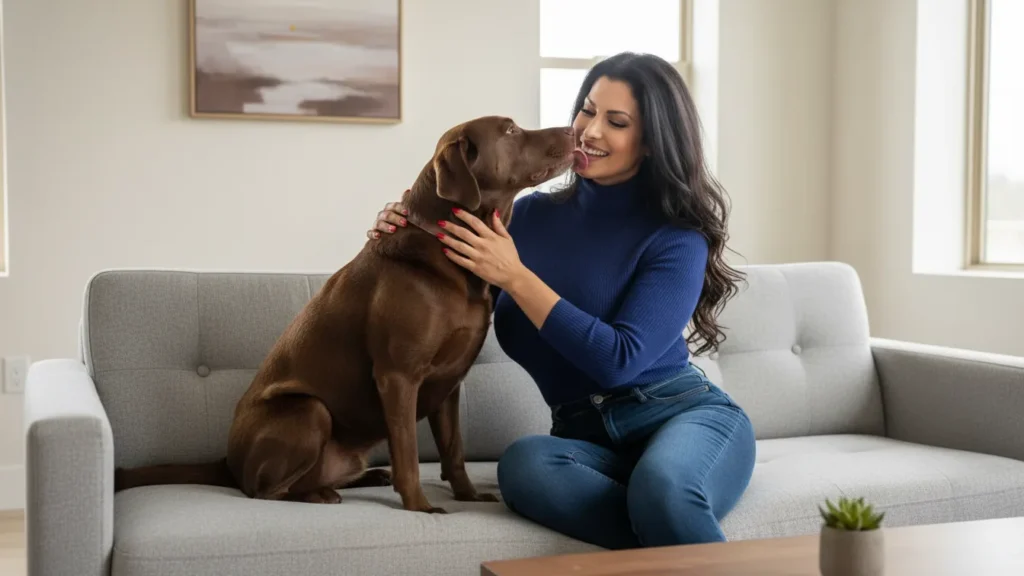
There’s a particular kind of trust dogs show that’s easy to take for granted. You take your dog to a vet’s office full of strange smells and stranger dogs, and they still glance back at you before deciding how nervous to be. You put a leash on them and walk into unfamiliar territory, and they follow. You leave the room, and something in them visibly settles the moment you walk back in.
This isn’t just obedience or habit. Researchers who study the human-dog bond have found that it runs on some of the same biological and psychological machinery that connects human parents to their children — and that this particular kind of cross-species trust may be something dogs evolved specifically to do.
The Same Chemistry as a Parent and Child
One of the most striking findings in this field came out of a 2015 study published in the journal Science. Researchers led by Miho Nagasawa measured oxytocin — often nicknamed the “bonding hormone” because of its central role in parent-infant attachment — in both dogs and their owners before and after a period of interaction that included mutual eye contact.
The results showed something remarkable: when dogs gazed at their owners for longer stretches, both the dog’s and the owner’s oxytocin levels rose. The owner’s rising oxytocin then appeared to increase affectionate behavior toward the dog, which in turn raised the dog’s oxytocin further — a self-reinforcing loop. Critically, when researchers ran the identical experiment with hand-raised wolves and their human caregivers, the effect didn’t appear. Wolf gaze didn’t trigger the same oxytocin rise in their handlers.
To test whether the relationship was actually causal rather than coincidental, the researchers administered oxytocin nasally to dogs before they interacted with their owners. The treated dogs gazed at their owners more — and that increased gazing then raised the owners’ oxytocin too. The researchers concluded that this gaze-triggered oxytocin loop likely evolved specifically during dog domestication, essentially wiring dogs into the same neurochemical bonding pathway that humans use with their own children.
Dogs Use Their Owner as a “Secure Base” — Just Like a Toddler Does
Decades before the oxytocin research, developmental psychologists studying human infants had already established a concept called attachment theory: young children treat their primary caregiver as a “secure base,” someone whose presence makes them feel safe enough to explore an unfamiliar environment, and a “safe haven” they retreat to when something frightens them.
Researchers eventually adapted the exact same experimental protocol used to study infant attachment — the Ainsworth Strange Situation Test — for dogs and their owners. The setup places a dog in an unfamiliar room through a series of episodes: alone with the owner, joined by a stranger, left alone with the stranger, and reunited with the owner. Across multiple independent studies using this test, dogs have reliably shown behavior that mirrors what researchers see in securely attached children: they explore more confidently when their owner is present, seek proximity to their owner over a stranger, and show measurable stress responses — including elevated heart rate and cortisol — when left without them.
One study measuring dogs’ heart rates found that a threatening approach from a stranger raised a dog’s heart rate significantly less when their owner was present than when the dog faced it alone — a real physiological buffering effect, not just a behavioral preference. Researchers describe this as a “safe haven effect,” directly borrowing the language used to describe how a parent’s presence calms a distressed child.
There’s also a documented link between the quality of that attachment and a dog’s stress physiology day to day. In one study comparing securely and insecurely attached dogs through the same testing procedure, dogs classified as insecurely attached showed significantly higher salivary cortisol after the stressful test than securely attached dogs did — suggesting the strength of a dog’s trust in their owner has measurable effects on how well they cope with stress in general.
Why This Bond May Be Unique to Dogs
Here’s a detail worth sitting with: this isn’t just “any domesticated animal grows to trust its caregiver.” When researchers ran a comparable attachment study on domestic pigs — also a domesticated species that lives closely with humans — pigs showed much less evidence of true attachment behavior toward their human caregivers compared to dogs, despite similar early-life exposure to people. The researchers concluded that alongside general domestication, dogs appear to have been specifically and intensely selected, likely across thousands of years, for dependence on and attunement to humans in a way that other domesticated species were not.
That lines up with what we know about the dog domestication timeline. Somewhere around 15,000 years or more of cohabitation with humans has apparently shaped dogs into a species uniquely wired to recruit human caregiving instincts — instincts humans otherwise reserve almost entirely for other humans.
What the Science Suggests About Your Own Dog
- That look your dog gives you isn’t just habit — it’s doing something biologically real. Sustained eye contact between you and your dog is associated with a genuine oxytocin rise in both of you, the same hormone system involved in human parent-child bonding.
- Your presence functions as an actual stress buffer, not just a comfort. Research shows dogs display measurably lower heart-rate spikes and cortisol responses to stressful situations when their trusted person is nearby.
- Consistency matters for the quality of that trust. Dogs classified as securely attached in research settings show better stress regulation overall — which tracks with what many owners already sense: a stable, predictable relationship seems to produce a calmer dog.
- This bond appears to be something dogs were shaped for, specifically. It isn’t simply “smart animal learns habits.” The comparative research against wolves and pigs suggests dogs carry something more particular: a species-level adaptation for trusting humans the way children trust caregivers.
The trust in your dog’s eyes when they look up at you isn’t sentimentality you’re projecting onto them. It’s backed by hormone data, stress physiology, and a body of attachment research that keeps landing in the same place: dogs didn’t just learn to live alongside us. Somewhere in the last several thousand years, evolution built them to bond with us the way we bond with our own kind.
Sources & Further Reading
- Oxytocin-gaze positive loop and the coevolution of human-dog bonds — Science
- The Importance of the Secure Base Effect for Domestic Dogs — PLOS ONE
- Human Analogue Safe Haven Effect of the Owner: Behavioural and Heart Rate Response to Stressful Social Stimuli in Dogs — PLOS ONE / PMC
- Physiological Indicators of Acute and Chronic Stress in Securely and Insecurely Attached Dogs — PMC/NIH
- Dogs, Humans, and the Oxytocin-Mediated Strong Social Bond — Psychology Today

Dr. Sofia Romano, DVM, is an experienced veterinarian specializing in small-animal medicine and preventive care. She has treated thousands of cases using evidence-based diagnostics and modern clinical practices. Dr. Romano is dedicated to providing science-backed pet-health guidance that helps owners make informed decisions and improve their pets’ quality of life.


Pingback: Why Dogs Sense Tension Before Arguments Start — The Invisible Signals They Read Before We Speak