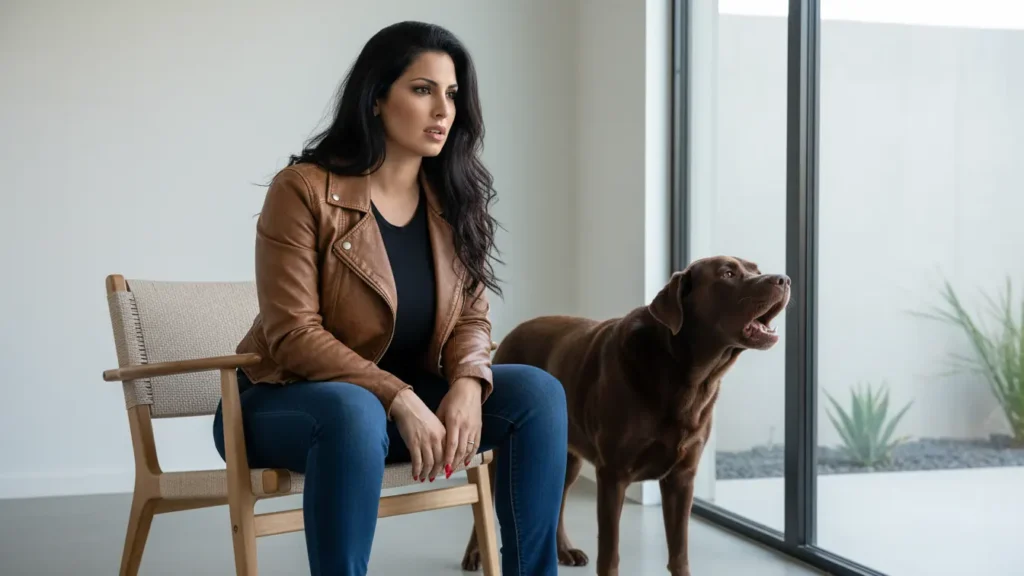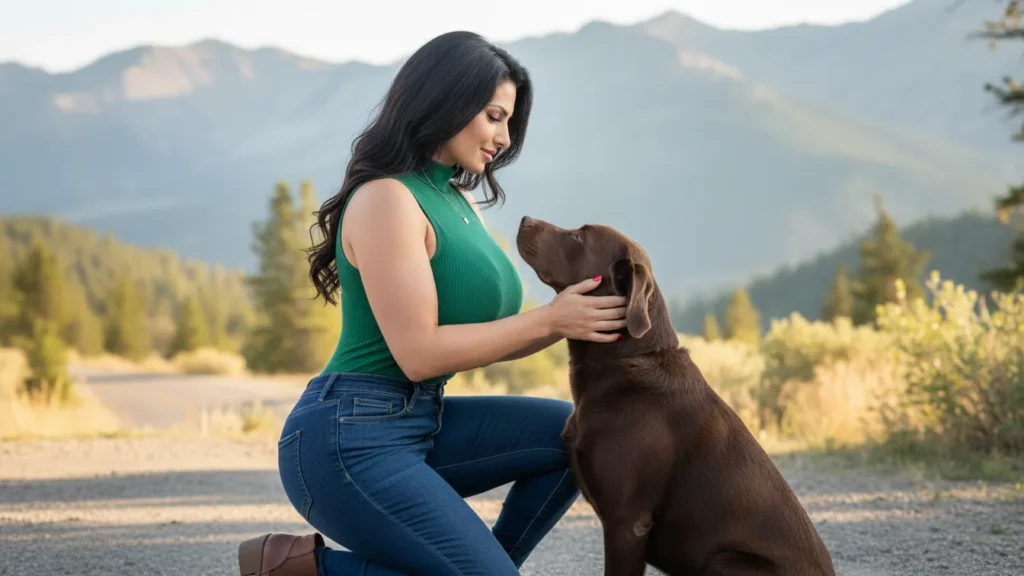
You’ve felt it: the moment your dog looks up at you with those big, soft, almost pleading eyes, and something in your chest just melts. It feels involuntary — like your dog found a switch in you and knows exactly how to flip it. As it turns out, that’s not far from the truth. Dogs’ eyes carry a surprising amount of real, decodable emotional information, and part of it may have literally evolved for the specific purpose of working on you.
“Puppy Dog Eyes” Are a Real, Evolved Muscle
The most striking discovery in this area comes from a 2019 study published in the Proceedings of the National Academy of Sciences by Dr. Juliane Kaminski and colleagues at the University of Portsmouth. Researchers dissected the facial anatomy of dogs and wolves and found a specific muscle — the levator anguli oculi medialis, responsible for intensely raising the inner eyebrow — present in dogs but essentially absent in wolves.
When researchers then observed live dogs and wolves interacting with a person for two minutes, dogs raised their inner eyebrows significantly more often, and with far greater intensity, than wolves did. The movement makes a dog’s eyes appear larger and more infant-like, and researchers noted it closely resembles the expression humans produce when they’re sad — a combination that appears to trigger a strong, largely involuntary nurturing response in people. The study’s authors concluded that this muscle likely evolved over roughly 33,000 years of domestication specifically because dogs that could produce this expression more often gained a real advantage: humans unconsciously preferred and cared more for dogs that made it.
That advantage wasn’t just theoretical. A related study by Waller and colleagues found that in a shelter setting, dogs who raised their inner eyebrows more frequently in front of visitors were adopted significantly faster than dogs who did it less — real evidence that this specific eye movement shapes how humans respond to dogs, right now, not just across evolutionary time.
Pupils Reveal Arousal — Positive and Negative Alike
Beyond the eyebrow, a dog’s pupils themselves carry genuine emotional information, though reading them takes some nuance. Dilated pupils in a dog are a sign of heightened arousal — but that arousal can be either excited/positive or fearful/negative, so pupil size on its own needs to be read alongside the rest of a dog’s body language rather than in isolation. A relaxed, content dog typically has pupils sized appropriately for the ambient light, without that glassy, wide-open look; a dog that’s fearful, threatened, or in a defensive state often shows visibly dilated pupils regardless of lighting.
Interestingly, researchers have found that this isn’t a fixed trait — it can be modulated biologically. In one study, dogs given nasal oxytocin, the same hormone involved in the human-dog bonding gaze loop, showed measurably different pupil responses to photos of angry versus happy human faces compared to dogs given a placebo. Under normal conditions, dogs’ pupils dilated more when looking at angry faces than happy ones — consistent with heightened vigilance toward a potential threat. Oxytocin treatment reversed this pattern, suggesting the hormone shifts how much emotional weight a dog’s visual system assigns to threatening versus friendly human expressions.
“Whale Eye” Is One of the Clearest Warning Signs You Can Learn
If there’s one eye signal every dog owner should be able to recognize, it’s what veterinary behaviorists call “whale eye” — when a dog turns its head away from something while keeping its eyes fixed on it, revealing a crescent of white sclera in the corner of the eye. This is a well-documented and widely used indicator in canine behavior assessment: it typically signals discomfort, anxiety, or a dog that wants more space, often appearing alongside other stress cues like a stiffened body, pinned ears, or lip licking.
Whale eye is worth taking seriously specifically because it often shows up before more obvious warning signs like growling or snapping. A dog showing whale eye while guarding food, being approached by an unfamiliar person, or in an uncomfortable situation is communicating discomfort in one of the earliest, clearest ways available to them — well before things escalate.
A related but distinct signal is the “hard stare”: a fixed, unblinking gaze with visibly dilated pupils and a tense face and body. Unlike a soft, relaxed, shifting gaze — which usually reflects curiosity or calm attentiveness — a hard stare is widely recognized by behaviorists as a precursor to defensive or aggressive escalation, and is a signal to give the dog space rather than approach.
Gaze Itself Is a Bonding Signal
It’s not just what a dog’s eyes look like — where and how long they look matters too. Sustained, voluntary eye contact between a dog and their owner has been linked to rising oxytocin levels in both species, part of the same gaze-mediated bonding loop covered in research on human-dog attachment. This is part of why a dog’s gaze toward you often feels different in quality from their gaze toward a stranger or an object — it plausibly reflects a real, hormonally reinforced social bond rather than simple visual tracking.
Slow blinking during calm, affectionate moments — sometimes informally called “dog kisses” by trainers — is also widely recognized as a relaxation signal, roughly the canine equivalent of a person’s softened, unguarded expression during a comfortable moment with someone they trust.
What This Means for Reading Your Own Dog
- Those “puppy dog eyes” aren’t manipulation in a calculated sense — they’re an evolved communication tool. Your dog isn’t scheming; the expression is a genuine, biologically wired signal, and it’s supposed to make you want to take care of them.
- Dilated pupils alone don’t tell you if a dog is happy or scared — check the rest of the body. Loose, bouncy posture with dilated pupils usually means excitement or play; a stiff body with dilated pupils usually means fear or threat.
- Whale eye is worth learning to spot immediately. It’s one of the most reliable early-warning signals in a dog’s entire behavioral vocabulary, and respecting it — by giving space rather than pushing closer — can prevent a situation from escalating.
- A soft, sustained gaze toward you is a real sign of trust and bonding, not just idle staring — it’s tied to the same biological bonding loop that makes your relationship with your dog measurably reciprocal.
Your dog’s eyes were never just windows into curiosity or hunger. Between an evolved muscle built to win your affection, pupils that shift with genuine emotional arousal, and warning signals fine-tuned over thousands of years of living alongside us, there’s a real and readable language happening every time your dog looks at you — you just have to know what you’re looking for.
Sources & Further Reading
- Evolution of facial muscle anatomy in dogs — Proceedings of the National Academy of Sciences (PNAS)
- The evolution of puppy dog eyes — University of Portsmouth
- Nasal Oxytocin Treatment Biases Dogs’ Visual Attention and Emotional Response toward Positive Human Facial Expressions — PMC/NIH
- Canine Body Language Tips — ASPCApro
- Adopter-dog interactions at the shelter: Behavioral and contextual predictors of adoption — ScienceDirect

Dr. Sofia Romano, DVM, is an experienced veterinarian specializing in small-animal medicine and preventive care. She has treated thousands of cases using evidence-based diagnostics and modern clinical practices. Dr. Romano is dedicated to providing science-backed pet-health guidance that helps owners make informed decisions and improve their pets’ quality of life.