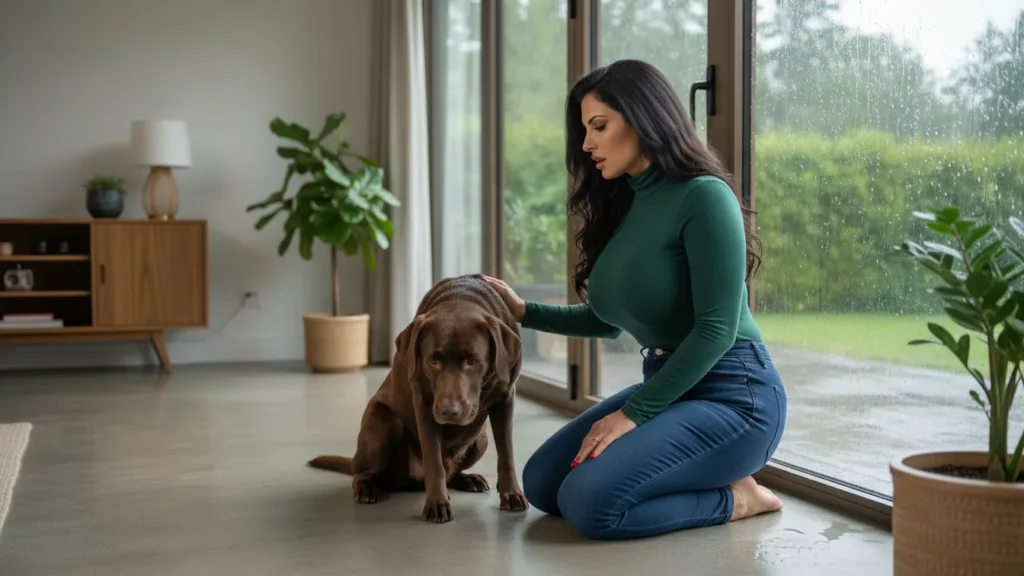
Hours before a storm even shows up on the radar, some dogs already know. They pace. They pant for no clear reason. They dig at the corner of the couch, refuse to settle, or press themselves against your leg like something’s wrong. To you, the sky still looks calm. To your dog, the world has already started changing.
This isn’t superstition, and it isn’t coincidence. Dogs are picking up on real physical signals — ones that exist well before the first drop of rain falls, and long before most humans notice anything different at all.
Their Bodies Feel the Pressure Drop Before Their Eyes See the Clouds
One of the most well-documented triggers behind pre-storm behavior is barometric pressure. As a weather front approaches, atmospheric pressure typically drops, and dogs appear to feel that shift internally, through their ears, sinuses, and joints. For many dogs, it’s simply an uncomfortable sensation. For dogs with arthritis or old injuries, a pressure drop can translate into real joint pain and stiffness, which shows up as restlessness or reluctance to move.
Some researchers have also proposed that dogs may detect the low-frequency infrasound waves generated as a weather front moves in — vibrations far below what human hearing can register. If that theory holds, it would give dogs something close to a built-in early warning system, one likely shaped by generations of ancestors who benefited from sensing danger before it arrived.
Their Ears Catch the Storm Miles Before You Do
A dog’s hearing range extends well beyond human capability, picking up frequencies far outside what we can detect. That means the rumble of distant thunder — still many miles away and completely silent to you — may already be audible to your dog. This is often why a dog appears anxious or on edge seemingly out of nowhere: they’re not reacting to nothing, they’re reacting to thunder you simply can’t hear yet.
Their Nose Smells the Storm Coming
Scientists estimate a dog’s sense of smell is somewhere between 10,000 and 100,000 times more sensitive than a human’s. That level of olfactory power lets dogs detect subtle chemical shifts in the air that accompany changing weather — including the distinctive scent of rain approaching and the ozone released by distant lightning strikes.
If your dog suddenly starts sniffing the air with unusual intensity, lifting their nose and scanning the room, it’s often this exact mechanism at work. They’re not just curious. They’re gathering information about a change that hasn’t reached your senses yet.
Static Electricity: The Sensation Most Owners Never Consider
One lesser-known factor is static buildup. Storms can increase static electricity in the air, and dogs — especially those with thick or long coats — may feel that charge building up in their fur before and during a storm. Some behaviorists believe this uncomfortable, tingling sensation is part of why certain dogs seek out grounded spaces like a bathtub, tiled floor, or basement during storms, since these surfaces may offer some relief from the static charge.
Recognizing the Signs
Pre-storm behavior tends to follow recognizable patterns, even if it looks different from dog to dog. Common signals include:
- Pacing or an inability to settle in one spot
- Excessive panting without physical exertion
- Whining or unusual vocalization
- Hiding, often in small, enclosed spaces
- Clinginess or repeatedly seeking physical contact
- Frantic sniffing of the air
- Trembling or visible restlessness
Between roughly 15% and 30% of dogs show genuine fear responses to thunder and lightning specifically, which means a notable portion of dogs aren’t just mildly bothered by storms — they’re genuinely frightened by them, often well before the storm is even visible.
When It’s More Than Just Weather Sensitivity
Most weather-related behavior changes are temporary and settle once conditions pass. But if your dog’s reaction seems unusually extreme, lasts far longer than the weather event itself, or is accompanied by signs like excessive scratching at the ears, limping, or behavior that doesn’t resolve once the storm clears, it’s worth a veterinary visit. A pressure-related reaction can sometimes overlap with — or mask — an unrelated issue like an ear infection, joint problem, or an underlying anxiety disorder that deserves its own attention.
How to Help Your Dog Through It
You can’t stop your dog from sensing the shift, but you can make the experience less overwhelming:
- Create a safe, enclosed space — a covered crate, closet, or quiet room — where your dog can retreat when they’re feeling unsettled.
- Stay calm yourself. Dogs pick up on human stress easily, and a composed, steady presence can help regulate theirs.
- Use white noise or calming sound to soften distant thunder and reduce how much your dog can hear.
- Offer a distraction, like a stuffed food toy or chew, to redirect nervous energy into something productive.
- Talk to your vet about anxiety support if storms trigger consistently severe reactions — there are safe, effective options for dogs whose fear goes beyond typical restlessness.
The Bigger Picture
What looks like your dog “acting weird” before a storm is really a finely tuned sensory system doing exactly what evolution built it to do — picking up on pressure shifts, distant sound, subtle scent, and electrical charge long before those changes become obvious to us. Your dog isn’t overreacting to nothing. They’re reacting to a storm that, as far as their senses are concerned, has already begun.
Sources
- Weather.com — It’s Confirmed: Dogs Sense Storms Before Humans Do
- American Kennel Club — Understanding Dog Anxiety
- VCA Animal Hospitals — Noise Aversion in Dogs
- PetMD — Why Do Dogs Get Anxious During Storms?
- Merck Veterinary Manual — Behavioral Problems of Dogs

Dr. Sofia Romano, DVM, is an experienced veterinarian specializing in small-animal medicine and preventive care. She has treated thousands of cases using evidence-based diagnostics and modern clinical practices. Dr. Romano is dedicated to providing science-backed pet-health guidance that helps owners make informed decisions and improve their pets’ quality of life.






Pingback: Why Dogs Get Diarrhea Out Of Nowhere — The Hidden Triggers Most Owners Never Notice