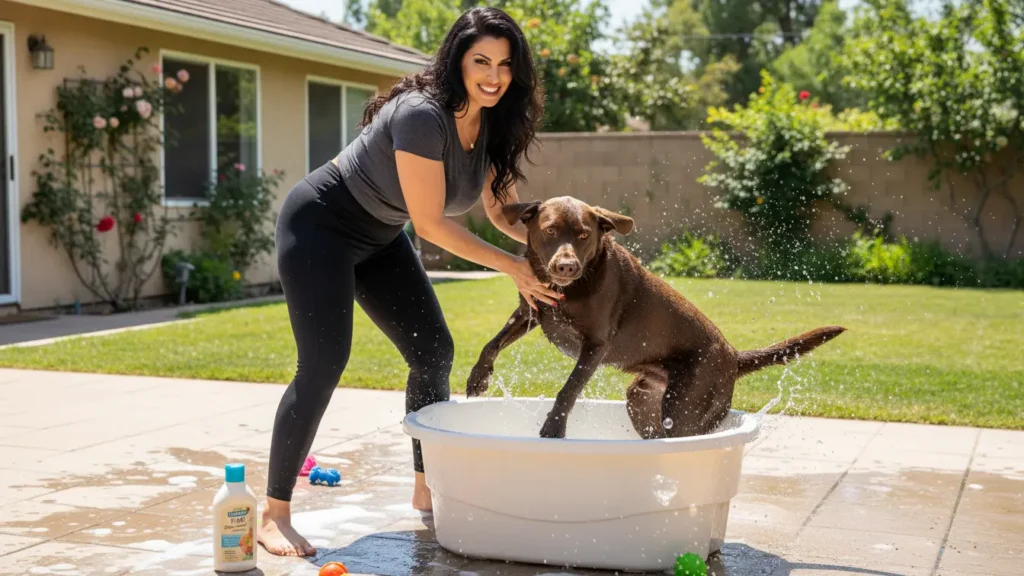
Here’s the detail that makes this genuinely puzzling: plenty of dogs who dread the bathtub will happily cannonball into a lake, chase a ball into the surf, or stand in a rainstorm looking thrilled about it. Even classic water-loving breeds like Labrador Retrievers often balk the moment they’re lifted into a tub. Which means the obvious explanation — “my dog just doesn’t like water” — is usually wrong. Something about the bath specifically is the problem, not water itself.
It’s the Bath, Not the Water
Once you rule out water as the actual issue, a clearer picture emerges: bath time bundles together several genuinely stressful elements at once, in a way that swimming or playing in a puddle simply doesn’t. A dog splashing in a lake chooses to be there, chooses how deep to go, and can leave whenever they want. A dog in a bathtub has none of those choices. That loss of control turns out to be doing most of the work here — not the water itself.
The Footing Problem
Start with something simple: a wet bathtub or shower floor offers almost no traction. For an animal whose entire sense of physical safety depends on stable footing, that’s genuinely destabilizing — when a dog can’t get solid purchase under their paws, an instinctive alarm response kicks in that has very little to do with willpower or trust and a lot to do with basic physical self-preservation. This single factor alone accounts for a meaningful share of bath-time panic, and it’s also one of the easiest to fix, with something as simple as a rubber mat.
Their Hearing Makes the Bathroom Genuinely Loud
Dogs hear across a dramatically wider frequency range than humans do, which means sounds that register as unremarkable background noise to us — a running faucet, a showerhead, water hitting a tub — can land as something closer to a roar for a dog. Bathrooms make this worse structurally: small rooms with hard, echo-heavy surfaces amplify and distort sound in ways a dog’s more sensitive hearing picks up acutely. Add the specific vibration of water pipes or a nearby pump, and what feels like an ordinary bath to you can be a genuinely overwhelming acoustic environment for your dog.
Being Restrained Feels Like Being Trapped
Dogs are generally used to a fair amount of bodily autonomy — where to stand, where to move, how close to let something get. A bath removes essentially all of that at once: lifted, held in place, scrubbed, sprayed, and often unable to leave even if they try. Veterinary sources consistently point to this loss of agency as one of the central drivers of bath-time anxiety, distinct from any specific sensory discomfort. It’s less “I hate getting wet” and more “I have no way to opt out of any part of this,” which is a genuinely stressful position for most animals to be in regardless of species.
One Bad Bath Can Shape Every Bath After It
Dogs are excellent at forming strong associations between a specific place or event and how it made them feel. Water that’s too hot or too cold, shampoo stinging in the eyes, a slip that triggered real fear, or simply being rushed and handled roughly during a single early bath can be enough to color every bath that follows. This is part of why a dog who’s only ever bathed after something unpleasant — a muddy mess, a skunk encounter, a vet-recommended medicated wash — can start associating the bathroom itself with the idea that something bad is about to happen, independent of the bath’s actual content.
You’re Probably Part of the Equation, Too
This one’s worth sitting with honestly: dogs are remarkably good at picking up on their owner’s emotional state, and bath time is often a moment where owners are already bracing for a struggle. If you approach the bath tense, rushed, or frustrated — even without raising your voice — your dog is likely picking up on that tension and reading it as confirmation that something concerning is happening. The dread, in other words, can become genuinely mutual and self-reinforcing, each of you anticipating the other’s stress before the water even starts running.
What Actually Helps
The good news in all of this: because the real drivers are mostly identifiable and fixable — footing, sound, control, and past association — there’s real, practical leverage here. A non-slip mat addresses the footing issue directly. Lukewarm water poured gently rather than sprayed loudly reduces both the temperature risk and the acoustic overwhelm. Letting a dog choose to step into the tub rather than being lifted or pushed restores some sense of control. And building positive associations gradually — treats, calm handling, short sessions that end before stress peaks — is the same evidence-based approach, systematic desensitization and counter-conditioning, that behaviorists use for essentially every fear-based issue in dogs.
For dogs whose reaction goes beyond ordinary reluctance into genuine panic — shaking, attempting to bite, refusing treats entirely during the bath — that’s a sign the fear has moved past what home troubleshooting alone typically resolves, and a certified professional trained in fear-free or low-stress handling techniques is worth bringing in rather than continuing to push through it alone.
Your dog’s bath-time dread was never really about getting wet. It’s a specific, identifiable stack of stressors — unstable ground, overwhelming sound, lost autonomy, and sometimes a genuinely bad memory — that happens to only show up in one particular room of the house.
Sources & Further Reading
- Why Do Some Dogs Hate the Bath? — Chewy
- Why Do Dogs Hate Baths? 6 Vet-Verified Reasons & Helpful Tips — Dogster
- Why Do Dogs Hate Baths? (& How to Bathe a Scared Dog) — Hill’s Pet
- How to Bathe a Dog That Hates Water: 8 Vet-Approved Tips — Stuck Soap
- Why Do Dogs Hate Baths? — Animal Medical Center of Bel Air

Dr. Sofia Romano, DVM, is an experienced veterinarian specializing in small-animal medicine and preventive care. She has treated thousands of cases using evidence-based diagnostics and modern clinical practices. Dr. Romano is dedicated to providing science-backed pet-health guidance that helps owners make informed decisions and improve their pets’ quality of life.



Pingback: How To Socialize A Fearful Dog Without Breaking Their Trust — What Actually Works