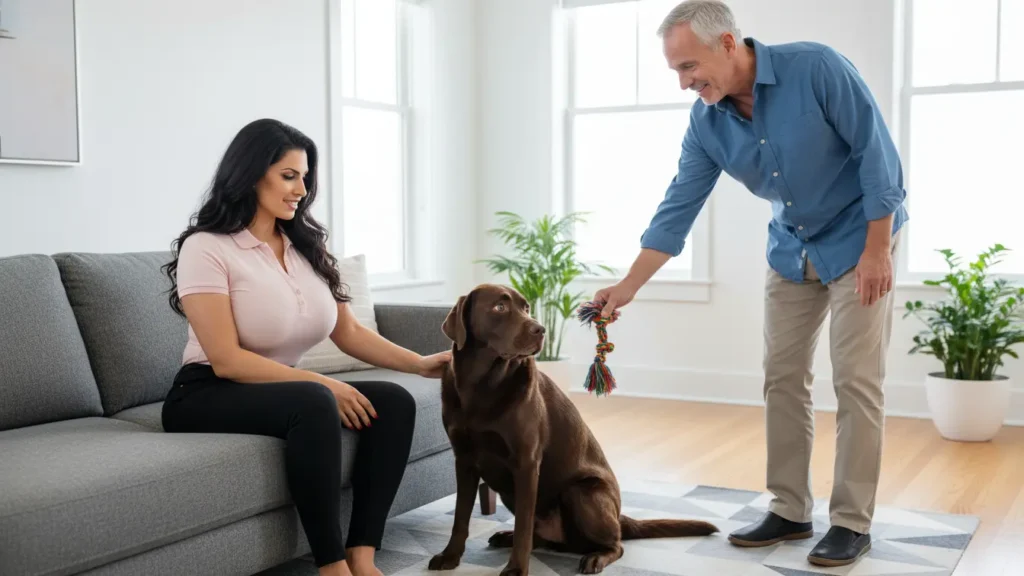
You haven’t said a word about it. No one’s rung the doorbell. But your dog is already pacing near the entryway, ears up, tail doing that stiff, uncertain wag that isn’t quite excitement and isn’t quite worry either.
Ten minutes later, the doorbell rings, and suddenly his behavior makes sense to you. But it made sense to him ten minutes ago — because he wasn’t reacting to the guest. He was reacting to everything that happened before the guest, all the small, overlapping signals that told him something was about to change in his world, long before you consciously noticed any of them yourself.
Your Dog Isn’t Predicting the Future. He’s Reading the Present More Closely Than You Are
It’s tempting to treat this kind of anticipatory behavior as something mysterious — a sixth sense, an intuition beyond explanation. The far more interesting truth is that it isn’t mysterious at all. It’s the natural result of a nervous system built almost entirely around picking up exactly the kind of subtle cues most humans have learned to tune out.
Dogs live inside a sensory environment layered with information most people never process consciously: faint sounds, shifting scents, small changes in a household’s rhythm. When a guest is about to arrive, several of those layers change at once — and your dog is often responding to the combination, not a single dramatic signal.
Signal One: You Change Before the Guest Ever Shows Up
Long before a knock at the door, you’ve usually already changed your own behavior — and your dog has been trained by years of living with you to notice.
Getting the house tidier than usual. Moving with a different rhythm. Checking the time more often. Setting out extra plates or snacks. None of this is dramatic to you; it barely registers as behavior at all. But behaviorists studying dog anticipation note that dogs are remarkably attuned to shifts in their owner’s body language and daily patterns — subtle cues like putting on shoes, adjusting appearance, or moving with unusual purpose can signal to a dog that something is about to change, well before any external evidence of a guest appears.
This is the same mechanism behind a phenomenon veterinary behavior resources describe extensively in a different context: pre-departure cues. According to the ASPCA, dogs learn over years of repetition to associate specific, seemingly minor actions — picking up keys, putting on a coat — with a coming event, to the point where the cue itself starts triggering a reaction before anything else happens. The same learning process applies just as easily to guest arrivals as it does to departures. If getting the vacuum out, opening certain cabinets, or checking the clock reliably precedes visitors in your house, your dog has almost certainly learned that pattern, even if you never consciously taught it to him.
Signal Two: He’s Smelling Something You Can’t
This is where things get genuinely remarkable. Dogs process the world through scent to a degree that’s difficult for humans to intuitively grasp, and one of the more striking demonstrations of this ability comes from research on how precisely dogs can detect human physiological states through smell alone.
A peer-reviewed study published in PLOS ONE found that dogs could reliably distinguish between a person’s baseline scent and their scent after a stress-inducing task, using breath and sweat samples alone — with the dogs in the study identifying the stress sample correctly more than 93% of the time. The researchers concluded that the physiological changes accompanying acute stress alter human breath and sweat in ways detectable to dogs, without any visual or auditory cues required at all.
Why does this matter for guests arriving? Because the moments before a visit are frequently, if mildly, stressful for the host. Last-minute tidying, a slightly elevated heart rate, the low hum of “I hope everything’s ready” — all of it changes your body chemistry in ways a dog can pick up on well before you’re consciously aware of feeling anything. Your dog isn’t imagining your nervousness. There’s a reasonable chance he’s smelling it.
Signal Three: Sound Arrives Before It Reaches You
The most straightforward explanation is also one of the most powerful: dogs simply hear things sooner and more precisely than people do. A car turning onto your street, footsteps on a walkway, a car door two houses down — sounds that are still below your threshold of conscious attention can already be fully audible and identifiable to your dog.
This same sensory gap shows up in research on dogs anticipating their owners’ return home. Investigations into this behavior have found that dogs often begin reacting well before any sound a human could plausibly hear, suggesting a combination of extremely sensitive hearing and learned pattern recognition — the sound of a particular engine, a particular gait, a particular rhythm of footsteps that the dog has filed away through repetition. A guest who visits often enough may have an equally recognizable “signature” to your dog long before you’d notice anything at all.
Signal Four: Learned Association, Repeated Until It’s Automatic
None of this requires anything mystical — it requires repetition. Veterinary behavior resources describing how dogs learn household routines note that these animals are exceptionally good at identifying which specific actions or sounds reliably predict a particular outcome, and once that link is formed, the dog responds to the cue itself, independent of the event that originally created the association.
This is precisely why a dog can seem to “know” a guest is coming before there’s any direct evidence of one: he’s not reacting to the guest at all. He’s reacting to the pattern — the assembled combination of your behavior, a faint scent shift, and early sound cues — that his experience has taught him reliably precedes a visitor.
Why This Matters Beyond Being a Fun Fact
Understanding this isn’t just trivia — it’s useful, particularly for dogs who find guest arrivals stressful rather than exciting.
A dog who reacts anxiously to visitors isn’t only responding to the doorbell moment. If he’s already picking up on your pre-visit tidying, your shifted body language, and the earliest sounds of an approaching car, then the anxious response may be building for several minutes before the guest is even visible — which means waiting until the door opens to manage his stress is often starting the intervention too late.
For dogs prone to over-arousal or anxiety around visitors, this explains why calm, low-key routines around anticipated guest arrivals can help more than owners expect. If your own movements and energy stay steady rather than shifting into a visibly “prepping for company” mode, you remove several of the early cues your dog would otherwise be reading and reacting to well before anyone arrives.
What You Can Do With This
Notice your own pre-guest routine. If your dog reliably gets anxious or overexcited before visitors, look at what you do in the twenty minutes beforehand. Tidying in a rush, checking the clock repeatedly, or moving with unusual urgency may be functioning as an early cue your dog has learned to key off of.
Practice neutral versions of your own cues, the same way behaviorists recommend for departure anxiety. Do your “getting ready for guests” routine on ordinary days when no one is coming, so the pattern stops reliably predicting a visitor and your dog’s response to it softens over time.
Give an anxious dog a job before the early signals even start, rather than waiting for the doorbell. A settled mat cue, a food puzzle, or a practiced “place” command introduced well before a guest is due can interrupt the anticipatory buildup rather than trying to manage it after it’s already peaked.
Keep your own energy calm during the lead-up, not just at the door. Since dogs appear to pick up on physiological stress signals through scent, staying genuinely relaxed in the run-up to a visit — not just acting relaxed once the guest is inside — may do more to settle your dog than any cue at the door itself.
The Bigger Picture
Your dog isn’t guessing when he starts acting differently before guests arrive. He’s assembling a remarkably accurate picture from information you’re not even aware you’re broadcasting — your shifting behavior, the faint chemical signature of your own anticipation, and sounds still below your own threshold of hearing.
None of it is a sixth sense. It’s a nervous system built, quite literally, to notice what yours has learned to filter out — and once you see the pattern behind it, the “mysterious” moment right before the doorbell rings stops feeling mysterious at all.
Sources
- American Kennel Club – Can Dogs Sense Stress?
- PLOS ONE – Dogs Can Discriminate Between Human Baseline and Psychological Stress Condition Odours
- ScienceDaily – Dogs Can Smell When We’re Stressed, Study Suggests
- ASPCA – Separation Anxiety
- VCA Animal Hospitals – Separation Anxiety in Dogs

Dr. Sofia Romano, DVM, is an experienced veterinarian specializing in small-animal medicine and preventive care. She has treated thousands of cases using evidence-based diagnostics and modern clinical practices. Dr. Romano is dedicated to providing science-backed pet-health guidance that helps owners make informed decisions and improve their pets’ quality of life.