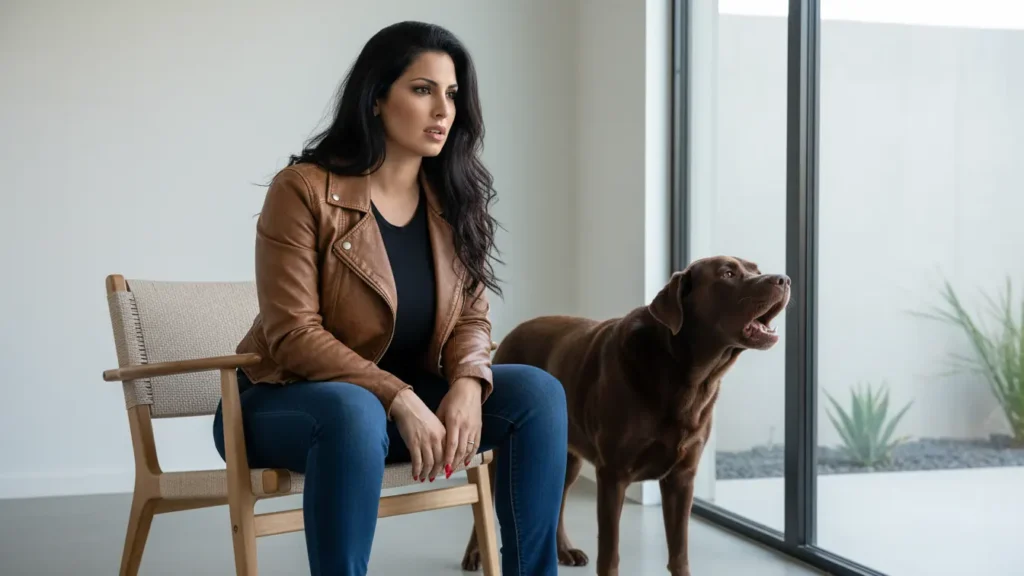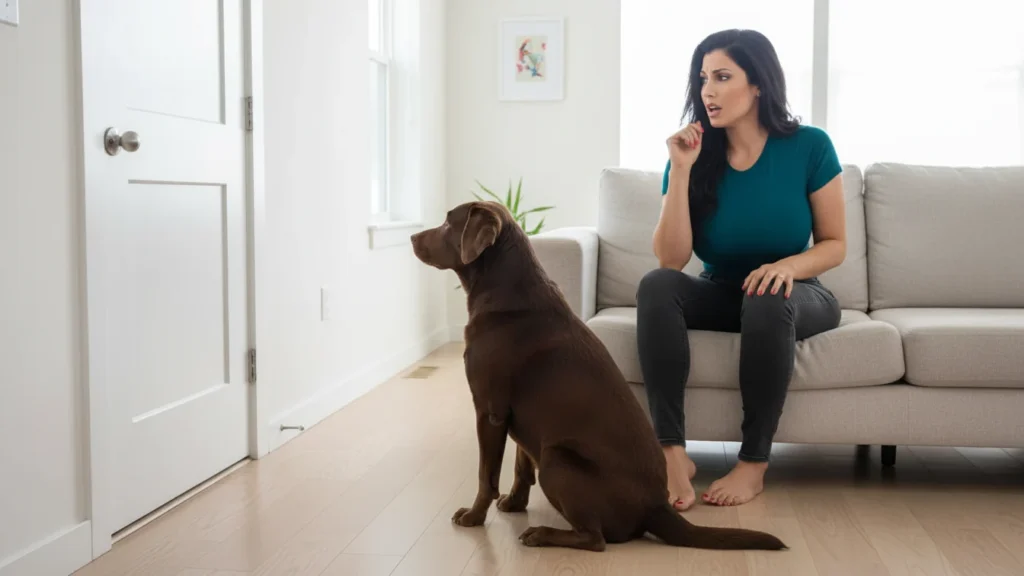
You’re deep into a movie, the house is quiet, nobody’s expected — and yet there’s your dog, lying by the front door, ears perked, eyes locked on it like a package is about to arrive.
No knock. No footsteps outside. No car in the driveway. Just… watching.
It’s one of those small, strange dog behaviors that most owners quietly notice and never really question. Is she waiting for someone? Is he anxious? Is this normal, or a sign something’s wrong?
The answer is a little bit of all three — and it says a lot about how differently dogs experience time, sound, and security compared to us.
Dogs Live in a World of Sound You Can’t Hear
The simplest explanation is also the most overlooked: your dog probably is noticing something — you just can’t perceive it.
Dogs can hear frequencies up to roughly 45,000 Hz, compared to the human ceiling of around 20,000 Hz, and their hearing range extends further at the low end too. Their ears also contain far more muscles than ours — up to 18, compared to our 6 — allowing them to rotate and pinpoint sound sources with remarkable precision. A neighbor’s door closing two houses away, a car slowing down on the street, wind shifting a gate — all of it can register clearly to a dog long before it’s audible, or even relevant, to you.
So when your dog stares at the front door with no obvious trigger, there’s a good chance the trigger exists. It’s just outside your sensory range.
But Sometimes, It’s Not About Sound at All
If door-watching happened only during identifiable sounds, it wouldn’t be nearly as puzzling. But many dogs do it during total silence, at consistent times of day, or right around when a specific person usually comes home — even before that person has left work.
This points to something more interesting than acute hearing: anticipatory behavior rooted in routine and time-pattern learning.
1. Dogs Track Time Through Pattern, Not Clocks
Dogs don’t understand “5:30 PM.” But they absolutely understand the sequence of environmental and internal cues that precede 5:30 PM — changing light levels, the sound of a particular street getting busier, their own hunger cycle, or simply the passage of a duration they’ve learned to associate with a person’s return.
Research on canine time perception suggests dogs can distinguish between different durations of absence and adjust their greeting behavior accordingly — dogs left alone longer tend to show more intense greeting responses than dogs left alone briefly, which indicates some internal tracking of elapsed time. Door-watching that ramps up “right on schedule” is often this system in action: not psychic anticipation, but a well-trained internal clock built from thousands of repetitions.
2. Classical Conditioning Runs Deeper Than We Realize
Every single day, a return home is preceded by the same sequence: a car in the driveway, keys jingling, footsteps on the porch, the door handle turning. Dogs are exceptional at picking up on associative chains like this — it’s the same learning mechanism behind Pavlov’s famous experiments.
Over time, dogs don’t need the full sequence to start anticipating. A single early cue — even one buried in the noise of daily life — can be enough to trigger door-watching well before anyone is actually near the house. The behavior can look premature or unprompted, but it’s really just conditioning working exactly as it’s supposed to, sometimes triggered a little early or by a false positive.
3. Attachment and Hypervigilance
For some dogs, especially those with a strong attachment bond to a specific person, door-watching isn’t about sound or scheduling at all — it’s about monitoring access to their secure base.
Dogs form attachment relationships with their primary caregivers that behavioral researchers have compared structurally to the attachment bonds seen in human infants. A securely attached dog checks in periodically. But a dog with heightened attachment anxiety — often shaped by past separation experiences, inconsistent routines, or a naturally more anxious temperament — may spend disproportionate time monitoring the point of return, essentially staying “on watch” for the person they’re most bonded to.
In these cases, door-watching isn’t casual curiosity. It’s a low-level vigilance behavior, and it often shows up alongside other signs like pacing, sighing, or reduced settling throughout the day.
4. Boredom and Under-Stimulation
Sometimes the explanation is far less complex: the dog simply doesn’t have anything better to do.
Dogs that are under-exercised or under-stimulated often default to environmental monitoring as a form of engagement. Watching the door provides a small, repeatable source of novelty and mild anticipation in an otherwise uneventful day — not unlike a person checking their phone out of habit rather than genuine expectation.
How to Tell the Difference
Not all door-watching means the same thing, and reading the context matters:
- Calm, occasional watching, easily interrupted → Likely just alert curiosity or mild anticipation. Nothing concerning here.
- Watching that intensifies at consistent times, paired with relaxed body language → Learned time-pattern anticipation. Normal and even a little charming.
- Watching paired with pacing, whining, or inability to settle → Possible attachment-related vigilance or early separation anxiety, worth monitoring.
- Watching that appears suddenly in a previously relaxed dog → Worth ruling out hearing changes, cognitive changes in senior dogs, or a recent stressful event that’s shifted their baseline alertness.
What You Can Do
- Provide enrichment. Puzzle feeders, sniff walks, and training sessions reduce the “nothing else to do” version of door-watching by giving your dog a more engaging use of their attention.
- Avoid overly dramatic greetings. Big, excited hellos and goodbyes can accidentally reinforce the idea that comings and goings are high-stakes events worth intense monitoring.
- Build calm independence. Encouraging your dog to settle in a bed or another room, rather than always near the entrance, can gently shift their default resting spot away from vigilance mode.
- Rule out hearing or cognitive changes in older dogs showing new or unusual watching behavior, since sensory decline can change how dogs orient toward sound.
- Don’t punish it. Door-watching is rarely misbehavior. In most cases, it’s simply a dog doing what dogs do best: paying close attention to a world that never quite stops being interesting to them.
The Bigger Picture
That quiet moment of your dog staring at the door isn’t random, and it isn’t nothing. It’s a glimpse into a sensory and cognitive world built on sound you can’t hear, patterns you didn’t realize you’d taught, and a bond most dogs take seriously enough to keep watch over.
Most of the time, it’s not worry. It’s devotion, wrapped in very good hearing.
Sources
- American Kennel Club – How Well Do Dogs Hear?
- American Veterinary Society of Animal Behavior – Position Statements on Canine Behavior
- ASPCA – Separation Anxiety in Dogs
- Cornell University College of Veterinary Medicine – Canine Cognition and Sensory Health
- Journal of Veterinary Behavior – Attachment Bonds and Time Perception in Domestic Dogs

Dr. Sofia Romano, DVM, is an experienced veterinarian specializing in small-animal medicine and preventive care. She has treated thousands of cases using evidence-based diagnostics and modern clinical practices. Dr. Romano is dedicated to providing science-backed pet-health guidance that helps owners make informed decisions and improve their pets’ quality of life.