Your dog wakes up from a nap, arches into that dramatic downward-dog pose, and holds it for a few seconds before shaking it off. Ten minutes later, she does it again at the door. And again when you pick up the leash. If you’ve ever wondered whether your dog is secretly a yoga instructor — or whether all that stretching means something is wrong — you’re asking a smarter question than you might realize.
Stretching isn’t just one behavior. It’s a whole language, and dogs use it constantly: to invite play, to release tension, to wake up their nervous system, and sometimes, to quietly tell you something hurts. The tricky part is that all of these stretches can look similar to an untrained eye. Here’s how to actually tell them apart.
First, the Biology: Why Dogs Stretch So Much in the First Place
Before you read anything into your dog’s behavior, it helps to know this: near-constant stretching is completely normal and even biologically necessary. Scientists call the instinctive stretch-and-release motion animals do after rest pandiculation — the involuntary contracting and lengthening of muscles that resets the nervous system and prepares the body to move. Cats and dogs pandiculate as often as 40 to 50 times a day. It’s the same reflex behind a human’s post-nap stretch and yawn, just far more frequent in our four-legged companions.
So if your dog stretches constantly throughout the day, that alone isn’t a red flag — it’s her body doing routine maintenance, restoring blood flow and muscle tone after periods of stillness. The real skill is learning to read the context around each stretch, because that’s where the actual message lives.
1. The Play Bow: “Let’s Go!”
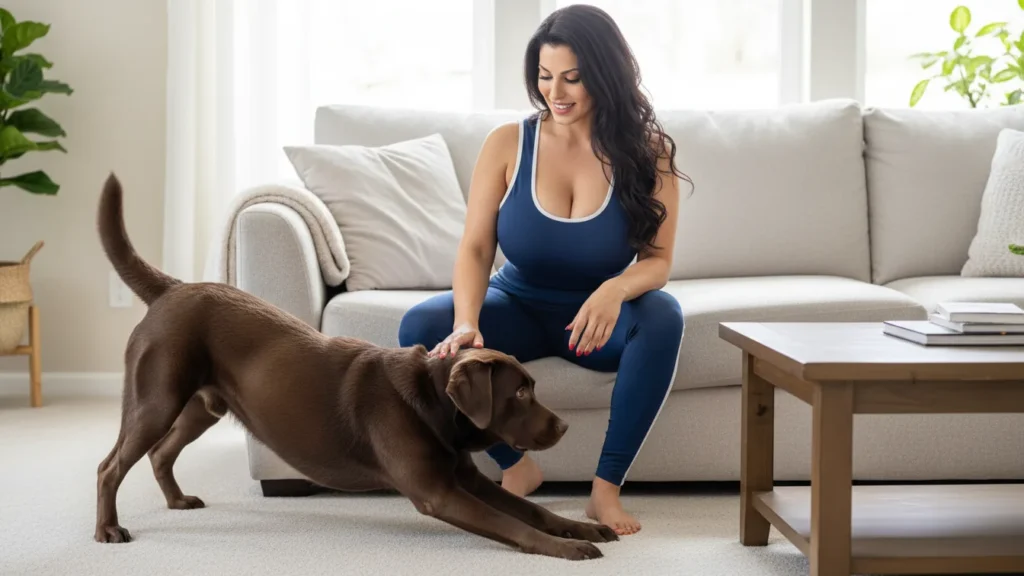
This is the stretch most owners already recognize, even if they don’t know its name. Front legs stretched forward, elbows nearly touching the floor, rear end high in the air, tail wagging, mouth relaxed and open. Trainers call it the play bow, and it’s one of the clearest, most universal signals in canine body language.
The play bow is a dog’s way of saying, “Everything that happens next is meant to be fun.” Dogs use it to invite play from both humans and other dogs, and it often shows up paired with a bouncy, exaggerated “butt wiggle” or a play growl. You’ll typically see it right as you walk through the door, right before you throw a ball, or when two dogs first meet and want to signal friendly, non-threatening intentions.
How to spot it: loose, wiggly body, wagging tail, open “smiling” mouth, and it’s almost always followed immediately by bouncing, chasing, or nudging — not by lying still.
2. The Wake-Up Stretch: Physical Maintenance
This is the classic full-body stretch — front legs extended forward, chest low, back legs stretched out behind, sometimes accompanied by a big yawn. It typically happens right after sleep, right before mealtime, or right before a walk.
Functionally, this stretch works nearly every major muscle group at once, relieving stiffness that builds up in the spine and limbs during rest and helping restore blood circulation before activity. It’s the canine equivalent of your own instinctive stretch-and-yawn combo first thing in the morning — and it’s a good sign, not a bad one. A dog who stretches thoroughly before getting up is simply prepping her body for movement.
3. The Greeting Stretch: Trust and Affection
Some dogs stretch specifically when you walk in the door or when you crouch down to say hello — even if they were wide awake beforehand. This is sometimes called a greeting stretch, and behaviorists consider it a genuinely emotional gesture rather than a purely physical one.
Because stretching lengthens the body and briefly puts a dog in a more exposed, vulnerable position, many dogs only do it around people or animals they feel safe and relaxed with. If your dog greets you with a stretch every time you come home, that’s less about sore muscles and more about comfort, trust, and a predictable, secure relationship with you.
4. The Stress Stretch: A Subtle Warning Sign
Here’s where things get more nuanced — and where a lot of owners miss the signal entirely. Stretching can also be a displacement behavior, a physical release valve dogs use when they’re anxious, conflicted, or unsure how to react to a situation.
Veterinary behavior experts note that while stretching is less commonly cited than other stress signals like yawning, lip-licking, or shaking off, it absolutely can indicate discomfort — especially if a dog who doesn’t normally stretch much suddenly starts doing it in response to a specific person, object, or situation. Because stretching triggers the release of tension-relieving hormones, dogs may use it almost like a self-soothing tool during moments of low-grade stress: meeting an unfamiliar dog, being approached by a stranger, or waiting anxiously near the vet’s exam table.
How to spot it: the stretch looks more rigid than relaxed — often paired with a stiff or lowered tail, a tucked posture, lip-licking, yawning, or a body that’s tense rather than loose and wiggly. It also tends to happen in a new or uncertain context rather than a familiar, happy one.
5. The Stiffness Stretch: When It’s Actually About Pain
The final category is purely physical: a dog stretching to relieve sore muscles or aching joints. This is far more common in senior dogs, large breeds carrying extra weight on their joints, and dogs with arthritis or other musculoskeletal issues. You may notice more frequent stretching after long naps, slower or more deliberate movement into the stretch, or audible joint popping in older dogs — all considered a normal part of aging, though worth mentioning at your next vet visit.
The warning sign to actually watch for isn’t stretching itself — it’s a sudden change in pattern. A dog who rarely stretched and now does it constantly, especially combined with reluctance to jump, limping, a hunched “prayer” posture held for unusually long periods, restlessness, vomiting, or abdominal tenderness, needs a same-day vet check. Repeated, exaggerated stretching paired with these symptoms can occasionally point to gastrointestinal pain or, in rare and more serious cases, bloat — a genuine emergency in dogs, especially large, deep-chested breeds.
Play Bow vs. Pain Stretch: The Quick Comparison
| Signal | Body Language | Context | What It Means |
|---|---|---|---|
| Play bow | Loose, bouncy, tail wagging, open mouth | Greeting, before play, meeting other dogs | “Let’s have fun!” |
| Wake-up stretch | Slow, full-body extension | After naps, before meals/walks | Normal muscle maintenance |
| Greeting stretch | Relaxed, calm, low-key | When you arrive home | Trust and affection |
| Stress stretch | Stiff, tense, tucked tail, lip-licking | New/uncertain situations | Anxiety or discomfort |
| Stiffness stretch | Slow, deliberate, joints popping | Seniors, after long rest | Age-related muscle/joint relief |
When to Simply Enjoy It (Most of the Time)
For the vast majority of dogs, stretching is nothing to worry about — it’s a normal, healthy, near-constant behavior woven into their daily routine, from waking up to greeting you to inviting a game of fetch. The goal isn’t to overanalyze every stretch your dog does. It’s to notice the exceptions: a new stretching pattern that appears out of nowhere, one that’s paired with tension rather than looseness, or one that shows up alongside other symptoms like limping, vomiting, or lethargy.
Learn your own dog’s normal stretching rhythm, and the abnormal moments will stand out clearly when they happen — which is exactly the kind of quiet, everyday awareness that helps you catch a real problem early.
Sources & Further Reading:
- Canine Journal — If Your Dog Stretches When They See You, This Is What They’re Really Saying
- Kinship — Why Does My Dog Stretch So Much? Reasons They May Need To
- The Dog Clinic — Dog Greeting Stretch: What Does It Mean?
- The Dog Alliance — Dog Bowing: What Does it Mean and When to Be Concerned
- ScienceABC — Why Do We Stretch When We Wake Up? (Pandiculation)

Dr. Sofia Romano, DVM, is an experienced veterinarian specializing in small-animal medicine and preventive care. She has treated thousands of cases using evidence-based diagnostics and modern clinical practices. Dr. Romano is dedicated to providing science-backed pet-health guidance that helps owners make informed decisions and improve their pets’ quality of life.