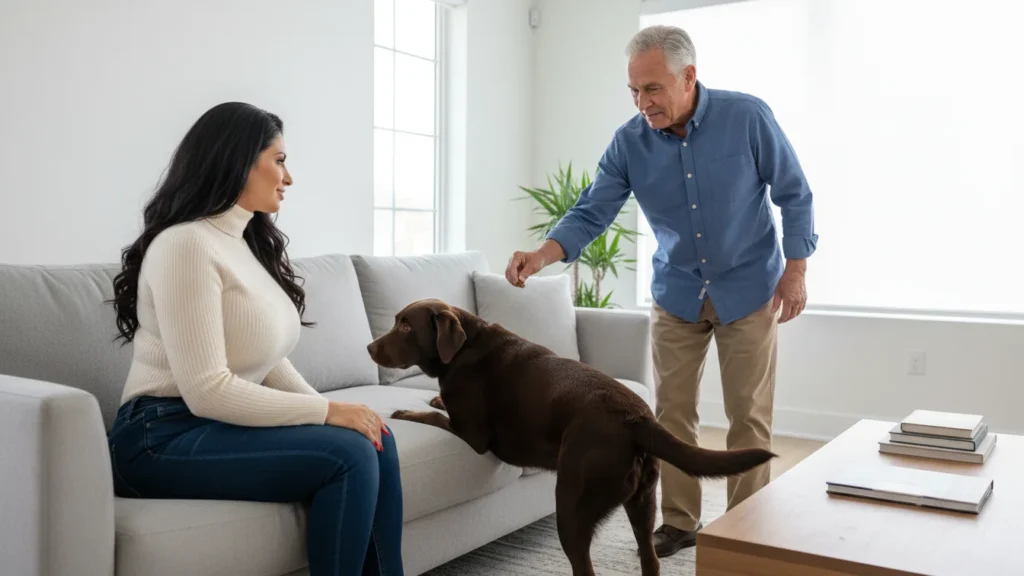
Same dog, same house, wildly different behavior depending on who walks through the door. He melts into a puddle for one person, barely glances up for another, and turns into a completely different animal — more obedient, more playful, more anxious — around a third. It can feel almost like living with several dogs at once.
It’s not favoritism in any simple sense, and it’s definitely not your dog being difficult. It’s the product of genuine attachment psychology, individual recognition, and — more than most owners realize — the specific patterns each family member has, often unknowingly, taught the dog to expect.
Dogs Form Real, Individual Attachment Bonds
This isn’t just anthropomorphizing. Research has repeatedly demonstrated that dogs form genuine attachment bonds with their human caregivers that closely mirror the attachment an infant forms with a parent — including the same core behavioral patterns and measurable hormonal responses. When researchers put dogs through adapted versions of the “Strange Situation Test” (originally designed to study infant-caregiver attachment), most dogs displayed classic secure-attachment behavior toward their primary person: seeking proximity, showing distress during separation, and exploring more confidently when that person was present.
Critically, dogs do not form this same depth of attachment with every person in a household equally. Attachment bonds are individual and specific — shaped by which person provides safety, consistency, and care most reliably — which is exactly why a dog’s behavior can look genuinely different depending on who’s in the room.
They Recognize Each of You as a Distinct Individual
Long before attachment style comes into play, dogs are working with a remarkably rich set of tools for telling family members apart:
- Scent — a dog’s sense of smell is powerful enough to memorize each person’s unique scent profile, allowing recognition even at a distance or out of sight.
- Voice — dogs can distinguish between different people’s voices, and even pick up on tone, pitch, and rhythm differences from the same person depending on their mood.
- Visual recognition — face, body language, gait, and posture all get learned and stored individually.
This means your dog isn’t just responding to “a person” — they’re responding to a specific individual with a specific history, and that history includes exactly how that person has treated them, communicated with them, and interacted with them over time.
The Biggest Factor: Consistency, Not Favoritism
Here’s the piece that surprises a lot of owners: much of the variation in how a dog treats each family member comes down to handler consistency, not affection or bonding depth alone. Dogs are constant pattern-recognition machines, and they build an individualized rulebook for every person in the house based on what that person actually enforces — not what the household theoretically agrees on.
A simple example: if one parent doesn’t allow the dog on the furniture and another quietly lets it slide, the dog isn’t confused or stubborn when they jump on the couch around the more lenient person — they’re accurately following two different sets of rules they’ve correctly identified. The same logic applies to leash pulling, jumping, counter-surfing, or coming when called: a dog will reliably comply with whoever consistently follows through, and will just as reliably test boundaries with whoever doesn’t.
Trainers describe this less as disobedience and more as sophisticated tracking: dogs notice and remember even small lapses in follow-through, and they adjust their behavior person-by-person to match what’s actually been enforced, rather than what’s supposed to be the household rule.
Tone, Body Language, and Energy Matter More Than the Words
Two people can say the exact same command word and get completely different responses, because dogs are reading far more than vocabulary. Posture, movement, facial expression, tone of voice, and even a person’s general emotional energy all factor into how a dog interprets a request. A hesitant, pleading, or overly excited tone can undercut a command just as much as inconsistent enforcement does — dogs tend to respond best not necessarily to the strictest person in the house, but to whoever is clearest and easiest to predict.
This is also why dogs often behave differently around children versus adults. Children tend to move more unpredictably, use higher-pitched excited tones, and blur the line between play and instruction from a dog’s perspective — which can make a dog’s response to them look more erratic, not because the dog trusts them less, but because the signals themselves are less consistent.
Different People, Different Roles
Dogs are also perceptive enough to associate specific people with specific kinds of value or interaction. A dog might seek out one person specifically for play, another for physical comfort or calm affection, and behave more submissively with one person while being noticeably bolder or more assertive with another. This isn’t a hierarchy of who’s loved more — it’s closer to a dog building an accurate mental map of what each relationship reliably offers.
What This Means If You Want More Balanced Behavior
The good news is that a dog’s differential treatment of family members isn’t fixed — it shifts as patterns shift. A few things reliably help even things out:
- Share the caregiving. Involving more than one family member in feeding, walks, and daily care helps the dog build a broader set of trusted relationships rather than orbiting a single person.
- Get everyone using the same rules and cues. Consistency across the household — not just within one person’s handling — is what actually teaches a dog to generalize good behavior to everyone, not just the “strict” one.
- Practice training together. Taking turns giving commands and following through on rewards helps establish more than one person as a reliable, trustworthy leader in the dog’s eyes.
- Mind your own energy. A calm, clear, confident tone tends to produce a calmer, more responsive dog than an anxious or uncertain one — dogs pick up on this instantly, regardless of who’s giving the command.
None of this means your dog loves anyone less. It means dogs are exceptionally good students of the people around them — and the differences you’re seeing are less a mystery and more a fairly accurate report card on how each person actually shows up.
Sources & Further Reading:
- Scientific American — Why Dogs Fit into Families So Well
- PMC / NCBI — Hierarchy-Dependent Behaviour of Dogs in the Strange Situation Test
- Highland Canine Training — Why Dogs Respond Differently To Different Family Members
- Dogzen — Why Does My Dog Respond Differently to Different People?
- San Diego Dog Training — Why Your Dog Only Listens to One Person in the Family

Dr. Sofia Romano, DVM, is an experienced veterinarian specializing in small-animal medicine and preventive care. She has treated thousands of cases using evidence-based diagnostics and modern clinical practices. Dr. Romano is dedicated to providing science-backed pet-health guidance that helps owners make informed decisions and improve their pets’ quality of life.

Pingback: Why Dogs Suddenly Avoid Eye Contact — The Quiet Signal They’re Trying To Send You
Pingback: Why Dogs Watch You Sleep — The Quiet Instinct That Keeps Them Awake While You Rest
Pingback: Why Dogs Sense Illness In Other Pets — The Invisible Biological Signals Humans Can’t Detect