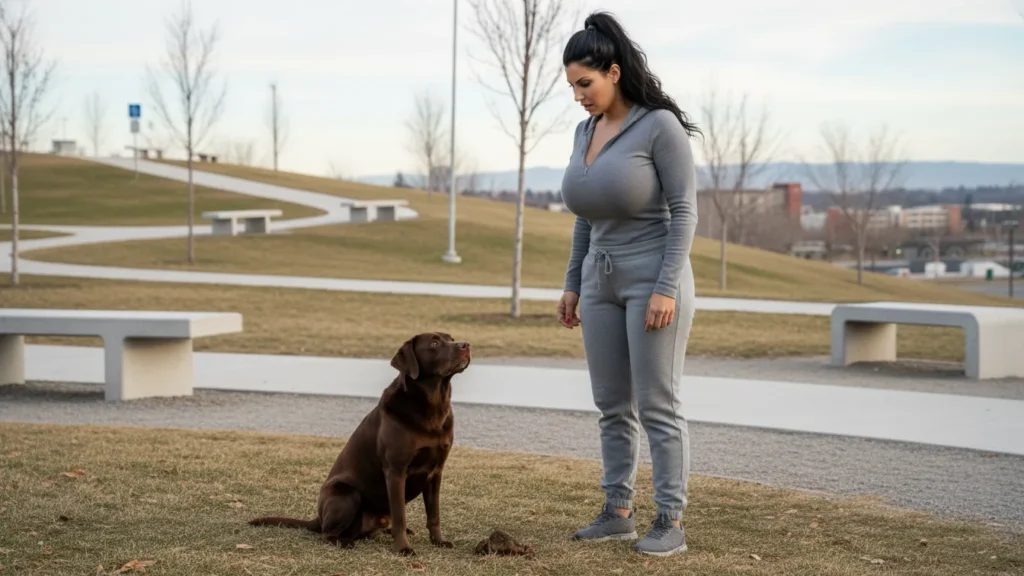
You’re standing on the sidewalk, poop bag in hand, waiting for your dog to finish their business. And then it happens — that unmistakable, unbroken stare. Not a glance. A full, locked-in gaze that somehow feels more intense than any eye contact you get from them during the rest of the day.
Most owners laugh it off, feel a little awkward, or joke that their dog has no sense of privacy. But there’s something far more interesting happening in that moment than embarrassment or coincidence. It’s one of the oldest instincts a dog carries, and it says more about your relationship than you’d expect.
The Real Reason: Vulnerability, Not Judgment
Squatting to defecate is one of the few moments when a dog genuinely cannot protect itself. Their legs are planted, their body is locked in position, and their ability to bolt, spin around, or react to a threat is severely limited. In the wild, this brief window was exactly when predators struck.
That instinct hasn’t disappeared just because your dog sleeps on a memory foam bed and eats from a ceramic bowl. According to veterinary behavior resources at VCA Animal Hospitals, dogs in this position are looking to their owner for protection, watching closely for any change in body language that might signal danger nearby. The stare isn’t about you specifically doing anything wrong — it’s your dog outsourcing the job of “keeping watch” to the one member of their pack they trust most.
In other words: they’re not judging you. They’re guarding against everyone else.
It’s Also a Sign of Deep Trust
Here’s the part that tends to surprise people. That same vulnerable-moment stare is tied to one of the most affectionate behaviors dogs display: prolonged eye contact.
Research on human-dog bonding has shown that mutual gazing between dogs and their owners raises oxytocin levels in both species — the same hormone responsible for the bond between a parent and infant. So when your dog holds eye contact while pooping, they’re not just watching for danger. They’re actively reinforcing the connection between you, using the same biological wiring that makes any close relationship feel safe.
Certified dog trainer Karen Piwinski has described this stare as an unspoken form of communication, one that essentially says: I trust you to keep watch right now. It’s not a stretch to call it one of the more sincere compliments a dog gives a human, even if it comes at an inconvenient moment.
Puppy Training Leaves a Lasting Mark
If you’ve ever house-trained a puppy, you already know the drill: praise, treats, and enthusiastic “good job!” moments every time they went in the right spot. Dogs remember that pattern long after the treats stop coming.
For many adult dogs, the stare during elimination isn’t purely about safety — it’s also a leftover expectation from training. They’re checking in, half out of habit and half hoping for approval, the same way a kid glances at a parent after doing something they were taught to do correctly. This is especially common in dogs that were rewarded consistently as puppies, and it tends to fade slightly with age as the behavior becomes automatic rather than reward-driven.
Does Breed or Personality Change the Behavior?
Not every dog stares with the same intensity, and personality plays a real role. Dogs bred for close human partnership — like retrievers, companion breeds, and working dogs — often maintain calm, steady eye contact because their instinct to stay connected to their owner is especially strong. More alert or high-strung breeds may glance around more before settling into a stare, scanning the environment first and checking in with their owner second.
Anxious or newly rescued dogs sometimes skip the stare altogether, instead choosing to eliminate quickly and retreat, or looking hesitant if they feel exposed in an unfamiliar environment. If your dog suddenly stops making eye contact during this moment and seems unusually tense, it may be worth paying attention to their overall stress levels rather than assuming nothing has changed.
What You Should (and Shouldn’t) Do About It
Behaviorists generally agree that the best response is a calm, steady one. A few small habits can reinforce your dog’s sense of safety during this vulnerable window:
- Keep your body language relaxed and avoid sudden movements, which can read as alarm.
- Avoid laughing or reacting dramatically, even if the stare feels comical — dogs pick up on tone and energy quickly.
- Glance around occasionally yourself, especially in unfamiliar areas, so your dog can see you’re “on watch.”
- Offer calm praise afterward if your dog seems to be checking in for approval.
None of this requires overthinking. Dogs aren’t expecting a performance — they’re looking for consistency, and consistency is what makes them feel secure.
The Bigger Picture
It’s easy to dismiss this as a quirky, slightly funny dog habit, but it’s really a small window into how much of a dog’s emotional world is built on trust and vigilance. Every stare during a bathroom break is a tiny vote of confidence: I believe you’ll protect me right now. Once you see it that way, the awkwardness tends to fade, and it becomes one of those small, strange, oddly touching parts of sharing your life with a dog.
So the next time your dog locks eyes with you mid-squat, you don’t have to look away. You’re not intruding on a private moment — you’ve been given a job. And whether your dog realizes it or not, showing up for that job, calmly and consistently, is part of what makes them trust you in every other moment too.
Sources
- VCA Animal Hospitals — Why Do Dogs Stare at You While They Poop?
- American Kennel Club — Understanding Canine Body Language
- ASPCA — Canine Body Language
- PetMD — Why Do Dogs Make Eye Contact With Humans?
- Frontiers in Psychology — Oxytocin and the Dog-Human Bond
Dr. Sofia Romano, DVM, is an experienced veterinarian specializing in small-animal medicine and preventive care. She has treated thousands of cases using evidence-based diagnostics and modern clinical practices. Dr. Romano is dedicated to providing science-backed pet-health guidance that helps owners make informed decisions and improve their pets’ quality of life.