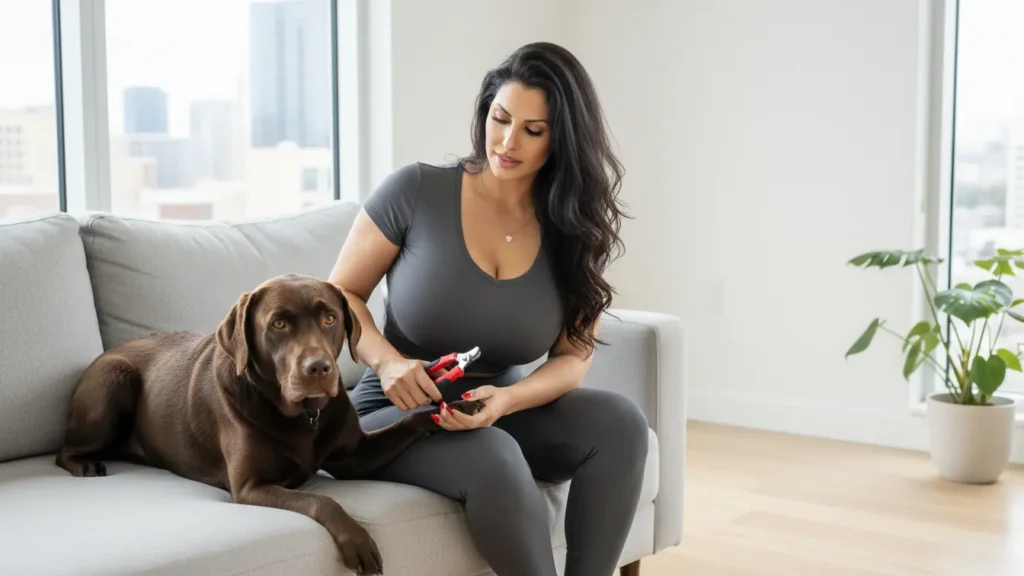
Somewhere in most households, there’s a recurring scene: clippers in one hand, treats in the other, a dog who has suddenly developed the evasive skills of a much smaller, much faster animal. Nail trims rank among the most dreaded routine tasks in dog ownership, and unlike a lot of dog behavior mysteries, this one has a pretty clear explanation once you look at it from the dog’s side of the clippers.
Paws Are Not a Neutral Body Part
Start with the anatomy. A dog’s paws are dense with sensory nerve endings — they’re a primary tool for navigating terrain, sensing vibration, and gathering information about the world, not just something a dog stands on. That sensitivity is a feature, not a flaw, in everyday life. But it also means paw-handling registers more intensely for a dog than, say, having their back scratched, even before anything painful has ever happened to them.
Then there’s the quick — the blood supply running through the center of each nail. Trim too close, and it bleeds and hurts, roughly comparable to cutting into the sensitive skin under a human fingernail. Groomers describe this as one of the most common reasons the whole process goes wrong in the first place: it’s genuinely easy to misjudge, especially on dark nails where the quick isn’t visible, and even one accidental cut can leave a lasting impression.
One Bad Experience Goes a Long Way
This is where a single incident can shape a dog’s response for months or years. A veterinarian writing about this exact question uses a useful frame: in the wild, an animal’s survival depends on remembering and avoiding situations where it once felt physically threatened — a place where a predator lurked, a ledge that gave way underfoot. A dog’s brain doesn’t distinguish that ancient survival wiring from a modern living room. If a nail trim once caused real pain, the memory of that event gets filed in the same category as genuine danger, and the fear response that follows is the same one built for actual threats.
This explains a pattern nail-averse dogs often show: they don’t just react to the sensation of clipping, they react to the sight of the clippers, sometimes well before their paw is even touched. Once fear and a specific object become linked this strongly, the association can trigger the stress response on its own.
Restraint Makes the Fear Worse, Not Better
Here’s the part that trips up a lot of well-intentioned owners: holding a struggling dog more firmly to get the trim over with tends to escalate the exact problem it’s trying to solve. When a dog feels physically unable to escape a situation that already scares them, their nervous system shifts from a manageable “flight” response into genuine panic — and if flight isn’t available, fight often is. This is frequently how nail-trim-related growling, snapping, or biting starts: not because a dog is being defiant, but because they’re in a full fear response with no perceived way out.
There’s also a subtler feedback loop worth knowing about: dogs read human body language closely, including tension and nervousness. An owner who’s braced for a fight — understandably, after past struggles — often unconsciously telegraphs that anxiety, which a dog picks up on and reads as confirmation that something is genuinely wrong here. The dread becomes mutual and self-reinforcing.
It’s Not Always About Trauma
Fear isn’t the only driver. Some dogs, especially rescues or dogs who didn’t have their paws handled much as puppies, simply never learned that paw-touching is safe and normal — the unfamiliarity itself is what triggers a self-protective reaction, independent of any specific bad memory. Individual sensitivity varies too, the same way it does in people; some dogs are simply more reactive to touch and sensation in general, which shows up here as much as anywhere else. And in senior dogs, arthritis can add a layer of legitimate physical discomfort to the experience — extended paw-holding, or the specific angle needed for a clean trim, may genuinely hurt in a way that has nothing to do with fear or memory at all.
What Actually Helps
Trainers and veterinary behavior sources are consistent on the core approach: gradual desensitization paired with positive association, done in small enough steps that the dog’s stress response never really gets triggered in the first place. That typically starts well before the clippers come out at all — simply touching paws calmly and rewarding it, then introducing the sight and sound of the clippers without them touching the dog, building a positive association step by step rather than attempting a full trim and hoping for the best. For a dog with an already-established fear, this process moves slower and more carefully than it would with a puppy starting fresh, since there’s an existing negative association to work against rather than a blank slate.
For dogs with significant fear or a bite history, this is genuinely a case where professional support — a credentialed force-free trainer, or a vet familiar with fear-free handling techniques — makes a real difference, both for safety and for actually making progress rather than accidentally deepening the fear through more failed attempts.
Your dog isn’t being stubborn or dramatic about something you consider minor. From their side of it, it’s a sensitive body part, a real risk of pain if it goes wrong, and — for a lot of dogs — a memory of exactly that happening before. Once you see it from that angle, the reaction makes a lot more sense than it does from the other end of the clippers.
Sources & Further Reading
- Stress-Free Ways to Trim Your Dog’s Nails — Healthy Paws Pet Insurance
- Ask A Vet: Why Does My Dog Hate To Have His Nails Trimmed? — iHeartDogs
- Why does my dog hate having his paws touched? — Modern Manners Dog Training
- Nail Trimming: The Foundation Steps — Great Falls Animal Hospital
- Why Dogs Hate Having Nails Trimmed — Great Falls Animal Hospital

Dr. Sofia Romano, DVM, is an experienced veterinarian specializing in small-animal medicine and preventive care. She has treated thousands of cases using evidence-based diagnostics and modern clinical practices. Dr. Romano is dedicated to providing science-backed pet-health guidance that helps owners make informed decisions and improve their pets’ quality of life.