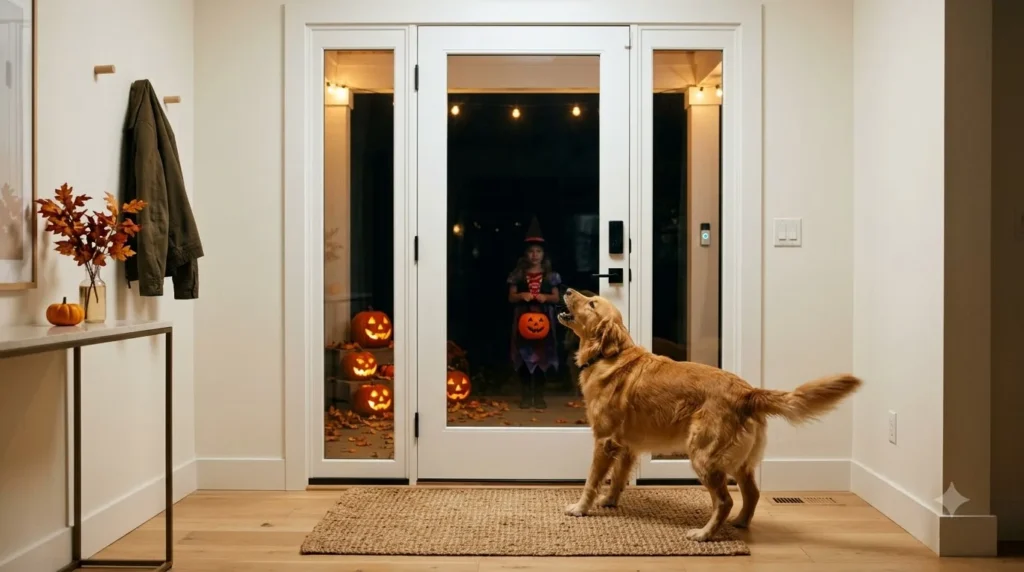
The first doorbell rings, and your dog races toward the entrance, barking before you have even stood up. A few minutes later, it happens again. Then again. By the time the next group of trick-or-treaters arrives, your dog may be pacing, whining, jumping at the door, or barking long after the visitors have left.
Halloween can turn an ordinary household habit into an exhausting evening. But there is a reason so many dogs react strongly to the doorbell, especially on a night filled with unfamiliar faces and repeated interruptions.
The doorbell has become a predictor of something exciting, uncertain, or potentially threatening—and Halloween delivers that experience over and over. The American Veterinary Society of Animal Behavior (AVSAB) has specifically highlighted how the combination of repeated doorbell rings, heightened excitement, and costumed visitors can intensify dogs’ reactions. AVSAB’s Halloween guidance explains why the problem involves much more than noise alone.
Understanding what your dog is responding to makes it easier to manage the evening without increasing the stress or accidentally reinforcing the behavior.
Your Dog Has Learned What the Doorbell Means
To a person, a doorbell is simply a sound announcing a visitor. To a dog, it can become a remarkably reliable signal that something is about to happen.
The bell rings. Someone approaches the door. The household becomes active. The door opens, and a person appears.
After enough repetitions, the sound itself can trigger an immediate response, even before the dog sees anyone. This is a form of associative learning: the doorbell predicts what follows.
Veterinary behaviorists describe how dogs can learn to bark because they are excited to greet people or because they are trying to keep unfamiliar visitors at a distance. In either case, the behavior can reinforce itself. VCA Animal Hospitals’ guidance on barking and jumping at the door explains both patterns.
Consider what happens from the dog’s perspective. A dog barks at someone approaching the entrance, and that person eventually walks away. A dog that feels uncomfortable may experience relief when the stranger disappears. Another dog barks while the family opens the door, allowing an anticipated greeting to happen.
In both situations, the barking may appear to work.
This does not mean the dog is deliberately misbehaving or trying to dominate the household. The behavior may reflect excitement, fear, territorial responses, frustration, or a mixture of emotions.
Halloween makes that established pattern harder to manage.
Why Halloween Makes the Reaction More Intense
Three factors can combine to make the usual doorbell response more difficult to settle.
1. Costumes change how familiar people look
Dogs use visual information, including body shape, movement, and facial cues, when responding to people.
Halloween disguises can alter these familiar signals. Oversized hats, masks, flowing capes, dark hoods, and props can make an approaching person look quite different from the people your dog usually encounters.
A child wearing a mask and moving excitedly may therefore be more startling to a dog than a familiar adult standing quietly at the door.
AVSAB’s Halloween guidance describes how changes to a person’s silhouette or the visibility of their face can unsettle even dogs that are generally comfortable around unfamiliar people.
That reaction does not automatically indicate aggression. A dog may be uncertain, frightened, excited, or simply struggling to interpret an unfamiliar appearance. However, uncertainty can become a safety concern if the dog feels trapped or a visitor approaches too quickly.
2. The doorbell keeps restarting the excitement
On an ordinary evening, the doorbell might ring once or twice. Halloween can bring a succession of visitors, sometimes with only a short break between groups.
Your dog repeatedly hears the same trigger, moves toward the entrance, encounters activity, and attempts to respond. Before fully settling, another group arrives.
As arousal builds, some dogs find it increasingly difficult to disengage from the doorway. They may bark longer, pace, jump, or react more intensely to movements that they would usually tolerate.
It is useful to think of these repeated encounters as cumulative stimulation rather than assuming that the dog simply needs to be told to calm down. The practical response is to reduce the number of triggers the dog must handle, rather than repeatedly exposing the dog to the same situation.
3. The dog may be excited and worried at the same time
Not all doorbell barking means the same thing.
Some dogs bark because they anticipate a greeting. Others are trying to create distance from a stranger. Some alternate between approaching the entrance and retreating when the visitor appears.
These different motivations matter because a dog that wants to greet everyone may need a different training emphasis from a dog that is frightened by unfamiliar people.
Watch the dog’s overall body language instead of relying on the volume of the barking alone. A tense, stiff posture, cowering, tucked tail, attempts to hide, or repeated efforts to retreat can suggest discomfort. Growling, lunging, or snapping should be taken seriously as possible signs that the dog needs more distance and careful management.
The VCA veterinary guide to canine fears and phobias describes how fearful dogs may try to escape or avoid an interaction and may escalate when unable to get away.
The goal is not to label every barking dog as fearful or aggressive. It is to recognise that excessive barking may be a response to an emotional state that commands alone cannot resolve.
What to Do If Your Dog Is Already Barking on Halloween Night
When trick-or-treaters are arriving every few minutes, this is not the ideal time to begin a complicated training programme. Focus on reducing stimulation, preventing unsafe encounters, and giving your dog somewhere comfortable to settle.
Move your dog away from the entrance
Set up a comfortable room away from the front door before the busiest period begins. Include familiar bedding, water, and a favourite safe chew or food puzzle if your dog enjoys these activities.
Close the door, reduce views of approaching visitors, and use background sound at a comfortable volume if it helps soften the noise from outside.
The ASPCA’s Halloween safety advice recommends keeping all but the most socially comfortable pets in a separate, comfortable room during busy trick-or-treating hours.
This is not a punishment or a sign that your dog has failed. It is a way of preventing an overwhelming situation from continuing unnecessarily.
Reduce unnecessary doorbell triggers
Where practical, turn off the doorbell sound and place a notice outside asking visitors to knock lightly or contact you another way. You could also arrange to distribute treats outside at a designated time instead of repeatedly opening the door.
The objective is to interrupt the repeated sequence that sends your dog into a barking frenzy.
If you need to open the door, secure your dog behind a closed interior door or an appropriate barrier first. Do not rely on quickly grabbing a highly excited dog at the last second, particularly when the front door opens directly onto the street.
Do not force a greeting
A costume party or a crowd of children is not an appropriate test of whether a frightened dog can tolerate unfamiliar people.
Do not ask children to approach, pet, hug, or offer treats directly to a dog that is barking, retreating, or showing signs of discomfort. Avoid bringing the dog into a crowded doorway simply to demonstrate that there is nothing to fear.
A dog that appears quiet may still be uncomfortable. Allowing the dog to remain in a safe space is often the better choice.
Avoid shouting or punishment
Shouting over the barking may add more excitement to an already stimulating situation. Physical corrections and aversive training equipment can also carry welfare risks, particularly when fear or anxiety is part of the problem.
AVSAB recommends reward-based methods for dog training and behaviour modification, rather than aversive methods such as shock collars, choke chains, or physical punishment. Its Humane Dog Training Position Statement explains the reasoning behind this position.
On Halloween night, management is generally more useful than repeatedly reprimanding the dog for reacting to a trigger that keeps returning.
How to Teach a Better Doorbell Response Before Next Halloween
If your dog regularly reacts to visitors, a planned training programme can help build a more manageable response. The important distinction is that training should take place in controlled, low-intensity situations—not at the height of the Halloween rush.
Start with a quieter version of the sound
Use a recording of your doorbell or ask someone to make a soft knocking sound while your dog is relaxed and at a comfortable distance.
Begin at a level that your dog can notice without immediately becoming overwhelmed. After the sound, offer a reward your dog enjoys. Repeat short sessions, increasing the volume or realism gradually only when the dog remains comfortable.
If the dog starts barking intensely, refuses a normally appealing treat, tries to escape, or appears distressed, the exercise may be too difficult. Reduce the intensity rather than continuing to expose the dog to a sound it cannot comfortably handle.
This gradual approach is called desensitisation. Pairing the trigger with something positive can also help change the dog’s emotional association with the sound. Dogs Trust’s visitor-training guide describes a gradual progression from quiet knocks to the actual doorbell.
Teach your dog to go to a mat
Instead of trying to teach the dog only what not to do, give it an alternative behaviour.
Choose a mat or bed away from the doorway. At a quiet time, reward your dog for going to the mat, then for sitting or lying down there and remaining briefly.
Once the behaviour is becoming reliable, introduce a cue such as “place.” Later, practise with a quiet doorbell recording, rewarding the dog for moving to the mat.
The doorbell can gradually become a signal to go to a designated resting place rather than a signal to race toward the entrance. VCA’s veterinary behaviour guidance describes this type of response substitution for dogs that bark or charge at the door.
Progress at your dog’s pace. Some dogs will need many short sessions over time before they can perform the behaviour around realistic visitors.
Practise with the whole sequence, not just the bell
A dog may become comfortable with a recorded chime but react again when a real person appears, the door opens, or a costumed visitor approaches.
Once the initial exercise is going well, practise progressively more realistic scenarios with a helper. Start with a quiet knock, then introduce the door opening and a familiar person standing at a comfortable distance.
Only increase the difficulty when your dog can cope with the current stage. If the dog becomes distressed, go back to an easier step.
The aim is not necessarily to eliminate every bark. A more realistic goal is for the dog to recover more easily, respond to a familiar cue, and remain safe around visitors.
When Doorbell Barking Needs Professional Help
Occasional alert barking is not automatically a behavioural disorder. The concern is greater when the reaction is intense, difficult to interrupt, escalating, or associated with fear and potential aggression.
Seek advice from your veterinarian if the behaviour is severe, worsening, or accompanied by substantial anxiety. A veterinarian can assess possible contributing factors and help determine whether referral to a qualified, reward-based behaviour professional is appropriate.
If your dog has a history of biting, snapping, or lunging at visitors, keep the dog securely separated during arrivals and do not use Halloween as an opportunity to test its tolerance. A professional can help develop a safer, individualised plan.
Any sudden change in behaviour, especially in an older dog or a dog with other signs of illness, also deserves veterinary assessment rather than an assumption that the problem is simply poor training.
A Quieter Halloween Starts With Understanding the Trigger
A dog that loses control at the doorbell is not necessarily trying to make the evening difficult. The sound may predict excitement, a greeting, or an unfamiliar person the dog would rather avoid. Halloween brings these possibilities together with repeated interruptions and unusual appearances.
For tonight, make the entrance less accessible and give your dog a comfortable place away from the activity. For the future, practise a calmer response gradually, rewarding behaviours you want to see rather than punishing the reaction.
The most useful measure of success is not whether your dog remains silent through every visitor. It is whether your dog can cope more comfortably, recover after a trigger, and stay safe around the people coming to your door.
Sources
1. American Veterinary Society of Animal Behavior (AVSAB) — “Don’t Spook Your Pet This Halloween!” Explains why repeated doorbell ringing, heightened excitement, and unfamiliar silhouettes can make Halloween difficult for dogs. Published October 8, 2015. https://avsab.org/dont-spook-your-pet-this-halloween/
2. VCA Animal Hospitals — “Dog Behavior Problems: Barking and Jumping at the Door.” Veterinary behaviour guidance on territorial responses, excitement, fear, and alternative behaviours for doorbell reactions. https://vcahospitals.com/tlc/know-your-pet/dog-behavior-problems-greeting-behavior-door-charging
3. American Veterinary Society of Animal Behavior (AVSAB) — “Position Statements and Handouts for the Public.” Current organisational guidance on humane, reward-based dog training. https://avsab.org/resources/position-statements/
4. ASPCA — “Halloween Safety Tips.” Seasonal recommendations for separating pets from stressful visitor activity and keeping them comfortable and safe. https://www.aspca.org/pet-care/general-pet-care/halloween-safety-tips
5. Dogs Trust — “How to Prepare Your Dog for Visitors.” Practical guidance on gradual introduction to door sounds and teaching alternative behaviours. https://www.dogstrust.org.uk/dog-advice/training/home/visitor-training
6. VCA Animal Hospitals — “Fears and Phobias in Dogs: Animals and People.” Veterinary guidance on canine fear signals and responses to unfamiliar people. https://vcahospitals.com/know-your-pet/fears-and-phobias-in-dogs
7. American Kennel Club (AKC) — “How to Stop Your Dog From Barking at the Doorbell.” Training guidance on doorbell desensitisation, positive associations, and a designated place behaviour. https://www.akc.org/expert-advice/training/stop-dog-barking-doorbell/

Dr. Sofia Romano, DVM, is an experienced veterinarian specializing in small-animal medicine and preventive care. She has treated thousands of cases using evidence-based diagnostics and modern clinical practices. Dr. Romano is dedicated to providing science-backed pet-health guidance that helps owners make informed decisions and improve their pets’ quality of life.