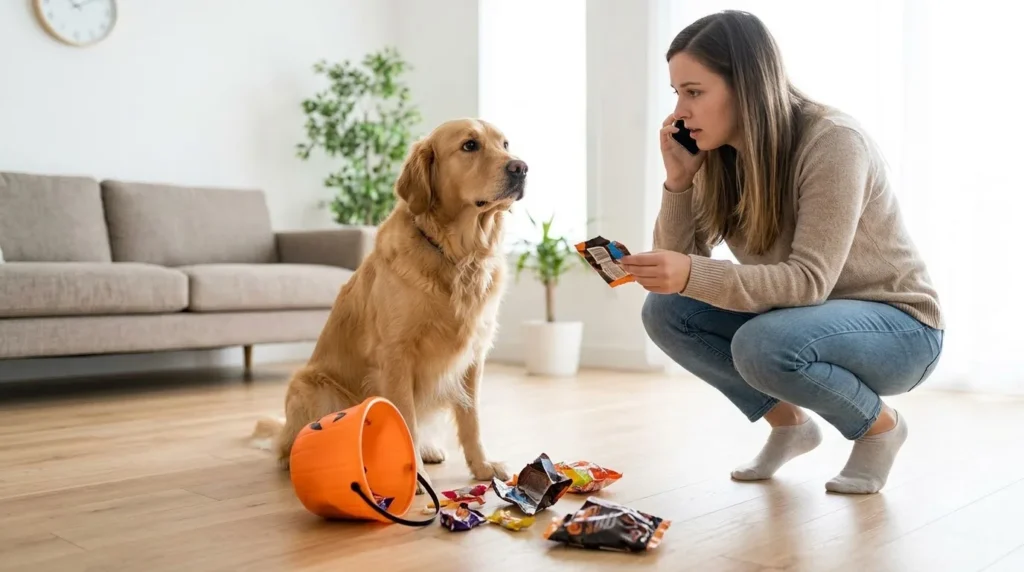
Halloween candy can disappear in seconds when a curious dog finds an unattended trick-or-treat bag. The difficult part comes afterward: figuring out whether the chocolate was dangerous, how much your dog may have eaten, and whether you need to rush to a veterinary clinic.
If your dog has eaten Halloween chocolate, contact your veterinarian or an emergency veterinary service now—even if your dog seems completely normal. Chocolate poisoning can cause serious heart and nervous system problems, and early veterinary advice can make a meaningful difference. Do not wait for symptoms to appear. The Merck Veterinary Manual and Cornell University College of Veterinary Medicine both emphasize prompt assessment after chocolate ingestion.
The first hour is especially valuable because a veterinarian may be able to reduce further toxin absorption before more serious effects develop. Here is how to use that time wisely.
What to Do in the First Hour
First 5 minutes: Remove the remaining candy and find the packaging
Move your dog away from the candy and secure any remaining chocolate, sweets, and discarded wrappers. Check the surrounding area for missing pieces so you can make a reasonable estimate of how much was eaten.
Keep the original packaging whenever possible. Look for the product name, chocolate type, cocoa percentage, ingredient list, and approximate amount missing.
If the candy was part of a mixed Halloween assortment, check whether it contained chocolate-covered raisins, sugar-free ingredients, coffee or espresso, or cannabis-derived ingredients. These can introduce additional risks beyond ordinary chocolate toxicity.
Do not delay the first veterinary call while searching the house for every missing wrapper.
Within 10 minutes: Call your veterinarian
Explain that your dog may have eaten chocolate and provide the best information you have.
The most useful details are:
- Your dog’s current weight.
- The type of chocolate, such as milk, dark, semisweet, baking chocolate, or cocoa powder.
- The estimated quantity eaten, including the number or size of bars if known.
- Approximately when the ingestion occurred.
- Whether your dog has any symptoms or underlying health problems.
If you cannot determine the amount, say so. A veterinary professional can help assess the uncertainty and decide whether your dog needs an examination or treatment.
In the United States, you can also contact Pet Poison Helpline at 855-764-7661, which lists 24-hour assistance, or the ASPCA Animal Poison Control Center at 888-426-4435. Fees may apply. In other countries, contact your local veterinary practice or emergency veterinary service for region-appropriate advice.
During the first 15–30 minutes: Follow the advice you receive
Depending on the type and quantity of chocolate, your dog’s size, the time since ingestion, and your dog’s current condition, the veterinarian may recommend immediate examination.
For a recent ingestion, a veterinarian may consider inducing vomiting in a dog that is still clinically well and for whom the procedure is appropriate. This is a veterinary decision, not a home remedy. Other cases may require observation, hospital monitoring, fluids, or medication to manage complications.
Do not induce vomiting at home unless a veterinary professional specifically instructs you to do so. Do not give hydrogen peroxide, salt, activated charcoal, milk, oils, or other home remedies on your own. These interventions can be inappropriate or harmful, depending on the animal and circumstances.
Keep your dog calm and prepare for transport if advised. If serious symptoms develop, do not spend time completing a checklist before seeking emergency care.
During the remainder of the hour: Do not mistake normal behavior for safety
A dog that is eating, walking, and behaving normally immediately after eating chocolate may still be at risk.
Signs of chocolate poisoning may begin within approximately 2–12 hours. The Merck Veterinary Manual reports that clinical signs usually develop within 6–12 hours, so the absence of early symptoms cannot reliably rule out poisoning.
Follow the professional’s instructions about transport, monitoring, and any further treatment. Do not decide to wait overnight simply because nothing appears wrong.
Which Halloween Chocolates Are Most Dangerous to Dogs?
The risk depends on three main factors: the kind of chocolate, the quantity consumed, and the dog’s body weight.
Chocolate contains theobromine and caffeine, stimulants that dogs process differently from people. Excessive exposure can affect the gastrointestinal tract, heart, and nervous system. The concentration of these compounds also varies between products and brands.
| Type of chocolate | Relative concern |
|---|---|
| Cocoa powder | Very high; highly concentrated |
| Unsweetened baking chocolate | Very high |
| Semisweet and dark chocolate | Higher concern, particularly with larger quantities |
| Milk chocolate | Lower concentration than dark chocolate, but still potentially toxic |
| White chocolate | Very little theobromine, although its fat and sugar content can cause other problems |
This is a relative comparison, not a toxicity calculator or a declaration that any quantity is safe. The concentration information is based on the Merck Veterinary Manual’s chocolate-toxicosis guidance.
Why a small dog may face greater danger
Imagine two dogs eating the same amount of dark chocolate. That quantity represents a larger exposure relative to the body weight of a small dog than it does for a much larger dog.
This is why the number of pieces alone is not enough to judge the risk. A small dog that gets into a few concentrated chocolate pieces may need more urgent assessment than a larger dog that eats a smaller amount relative to its body weight.
Even when the amount seems small, the type of chocolate, the accuracy of the estimate, and the individual animal all matter. Ask a veterinary professional to assess the exposure rather than relying on a general online threshold.
Symptoms of Chocolate Poisoning: What to Watch For
Signs vary with the amount consumed and the individual dog. Early symptoms may look like an upset stomach or unusual behavior before more serious complications become apparent.
Possible signs include:
- Vomiting or diarrhea.
- Increased thirst or urination.
- Restlessness, agitation, or unusual hyperactivity.
- Panting or unusually rapid breathing.
- A rapid or irregular heartbeat.
- Muscle tremors, loss of coordination, or seizures.
More severe poisoning can lead to dangerous heart rhythms, seizures, collapse, and other life-threatening complications. Chocolate’s fat content may also contribute to pancreatitis, an inflammation of the pancreas, in susceptible dogs.
Seek emergency veterinary care immediately if your dog develops tremors, seizures, collapse, significant breathing difficulty, or other severe or rapidly worsening signs. Call the clinic while arranging transport if doing so does not delay getting help.
Do not wait for multiple symptoms to appear before acting. If your dog vomits, becomes unusually restless, or develops another possible sign after eating chocolate, contact a veterinarian promptly for assessment.
Halloween Candy Has Other Hazards, Too
Sometimes the chocolate itself is not the only concern.
Halloween assortments and treat bags may contain ingredients or objects that create separate emergencies.
Sugar-free sweets: Some contain xylitol, a sweetener that can cause dangerously low blood sugar and liver injury in dogs. If the packaging lists xylitol, report this to the veterinarian immediately.
Chocolate-covered raisins: Raisins can cause acute kidney injury in dogs, so the combination introduces an additional toxic exposure.
Cannabis edibles: Gummies or other products containing THC can be mistaken for ordinary sweets. Tell the veterinarian if these may have been eaten.
Candy wrappers and sticks: Swallowing foil, plastic wrappers, or lollipop sticks can cause gastrointestinal irritation or obstruction, depending on the material, size, and circumstances.
These risks are covered in Pet Poison Helpline’s Halloween pet-safety guidance and Cornell’s holiday-safety guidance.
When calling the veterinarian, mention everything your dog may have swallowed, not just the chocolate.
What Will the Veterinarian Do?
Treatment depends on the estimated exposure and your dog’s clinical condition. There is no single treatment appropriate for every chocolate ingestion.
If the ingestion was recent and the dog is still clinically well, the veterinarian may consider a medically supervised method of removing stomach contents. In other circumstances, treatment may include intravenous fluids, medications to control tremors or seizures, monitoring of heart rhythm, or other supportive care.
Some dogs require hospital observation because complications may develop after the initial ingestion. Others may be managed differently following a professional assessment of the actual exposure.
The aim is to reduce further absorption where appropriate, recognize complications early, and support the dog’s body while the toxic compounds are eliminated.
Prompt advice does not mean every dog that eats chocolate will need hospitalization. It means the decision is made using the details of the exposure and the dog’s condition rather than guesswork.
How to Prevent Another Halloween Chocolate Scare
Once the immediate situation has been addressed, a few practical changes can reduce the chance of another accidental ingestion.
Store trick-or-treat bags and chocolate in closed cupboards or containers that your dog cannot access. Keep candy bowls off low tables, clear away dropped sweets during parties, and secure rubbish containing wrappers.
Ask children and visitors not to share sweets with the dog. If the dog tends to investigate food when guests arrive, use a secure, comfortable area away from unattended candy.
After Halloween, check bags and storage areas for overlooked sweets. Chocolate left behind on a bedside table or tucked into a child’s backpack can present the same risk days later.
The Most Important Thing to Remember
The first hour after a dog eats Halloween chocolate is not a window for waiting to see whether symptoms appear. It is an opportunity to get the exposure assessed while early veterinary interventions may still be useful.
Remove the remaining candy, keep the packaging, establish what you can about the quantity and timing, and call a veterinary professional promptly. If severe symptoms develop, seek emergency care immediately.
You do not need to know the exact toxic dose before making that call. You need to give the veterinarian the best information available and act on the guidance you receive.
Sources
1. Merck Veterinary Manual — “Chocolate Toxicosis in Animals.” Clinical toxicology reference covering toxic compounds, relative concentrations in chocolate types, clinical signs, and treatment principles. The page indicates a February 2026 update. https://www.merckvetmanual.com/toxicology/food-hazards/chocolate-toxicosis-in-animals
2. Cornell University College of Veterinary Medicine — “Chocolate toxicity: What should I do if my dog eats chocolate?” Veterinary guidance on exposure assessment, symptoms, treatment, and prognosis. https://www.vet.cornell.edu/departments-centers-and-institutes/riney-canine-health-center/canine-health-topics/chocolate-toxicity-what-should-i-do-if-my-dog-eats-chocolate
3. Pet Poison Helpline — “My Dog Ate Chocolate: What To Do.” Guidance on immediate action, delayed symptoms, packaging, and professional assessment. The page indicates an October 2026 update. https://www.petpoisonhelpline.com/pet-safety-tips/is-chocolate-poisonous-to-dogs/
4. Pet Poison Helpline — “Halloween Pet Safety: Dangers for Dogs & Cats.” Seasonal information on chocolate, xylitol, raisins, THC edibles, and wrappers. The page indicates an October 2026 update. https://www.petpoisonhelpline.com/pet-owners/seasons/halloween/
5. PDSA — “Chocolate poisoning in dogs.” UK-oriented pet-health advice on chocolate exposure, symptoms, and the importance of contacting a veterinarian promptly. https://www.pdsa.org.uk/pet-help-and-advice/pet-health-hub/conditions/chocolate-poisoning
6. Cornell University College of Veterinary Medicine — “Spooky but safe: tips for keeping pets happy on Halloween.” Seasonal precautions concerning candy, hazardous ingredients, and other common Halloween risks. https://www.vet.cornell.edu/about-us/news/20201027/spooky-safe-tips-keep-pets-happy-halloween

Dr. Sofia Romano, DVM, is an experienced veterinarian specializing in small-animal medicine and preventive care. She has treated thousands of cases using evidence-based diagnostics and modern clinical practices. Dr. Romano is dedicated to providing science-backed pet-health guidance that helps owners make informed decisions and improve their pets’ quality of life.