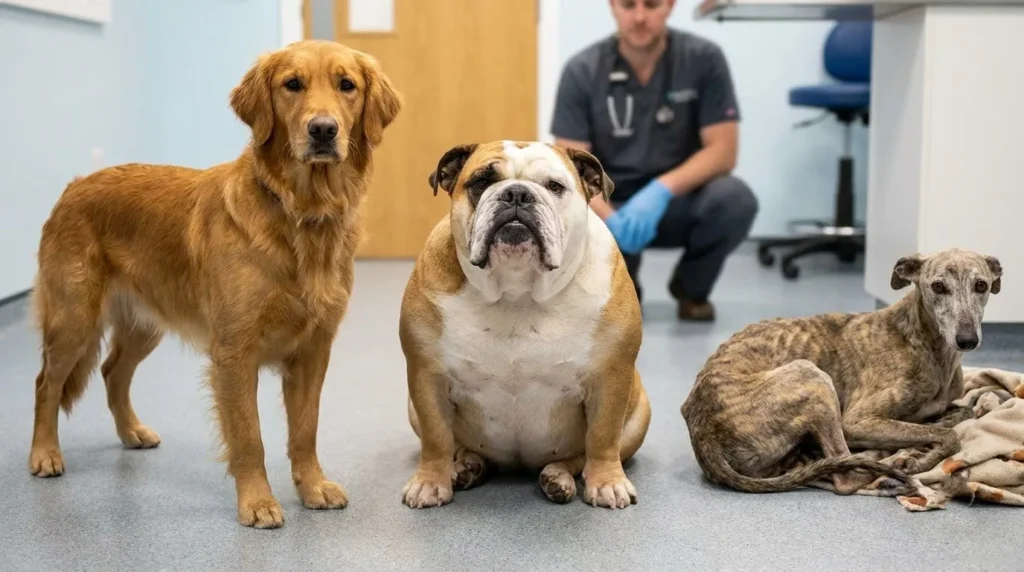
A dog can look perfectly normal in photographs and still be carrying more body fat than is healthy. Thick fur, a broad chest, or a naturally rounded shape can make it difficult to judge weight by appearance alone. That is why veterinarians assess more than the number on the scale.
One of the simplest checks you can perform at home is the rib test. It takes less than a minute and gives you a useful first indication of whether your dog may be at a healthy weight, carrying extra fat, or becoming too thin.
The key is not whether you can feel your dog’s ribs at all. It is how easily you can feel them, how much fat covers them, and whether the rest of your dog’s body has the shape expected at a healthy weight.
How to Perform the Rib Test on Your Dog
Ask your dog to stand comfortably on a level surface. If your dog is relaxed, gently place both hands along the sides of the chest, just behind the front legs.
Spread your fingers across the rib cage and move them gently over the ribs. Use light pressure rather than pressing firmly into the body.
You are trying to identify the ribs beneath the skin and a thin layer of fat. You should not need to dig your fingers into your dog’s sides to find them.
Veterinary body-condition assessment uses this kind of hands-on evaluation alongside a visual examination. The rib test is a practical screening step, not a stand-alone diagnosis. The 2021 AAHA Nutrition and Weight Management Guidelines recommend assessing body condition as part of a broader nutritional evaluation.
What should your dog’s ribs feel like?
If your dog is at a healthy weight: You should be able to feel the ribs individually without applying much pressure. A light covering of fat is normal. The ribs generally should not look prominently protruding when your dog is standing naturally.
If your dog may be overweight: The ribs may feel padded or difficult to distinguish because a thicker layer of fat covers them. You may need to press more firmly than expected to identify individual ribs.
If your dog may be underweight: The ribs may feel very prominent, with little padding over them, and they might be visible even when your dog is standing normally. This can be a sign of low body fat, although muscle loss or illness may also be involved.
A useful way to understand the difference is to compare your dog’s ribs with the bones on your own hand. In a commonly used veterinary teaching comparison, ribs at a healthy body condition feel similar to the knuckles on the back of a relaxed hand. Very prominent ribs feel more like pronounced knuckles, while heavily padded ribs feel more like the fleshy palm.
This comparison is only a rough guide. It cannot account for every breed, body type, age, or medical condition.
The Rib Test Is Only Half the Assessment
A dog can have ribs that are reasonably easy to feel but still carry excess fat around the abdomen or the base of the tail. Another dog may have a naturally lean frame and need a different interpretation of its body shape.
That is why veterinarians combine palpation, which means feeling the body with the hands, with visual assessment. Three features are especially useful when considered together.
1. Look for a waist from above
Stand behind your dog and look down at the body while your dog is standing naturally.
A dog at an appropriate body condition generally has a visible waist behind the rib cage. The body narrows between the chest and hips rather than forming a straight-sided or broadly rounded outline.
If the waist has become difficult to distinguish, excess body fat may be contributing to the shape.
Do not judge this feature in isolation. Breed conformation, coat thickness, and natural body proportions can make the waist more or less obvious.
2. Check the abdominal tuck from the side
Look at your dog from the side, ideally at roughly the same height as the body.
In many dogs at a healthy weight, the underside of the abdomen rises from the chest toward the hind legs. This upward contour is called the abdominal tuck.
If the abdomen appears relatively straight or hangs downward, your dog may be carrying extra fat. However, body shape can also be affected by anatomy, posture, pregnancy, muscle condition, or abdominal enlargement from another cause.
A newly enlarged or distended abdomen should not automatically be attributed to weight gain. If the change is sudden, pronounced, or accompanied by discomfort, weakness, retching, or other signs of illness, contact a veterinarian promptly. A rapidly enlarging abdomen accompanied by unproductive retching or collapse warrants emergency veterinary care.
3. Feel the body beyond the ribs
A complete body-condition assessment also considers the area over the spine, hips, and tail base.
At a healthy body condition, these structures should generally be possible to identify beneath a modest covering of tissue without forceful pressure.
Excessive padding over the lower back or tail base may support the impression that your dog is carrying extra fat. Conversely, sharply prominent bones, particularly alongside visible muscle loss, deserve attention.
Do not press hard on the back or hips if your dog appears painful or has difficulty moving. A veterinarian can assess these areas more safely when discomfort or arthritis is a possibility.
What Is the Veterinary Body Condition Score?
Veterinarians commonly use a body condition score, or BCS, to describe the amount of fat covering a dog’s body. One widely used system runs from 1 to 9.
In this system, a score of 1 represents extreme thinness, while 9 represents severe excess body fat. Scores of 4 and 5 are generally considered the ideal range.
Here is a simplified overview of the nine-point scale.
- BCS 1–3: Underweight, with the ribs and other bony structures becoming increasingly prominent as the score decreases.
- BCS 4–5: Generally ideal, with ribs that are easy to feel beneath a thin fat covering, a visible waist, and an abdominal tuck.
- BCS 6–7: Excess body fat is increasingly apparent. The ribs may be covered by more fat, and the waist or abdominal tuck may become less distinct.
- BCS 8–9: Marked excess body fat, with substantial fat deposits and ribs that can be difficult to feel.
This summary is not a substitute for the full scoring system. A veterinarian assesses the combination of physical findings rather than assigning a score based on one characteristic alone.
The American Animal Hospital Association’s canine body-condition chart provides more detailed descriptions of the nine-point scale.
An important distinction is that body condition and muscle condition are not the same thing. Body condition primarily helps assess fat stores, while a muscle condition assessment evaluates whether muscle mass is normal or reduced. Both matter, particularly in senior dogs and animals with chronic health problems.
Why a Few Extra Pounds Can Matter
Extra body fat is not simply a cosmetic concern. Carrying excess weight increases the workload placed on a dog’s body and can affect mobility and overall health.
According to the Cornell University College of Veterinary Medicine, obesity can worsen joint problems and contribute to inflammation. It can also increase complications associated with anaesthesia.
An overweight dog may be less comfortable during exercise, tire more easily, or find it harder to move freely. These changes can gradually reduce normal activity, making weight management more difficult.
The aim is not to make every dog look lean or athletic. It is to maintain a body condition that supports comfortable movement, adequate muscle, and long-term wellbeing.
Nor should owners assume that every overweight dog simply eats too much. Feeding habits and activity levels are common contributors, but genetics, medication, and certain medical conditions can also influence body weight. A veterinarian can help investigate the factors relevant to an individual dog.
What to Do If Your Dog’s Ribs Are Hard to Feel
If you have performed the rib test and suspect your dog may be overweight, start by arranging a routine appointment with your veterinarian. This is particularly useful if you do not know your dog’s ideal weight or have noticed a gradual change in body shape.
A practical next step is to review what your dog eats throughout a typical day. Include meals, training treats, dental chews, table scraps, food used to administer medication, and anything offered by other household members. These extras can contribute meaningful calories even when the main meals appear appropriately portioned.
You can also record your dog’s current weight and compare it with previous measurements. A consistent upward trend may be more informative than one isolated number.
At the appointment, ask the veterinarian to assess your dog’s body condition and muscle condition, establish a suitable target weight if needed, and recommend an appropriate feeding plan. The right calorie intake depends on factors including age, activity, current condition, and health status.
Avoid suddenly cutting your dog’s food intake or putting your pet on a restrictive diet based only on the home rib test. A poorly planned diet can fail to meet nutritional requirements, and growing puppies, senior dogs, and dogs with medical conditions may need individual adjustments.
If weight reduction is appropriate, a measured plan with regular weigh-ins makes it easier to track progress and adjust food intake safely. Exercise can be part of the plan, but activity should increase gradually when a dog has been sedentary or has joint discomfort.
Can Breed and Age Affect the Rib Test?
Yes. Body shape varies considerably among dogs, so the same visual impression does not mean the same thing in every breed.
Some naturally lean, deep-chested dogs have prominent body contours that differ from those of a broad-chested or heavily muscled breed. Long or dense coats can also make changes in waist shape difficult to see.
Age brings another consideration: a dog can lose muscle while retaining excess fat. The result may be a body that looks heavy but has less muscle than expected. Feeling the ribs alone will not identify that problem reliably.
These are reasons to assess the whole dog rather than aim for a single appearance. Breed and body type provide context, but they do not replace hands-on assessment or establish an individual dog’s ideal weight.
Frequently Asked Questions
Should I be able to see my dog’s ribs?
Generally, a dog at an ideal body condition should have ribs that are easy to feel beneath a thin fat covering, but they should not be prominently visible. Some naturally lean body types can look different, so breed, muscle mass, and overall body shape also matter.
How often should I check my dog’s ribs?
Checking periodically at home can help you notice gradual changes. It is useful to combine the check with monitoring body shape and weight rather than relying on touch alone. Ask your veterinarian to assess body condition during routine examinations and whenever you notice a meaningful change.
Does a dog with a big belly always have excess fat?
No. A rounded abdomen can reflect body fat, but it can also have other explanations, including anatomical differences or medical problems. A sudden or unusual enlargement should be assessed rather than assumed to be ordinary weight gain.
Can I tell my dog’s ideal weight from the rib test?
No. The rib test helps screen for possible excess or insufficient body fat, but it cannot determine an exact ideal weight. Your veterinarian can combine body condition, muscle condition, body size, health history, and weight measurements to estimate an appropriate target.
Should I feed my dog less if I cannot feel the ribs?
Do not make a major food reduction based on that sign alone. Check the waist and abdominal tuck, review your dog’s weight trend, and arrange a veterinary assessment. If weight loss is needed, a planned diet is safer than an arbitrary reduction in food.
The Most Useful Check Is the One That Looks at the Whole Dog
The rib test is a simple way to notice when your dog’s body condition may be changing. If the ribs are difficult to feel, the waist has disappeared, or the abdomen no longer has its usual contour, it is worth investigating rather than waiting for a large change on the scale.
But a single finding is not a verdict. The most reliable assessment combines how the ribs feel, how the dog looks from above and from the side, the condition of the muscles, and the dog’s weight history. A veterinarian can put those findings together and help you decide whether any change in feeding or activity is appropriate.
Veterinary note: This article provides general educational information. It cannot establish the ideal body condition or diagnose a medical problem in an individual dog. Sudden changes in body shape or unexplained weight changes warrant veterinary assessment.
Sources
- American Animal Hospital Association (AAHA). 2021 AAHA Nutrition and Weight Management Guidelines. Published June 21, 2021. https://www.aaha.org/resources/2021-aaha-nutrition-and-weight-management-guidelines/
- American Animal Hospital Association (AAHA). Canine Body Condition Score. https://www.aaha.org/wp-content/uploads/globalassets/02-guidelines/2021-nutrition-and-weight-management/resourcepdfs/nutritiongl_bcs.pdf
- Cornell University College of Veterinary Medicine, Riney Canine Health Center. Obesity and Weight Loss in Dogs. Updated June 2024. https://www.vet.cornell.edu/departments-centers-and-institutes/riney-canine-health-center/canine-health-topics/obesity-and-weight-loss-dogs
- VCA Animal Hospitals. Body Condition Scores. https://vcahospitals.com/aldrich/know-your-pet/body-condition-scores

Dr. Sofia Romano, DVM, is an experienced veterinarian specializing in small-animal medicine and preventive care. She has treated thousands of cases using evidence-based diagnostics and modern clinical practices. Dr. Romano is dedicated to providing science-backed pet-health guidance that helps owners make informed decisions and improve their pets’ quality of life.