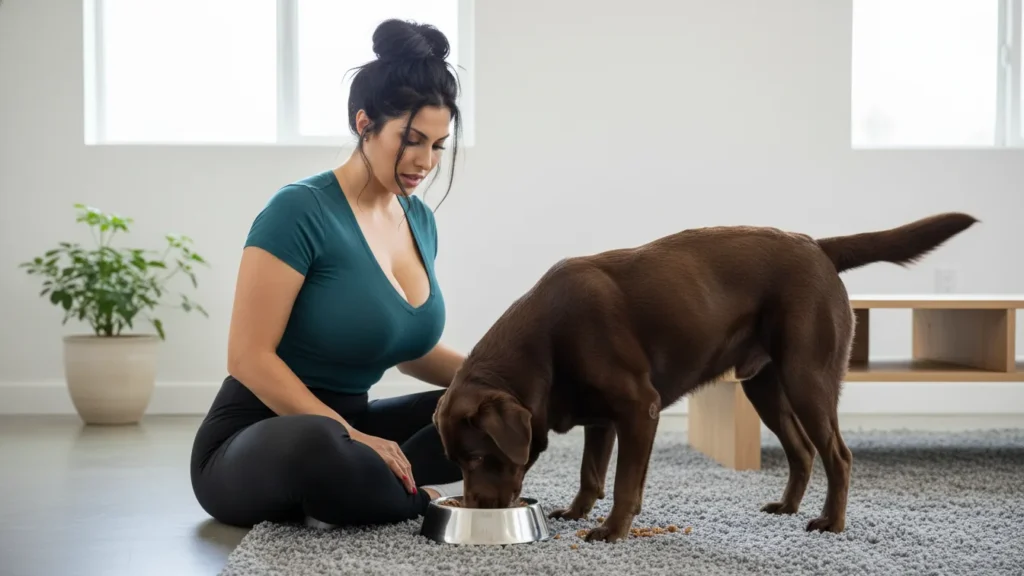
You set the bowl down. Before you’ve even stood back up, it’s empty. No chewing, barely any pausing to breathe — just pure, frantic gulping until every last kibble is gone. Most owners laugh it off as a funny personality quirk. Some even find it a little impressive.
But fast eating in dogs isn’t just a harmless habit. In certain dogs, it’s a documented risk factor for one of the most sudden, life-threatening emergencies in veterinary medicine — one that can turn a normal evening into an emergency room dash within a matter of hours.
Why Dogs Gulp Their Food in the First Place
Before getting into the risks, it helps to understand where this behavior comes from. Most fast eating traces back to instinct, not impatience. In the wild, food was inconsistent and often contested, so eating quickly meant eating more before a rival showed up. That wiring doesn’t disappear just because a bowl now appears on schedule twice a day.
Dogs who came from large litters, spent time in shelters, or were fed alongside other animals tend to show this behavior more intensely, since they learned early that hesitation could mean going without. Breed and personality play a role too — some dogs are simply more food-driven or anxious by nature, and that shows up clearly at mealtime.
The Real Danger: Bloat and GDV
The condition at the center of this concern is called gastric dilatation-volvulus, more commonly known as bloat. It happens when a dog’s stomach rapidly fills with gas, food, or fluid and becomes distended. In more severe cases, the distended stomach can rotate on itself, a twist that traps gas inside and cuts off blood flow — a version of the condition known as GDV.
According to the American Kennel Club, fast eaters have roughly five times the bloat risk of dogs that eat slowly, making eating speed one of the most significant behavioral risk factors identified so far. Once the stomach twists, both the entrance and exit are blocked simultaneously, and the condition can become fatal within hours without emergency surgery.
This isn’t a rare or fringe concern. The Purina Institute and multiple veterinary hospitals list rapid eating speed alongside large-breed size, deep chest conformation, and nervous temperament as one of the recognized contributing factors behind GDV.
Why Speed Specifically Makes It Worse
Eating quickly does two things that raise risk simultaneously. First, it means a large volume of food (and often air, swallowed alongside it) enters the stomach in a very short window, rather than gradually. Second, dogs who gulp tend to swallow significantly more air with each bite, which contributes directly to the gas buildup that defines bloat in its early stage.
Combine that with other common risk factors, like eating one large meal a day instead of two smaller ones, exercising or playing vigorously right after eating, or being naturally anxious or high-strung, and the risk compounds. Veterinary researchers often describe GDV as the result of a “perfect storm” of overlapping factors rather than any single cause.
Which Dogs Are Most at Risk
While any dog can technically develop bloat, some are far more vulnerable than others:
- Large and giant breeds with deep, narrow chests — Great Danes, German Shepherds, Standard Poodles, Weimaraners, and Doberman Pinschers are frequently cited as high-risk.
- Dogs with a first-degree relative who has had GDV — genetics appear to play a real role.
- Older dogs, since risk tends to increase with age.
- Anxious, fearful, or highly excitable dogs, since stress-related air swallowing and stomach movement may contribute.
- Dogs fed once a day, who are roughly twice as likely to bloat as those fed two smaller meals.
Smaller and medium-sized dogs can still experience uncomfortable bloating from fast eating, even if their risk of a full stomach twist is considerably lower.
Warning Signs You Should Never Ignore
Bloat can escalate from mild discomfort to a full emergency within a couple of hours, which is why recognizing the early signs matters so much. Watch for:
- A visibly swollen, firm, or distended abdomen
- Restlessness, pacing, or an inability to get comfortable
- Unproductive retching — the appearance of trying to vomit with nothing coming up
- Excessive drooling
- Labored breathing or a hunched, uncomfortable posture
- Weakness or collapse in more advanced cases
If you notice any combination of these signs, especially the unproductive retching, this warrants an emergency veterinary visit immediately rather than a wait-and-see approach. Early treatment dramatically improves outcomes, while delays of even an hour or two can be the difference between recovery and a life-threatening crisis.
How to Slow Down a Fast Eater
The good news is that this is one of the more manageable risk factors. A few consistent changes can make a meaningful difference:
- Use a slow feeder bowl with raised ridges or a maze pattern that forces smaller bites.
- Split meals into two or three smaller portions throughout the day instead of one large feeding.
- Feed dogs separately if competition with other pets is fueling the rush.
- Avoid vigorous exercise for at least an hour before and after meals, since activity on a full stomach is a known contributing factor.
- Address underlying anxiety, since calmer dogs are consistently shown to carry lower bloat risk than stressed or hyperactive ones.
- Talk to your vet about preventive surgery (gastropexy) if you own a high-risk breed, which can often be performed during a routine spay or neuter procedure.
The Bigger Picture
A dog inhaling their dinner might look like nothing more than enthusiasm, but for the wrong combination of breed, temperament, and feeding habits, it’s a genuine warning sign worth taking seriously. The behavior itself is manageable, often with something as simple as a slow feeder bowl or a change in feeding schedule. What matters most is recognizing that fast eating isn’t just a quirky habit to laugh about — it’s a documented risk factor for one of the most urgent emergencies in canine health, and a little prevention goes a long way toward keeping mealtime safe.
Sources
- American Kennel Club — Bloat (GDV) in Dogs
- VCA Animal Hospitals — Bloat: Gastric Dilatation and Volvulus in Dogs
- PetMD — Bloat in Dogs
- Purina Institute — Canine Gastric Dilatation-Volvulus (GDV)
- American Animal Hospital Association — Understanding Canine Bloat (GDV)

Dr. Sofia Romano, DVM, is an experienced veterinarian specializing in small-animal medicine and preventive care. She has treated thousands of cases using evidence-based diagnostics and modern clinical practices. Dr. Romano is dedicated to providing science-backed pet-health guidance that helps owners make informed decisions and improve their pets’ quality of life.



Pingback: Why Dogs Pass Gas More Often Than Usual — What Their Gut Is Trying To Tell You
Pingback: Why Dogs Pause Before Eating — The Quiet Behaviour That Tells You More Than You Think